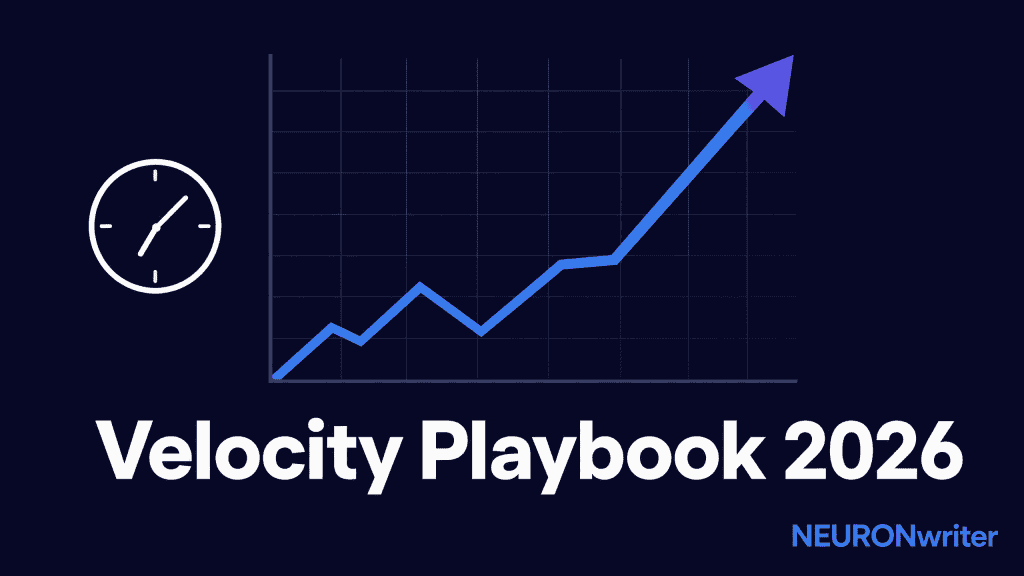
The Velocity Playbook: Using Google Trends for Real-Time Content Creation
📍 Semantic Summary
- Idea: In the era of AI Overviews and conversational search, traditional SEO based on historical keyword volume is too slow. Brands must pivot to velocity content identifying and publishing around trending entities while search demand is actively spiking.
- Challenge: Traditional keyword tools aggregate data over 30 to 90 days. By the time a “Breakout” topic appears in these databases, the trend curve has already flattened, and the “freshness” slots in Generative Engine Optimization (GEO ) have been claimed by faster competitors.
- Summary: The Velocity Playbook relies on the newly upgraded Google Trends infrastructure, which now refreshes every 10 minutes
By combining real-time trend data with NEURONwriter semantic optimization, content teams can publish breaking commentary that secures the “Zero-Hour” citation advantage in AI search engines.
Read the full guide below, or explore related topics:Google Discover Optimization 2026 · The Attribution Crisis
Here is a scenario most content marketers know well. A big story breaks in your industry on a Tuesday morning. You spot it, get excited, brief a writer, wait for the draft, go through edits, and finally publish on Thursday afternoon. By then, three competitors have already ranked, Google’s AI Overview has cited two of them, and your article lands on page two.
That is not a writing problem. That is a speed problem.
In 2026, the teams winning at SEO are not necessarily the ones writing the best long-form guides. They are the ones who show up first with a good enough, well-structured take on a topic that is trending right now. This is what the Velocity Playbook is all about.
Why Timing Now Matters as Much as Quality.
For years, SEO was a patience game. You wrote a great article, built some backlinks, and waited six months for it to rank. That model still works for evergreen topics — “what is semantic SEO” is not going anywhere.
But search behavior has changed. People now ask Google questions like a colleague: “What does the new EU AI Act mean for my SaaS product?” or “Is the Google March 2026 update affecting e-commerce sites?” These are real-time questions. They need real-time answers.
When an AI Overview assembles a response to a question like this, it looks for the most recent, most structured, and most authoritative source it can find
If your article is six months old and a competitor published yesterday, the AI will likely pick theirs.
“When a major industry shift occurs a new regulation, a competitor acquisition, or a breakthrough technology release — the first few hours define who owns the narrative.” — SteakHouse Blog
This is what practitioners call the “Zero-Hour” citation advantage. The first credible source to publish a structured breakdown of a breaking topic often becomes the “seed” for how AI models understand that event. That citation can stick for weeks, even after dozens of competitors publish their own takes
Google Trends Has Changed — Here Is What You Need to Know.
Most people use Google Trends to check whether a keyword is seasonal. That is fine, but it barely scratches the surface of what the tool can do in 2026.
Google upgraded the underlying infrastructure of Trends in late 2024 and 2025 to support near-real-time data. Three features are now essential for any velocity-focused content team.
The “Trending Now” Dashboard Refreshes Every 10 Minutes.
This is the big one. Unlike the historical “Explore” tab which shows you aggregated data from the past the “Trending Now” section updates every 10 minutes
That means you can spot a story gaining momentum before it peaks, not after. Think of it as a weather radar for search demand. You are not looking at yesterday’s storm; you are watching the clouds form in real time.
“Breakout” Topics Are Your Biggest Opportunity.
In Google Trends, a “Breakout” label means a search term has grown by more than 5,000% in a short window. These are not just popular topics they are topics with almost no existing competition yet.
Traditional keyword tools like aggregate clickstream data over 30 to 90 days. By the time a Breakout term shows up there with a volume number attached, the wave has already crashed. Google Trends shows you the wave while it is still building.
Active vs. Lasted: Do Not Chase Dead Trends.
Not every spike is worth chasing. Google Trends now helps you tell the difference between:
- Active trends — search interest is still growing, worth writing about now.
- Lasted trends — the spike has already peaked and is declining, probably not worth the effort.
This distinction alone can save your team hours of wasted work every week.
Algorithmic Newsjacking: Speed Without Sacrificing Quality.
Knowing a trend is rising is only useful if you can act on it fast. This is where algorithmic newsjacking comes in.
The idea is simple: instead of a human writer spotting a trend, drafting a brief, writing an article, and waiting for edits, you use AI tools to compress that process from hours to minutes.
The AI ingests the breaking news, applies your brand’s perspective and knowledge, and generates a structured first draft ready for a human editor to review and publish.
| Traditional Newsjacking | Algorithmic Newsjacking | |
| How it starts | Someone notices a trend manually | An API or tool detects a signal automatically |
| Time to draft | 4–8 hours | 2–5 minutes |
| SEO optimization | Often rushed, basic keywords only | Structured, full entity mapping |
| How many topics/day | Limited by writer bandwidth | Dozens, consistently |
The key difference is not just speed — it is the depth of optimization possible at that speed. A traditional rushed article often skips proper headings, misses key entities, and lacks the structured formatting that AI models need to extract and cite information. An algorithmic approach enforces these best practices automatically
The NEURONwriter Velocity Workflow.
Speed without semantic depth is just noise. If you publish fast but your content lacks the right entities and structure, Google’s algorithms will still ignore it. Here is how to combine real-time trend data with proper semantic optimization using NEURONwriter.
Step 1 — Spot the Breakout. Open the Google Trends “Trending Now” dashboard and filter by your industry. Look for “Active” Breakout topics that connect to your core business.
Step 2 — Generate the Semantic Blueprint. Plug the trending query into NEURONwriter immediately. Even if the topic is only hours old, NEURONwriter will analyze the top-ranking articles and extract the NLP entities that Google already associates with it.
Step 3 — Draft with a Unique Angle. Do not just summarize the news — everyone will do that. Use NEURONwriter Content Editor to weave in your brand’s perspective, a relevant data point, or a quick expert quote. Hit a strong Content Score by naturally including the recommended entities.
Step 4 — Structure for AI Extraction. Use clear H2 and H3 headings. Write a concise “mini-answer” paragraph right after each heading. This is the format that AI Overviews and featured snippets pull from.
Publish. Then monitor Google Search Console over the next 24 hours — velocity content often sees indexing and ranking signals faster than evergreen pieces, because the freshness signal gives it an initial boost.
FAQ
What is search velocity in SEO?
Search velocity is the rate at which interest in a topic is growing right now, as opposed to its historical average volume. Optimizing for velocity means publishing content while demand is spiking, not after it has already peaked.
How often does Google Trends update?
The “Trending Now” section in Google Trends updates every 10 minutes. This makes it one of the most real-time data sources available to content marketers, far faster than any third-party keyword tool.
What does “Breakout” mean in Google Trends?
A “Breakout” label means that search interest for a term has grown by more than 5,000% within the selected timeframe. These topics typically have very low existing competition, making them a significant opportunity for fast-moving publishers.
What is algorithmic newsjacking?
Algorithmic newsjacking is using AI tools to automatically detect breaking news, generate a structured first draft, and publish it in minutes rather than days — while maintaining proper SEO formatting and entity coverage.
What is the “Zero-Hour” citation advantage?
It is the edge you get by being among the first credible sources to publish on a breaking topic. AI Overviews often use these early articles as their primary reference, and that citation can persist even after many competitors publish later.
Why are traditional keyword tools too slow for trending topics?
Tools aggregate data over 30 to 90 days. By the time a trending topic appears in their databases with a volume number, the trend has usually already peaked. Google Trends shows you the momentum in real time.
How does NEURONwriter help with velocity content?
NEURONwriter lets you instantly generate a semantic blueprint for any query even a brand-new one. It identifies the key NLP entities needed to rank, so your velocity content is not just fast, but semantically complete and optimized for AI algorithms from the moment it is published.