SEO for Niche Industries: Why General Best Practices Fail
Semantic summary
Idea: General SEO advice like chasing high-volume keywords or publishing daily AI-generated blog posts often fails spectacularly when applied to SEO for niche industries or highly regulated sectors like finance, healthcare, and B2B tech.
Challenge: These sectors operate squarely in Google’s Your Money or Your Life (YMYL) territory. In 2026, AI Overviews and LLMs scrutinize these industries even more harshly. A generic content strategy without compliance review or subject matter expert (SME) authorship can result in zero visibility or, worse, algorithmic penalties.
Summary: Success requires a trust-by-design approach. Instead of generic best practices, niche sites must prioritize E-E-A-T signals, structured data for entity recognition, and rigorous compliance. Tools like NEURONwriter help map semantic relevance while ensuring that your expert content remains highly optimized for AI-driven search.
Related reads:
Brand Mentions vs. Backlinks: Why AI Search Changed the Rules
The End of Commodity Content: Why High-Friction SEO is the Only Way to Win in 2026
If you operate in a highly regulated or technical niche like fintech, medical devices, or specialized B2B software you have probably noticed something frustrating. The standard SEO playbook just does not work for you.
You read the same marketing blogs as everyone else. You try to publish high-volume, top-of-funnel content. You optimize your title tags. Yet, your traffic flatlines, and your AI search visibility remains non-existent.
The truth is that SEO for niche industries requires a completely different set of rules in 2026. General best practices are designed for consumer blogs and e-commerce stores, not for businesses where bad information could cost someone their health or their life savings.
Here is why the standard advice fails, and what you actually need to do to rank in a regulated niche.
The YMYL Reality: Why General Advice Fails
Google classifies regulated and highly technical sectors as Your Money or Your Life (YMYL) topics. This means the search engine applies a significantly higher standard of scrutiny to your content.
In a general consumer niche, you might rank by simply having a fast website and a few good backlinks. In a YMYL niche, if Google’s algorithms (and now, its AI Overviews) do not explicitly trust you, you will not rank period.
“Accuracy and credibility have always mattered for SEO success in regulated sectors, but in today’s AI-driven search environment, the bar is significantly higher. Experience, expertise, authoritativeness, and trustworthiness (E-E-A-T) are not optional for regulated industries such as finance, healthcare, government, and education, which sit squarely within Google’s YMYL territory.”
When you try to apply general SEO tactics to a YMYL site, you run into three massive roadblocks:
- Volume over accuracy: Pumping out generic AI content without human oversight triggers quality filters.
- Lack of entity validation: Without recognized Subject Matter Experts (SMEs) authoring your posts, AI models ignore your claims.
- Missing compliance signals: Failing to include necessary legal disclaimers or citations signals a lack of accountability.
General SEO vs. Niche SEO
| Tactic | General SEO Approach | Niche / Regulated SEO Approach |
| Content Creation | High volume, AI-assisted generation | Trust-by-design, SME-authored, human-reviewed |
| Keyword Strategy | High search volume, broad topics | Low volume, high-intent long-tail queries |
| Link Building | Guest posting, mass outreach | Digital PR, industry citations, authoritative brand mentions |
| On-Page Signals | Keyword density, standard metadata | E-E-A-T signals, author bios, compliance disclaimers |
| Technical Focus | Site speed, mobile usability | Structured data (Person, Organization, FAQ schema) |
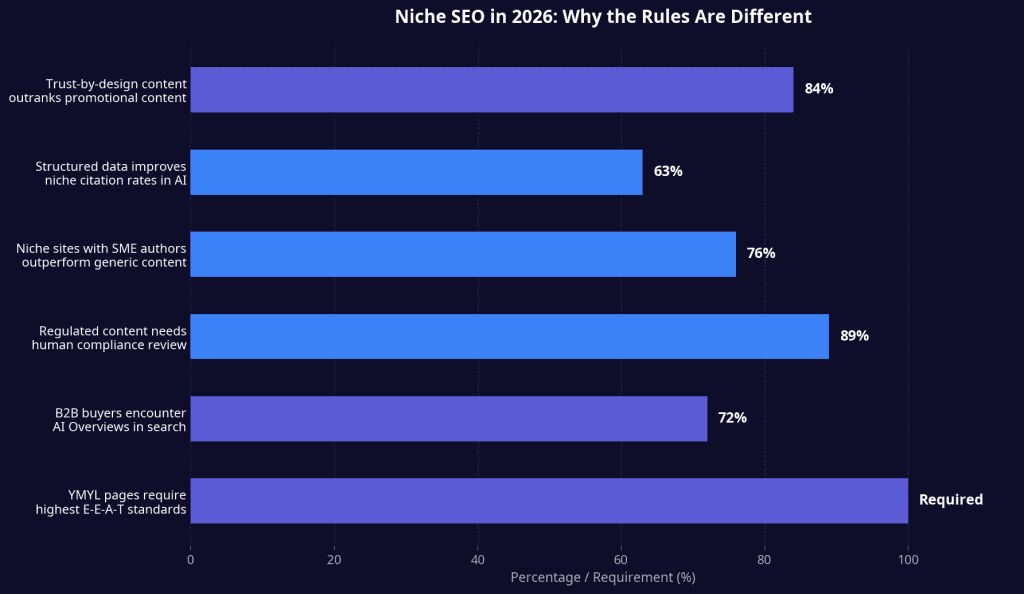
The 3 Pillars of Niche SEO in 2026
To succeed in a highly regulated or technical niche, you must shift your focus from “optimizing for clicks” to “optimizing for trust.”
1. Trust-by-Design Content
Trust is not just a ranking factor; it is a prerequisite. Trust-by-design means that every piece of content is built from the ground up to demonstrate credibility.
This requires moving away from anonymous ghostwriters. Search engines and AI systems recognize credibility through work authored by Subject Matter Experts (SMEs). Your authors need detailed bios, linked social profiles (like LinkedIn), and a documented history of external publications. Furthermore, every claim must be backed by citations, and content must undergo strict compliance review before publishing.
2. Structured Data for Entity Recognition
Technical clarity in 2026 is about ensuring that Large Language Models (LLMs) can understand and cite your content. When AI systems surface your brand, they rely on clean architecture.
Using structured data explicitly defines your authorship and organizational entities. Schema markup functions as a massive trust-building element. By implementing Organization, Person, and FAQ schema, you help search engines validate your credibility and understand exactly who is responsible for the information.
3. Authority Beyond Your Website
In regulated verticals, authority requires far more than just backlinks. It depends on coordinated efforts that generate consistent credibility signals across the entire web.
This means investing in Digital PR and external visibility. Mentions in credible industry forums, citations in respected publications, and public education sessions (like webinars) create the exact signals that AI-driven search systems rely on to assess expertise.
How NEURONwriter Supports Niche Compliance
Balancing strict regulatory compliance with semantic SEO is incredibly difficult. This is exactly where NEURONwriter excels for niche industries.
Instead of relying on generic keyword stuffing, NEURONwriter analyzes the top-ranking competitors in your specific, highly technical niche. It extracts the exact semantic entities and terms that Google expects to see in a trustworthy, expert-level document.
You can provide your SMEs with a highly structured content brief generated by NEURONwriter. The expert provides the raw knowledge and compliance oversight, while NEURONwriter ensures the final draft hits all the necessary semantic density markers to trigger AI Overviews and rank in traditional search.
FAQ
Why does my niche site struggle to rank despite good content?
If you are in a regulated or technical niche, you are likely failing Google’s strict YMYL (Your Money or Your Life) standards. Good content is not enough; it must be demonstrably authored by recognized experts and backed by strong E-E-A-T signals.
What is trust-by-design content?
Trust-by-design is a strategy where credibility is built into the content creation process. It involves using verified subject matter experts, providing clear citations, publishing revision histories, and ensuring mandatory human compliance reviews.
Do I really need an author bio for every post?
Yes. In niche and regulated industries, anonymous content is treated with extreme suspicion by search engines. Detailed author bios linked to Person schema and external profiles (like LinkedIn) are critical for establishing expertise.
How does structured data help regulated industries?
Structured data (schema markup) provides search engines and AI models with explicit, machine-readable proof of your identity, your authors’ credentials, and your organization’s relationships. It acts as a foundational trust signal.
Are backlinks still important for niche SEO?
Yes, but the type of backlink matters more. Generic guest posts are largely ignored. You need authoritative brand mentions and citations from recognized industry publications, government sites, or educational institutions.
Can I use AI to write content for a regulated industry?
You can use AI for drafting and outlining, but mandatory human oversight is non-negotiable. Publishing unreviewed AI content in a YMYL niche is highly risky and can lead to severe algorithmic penalties.
How does NEURONwriter help with technical niches?
NEURONwriter analyzes the exact semantic entities required to rank for highly specific, technical queries. It allows you to combine your subject matter expert’s knowledge with data-driven semantic optimization, ensuring your content is both compliant and highly visible to AI search engines.