
How can I optimize my blog posts for SEO?
A blog post can be accurate, useful and beautifully written, then quietly collect impressions from page two.
That is frustrating because the usual explanation is wrong. It is rarely a missing keyword or a meta description that is three characters too long. More often, the article was built around what the writer wanted to say instead of what the searcher needed to do next.
A post about blog SEO can become a shallow list of familiar advice very quickly: add keywords, write headings, get backlinks, update old content. None of that is wrong. It is just incomplete.
To optimize your blog posts for SEO, you need a process that starts before the draft, carries through the edit and continues after the page is live. You need to understand the search result, build the article around the reader’s task, then use performance data to decide what deserves another round of work.
That is what this guide covers.
Search engine optimization starts before you write
Search engine optimization is often treated as a finishing task. Someone writes the article, then adds a keyword to the title, checks the meta description and calls it optimized.
That sequence creates weak content.
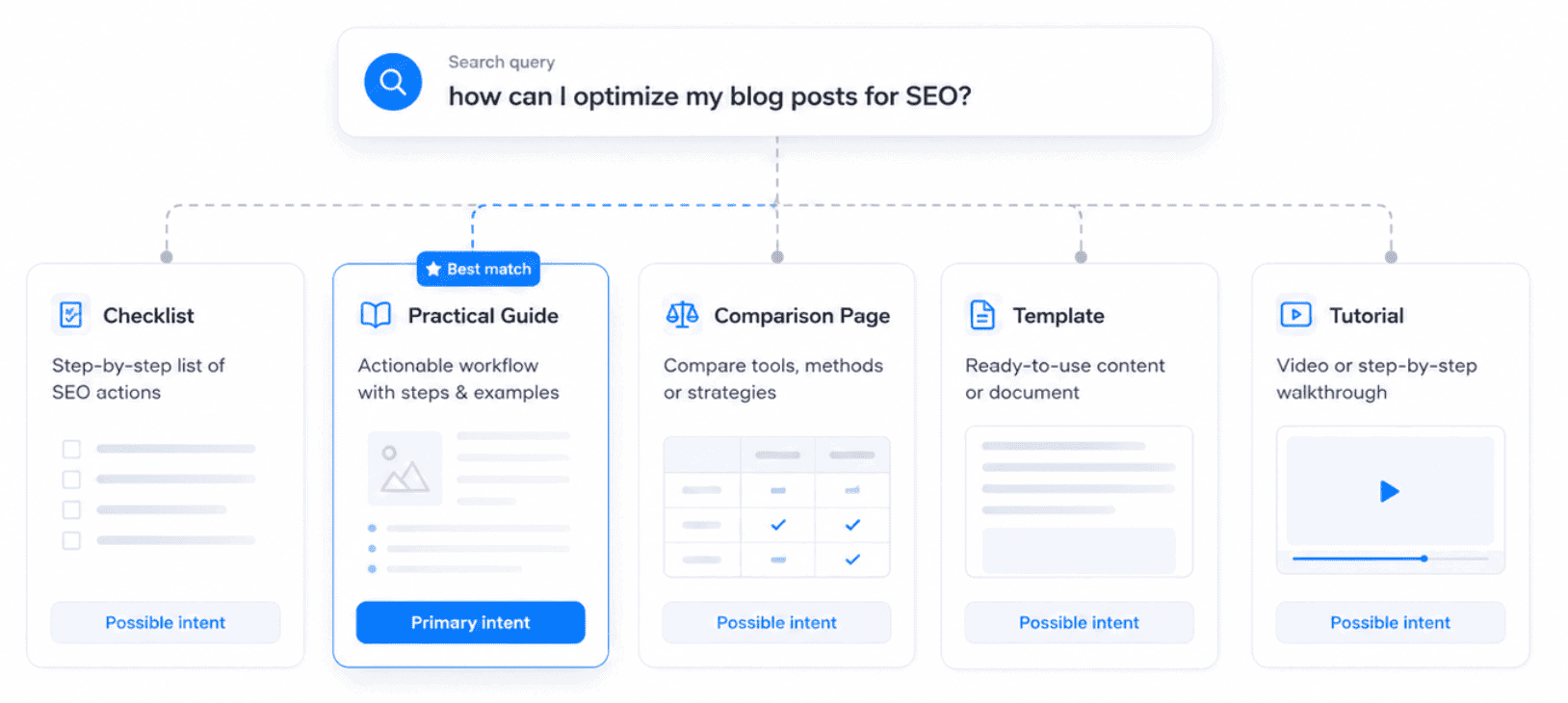
The better move is to start with the search result before you create content. Search the phrase you want to target and look at the first page as a reader would. What kind of help is Google trying to provide?
You may see detailed guides, short checklists, templates, comparison pages or tutorials with screenshots. That tells you more than a keyword volume ever can. It tells you what the searcher expects to find.
A search for “how can I optimize my blog posts for SEO?” is not asking for a history lesson on Google. It is asking for a usable workflow. The reader wants to know what to check, what to change and how to tell if the work paid off.
This is the principle behind semantic SEO: search engines do not only match words. They try to understand the meaning, context and purpose of the page.
What a post needs to rank
A post to rank needs to do three things well.
- It needs to match the task behind the query. If the reader wants a process, do not give them a list of definitions.
- It needs to cover the parts of that task people expect. A blog SEO guide that ignores internal links, content structure or performance tracking will feel incomplete.
- It needs to make the answer easy to use. A great blog post does not bury the practical advice under broad claims about “quality content.” It gives readers a next step.
That is how blog posts rank over time. Not because they repeat a phrase more often, but because the page becomes a strong answer to a recognisable problem.
Use keyword research to create content based on intent
Keyword research is not a menu of phrases to distribute through the copy.
It is a starting point for understanding demand. The real work begins when you compare the keyword with live search engine results.
Look for patterns in the pages already ranking:
- What format do they use?
- Which questions appear repeatedly?
- How deep do they go before they move to the next step?
- What examples do they include?
- Which parts feel vague, outdated or overly generic?
This helps you create content based on evidence, not assumptions.
For instance, a keyword may look broad in a tool, but the actual SERP may show that searchers want practical instructions. If every top-ranking page explains a workflow, your article should not open with “What is SEO?” and spend 800 words on background.
Your keyword gives you the topic. The search result tells you the job.
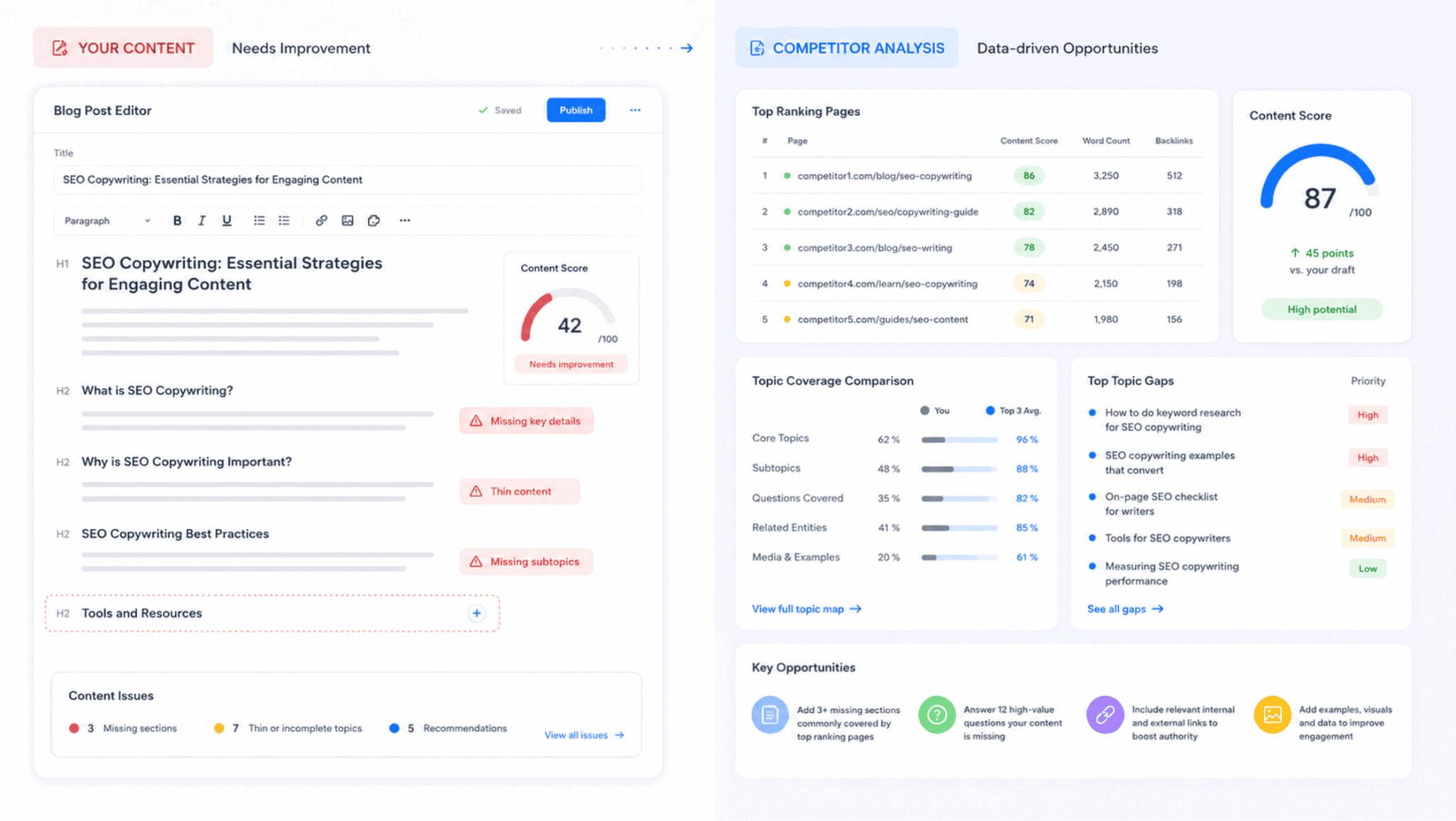
NEURONwriter’s content optimization workflow is useful at this stage because it starts with SERP analysis instead of asking writers to guess which subtopics matter.
Turn the query into an editorial brief
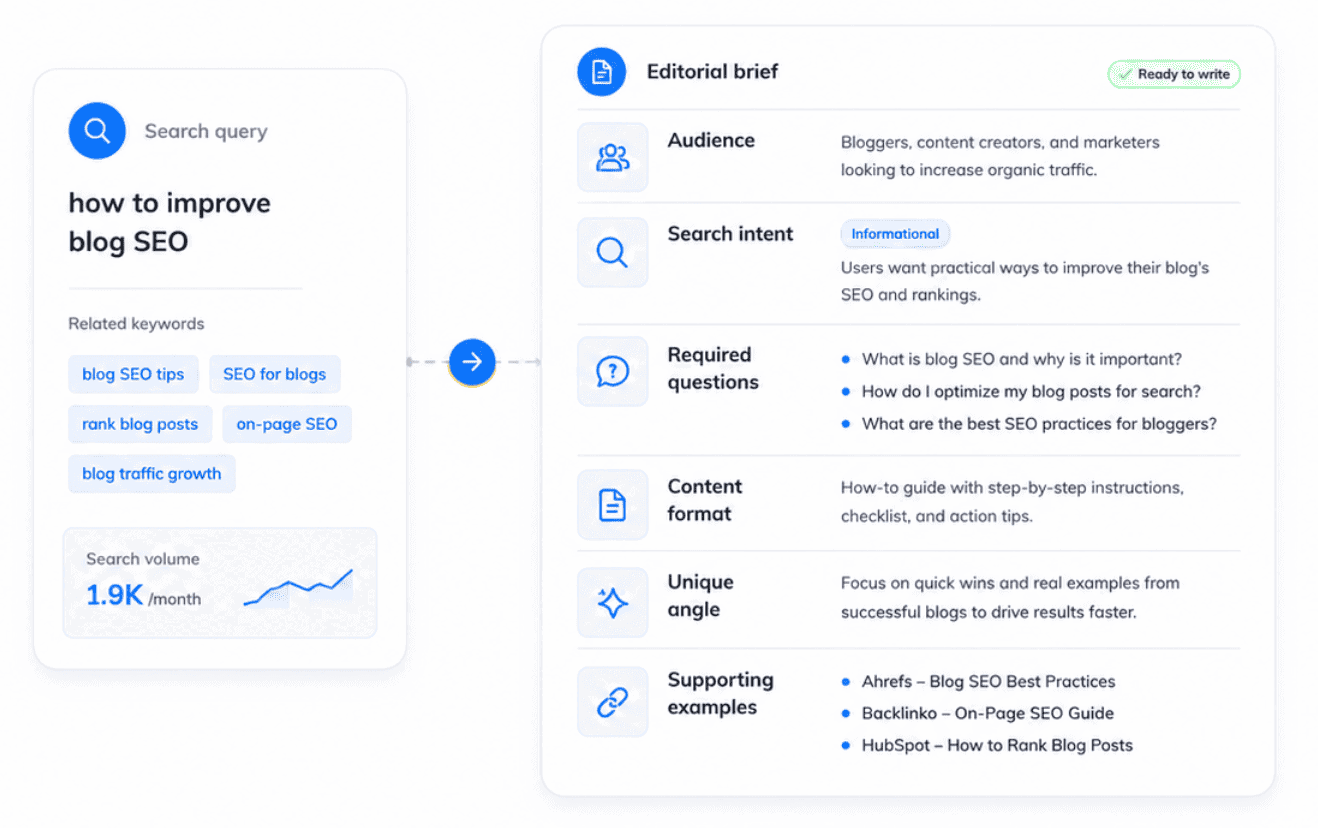
Before you write blog content, answer these questions:
- Who is searching?
- What are they trying to accomplish?
- What information do they need before they can act?
- What format will help them complete that task?
- What can you add that current ranking pages do not explain well?
That gives you a real brief.
It also stops you from creating a new post just because the keyword looks attractive. Sometimes the better choice is updating an existing blog article that already covers most of the topic and has enough authority to improve.
A useful content marketing strategy does not reward volume for its own sake. It rewards pages with a clear role in the wider site.
How to optimize your blog structure before drafting
A messy outline produces a messy article.
You do not need to make your blog posts longer before you make them more useful. You need to organize your blog around the order in which readers make decisions.
For this topic, the reader needs to understand the search result before they start writing. They need to know how to structure a draft before they optimize the title. They need to understand the difference between meaningful content gaps and empty keyword additions before they use a score.
That sequence becomes the article structure.
A strong outline for a blog SEO guide might move from research to writing, then from optimization to measurement. Each section should answer the next reasonable question.
This is more useful than treating every blog post as a container for as many SEO tips as possible.
Give every piece of content one job
A piece of content should help someone complete one main task.
A keyword research guide helps someone choose a topic. An internal linking guide helps them connect related pages. A content refresh guide helps them improve an older article. This guide helps them optimize blog posts from research through publication.
That focus matters. It makes your SEO writing easier to follow, and it helps search engines understand the content more clearly.
If you are creating a blog from scratch, map these roles early. Identify the broad pillar pages, then plan related blog posts that solve more specific problems. NEURONwriter’s internal linking guide explains how that structure can turn separate articles into a usable content system.
Optimize blog elements readers see first
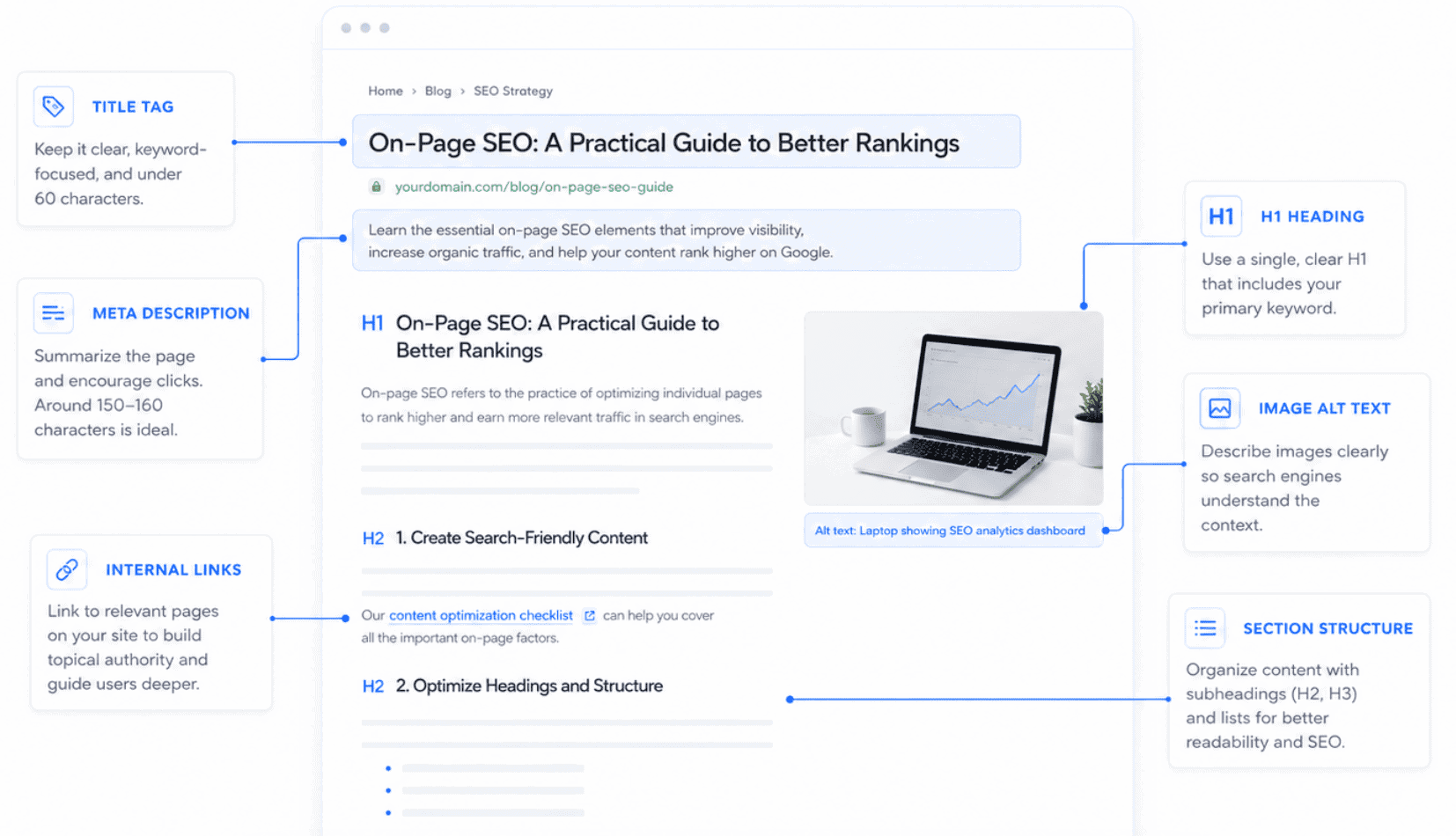
Before someone reads your advice, they see your title, URL, meta description and opening lines.
Those elements are small, but they can affect SEO because they shape the first interaction with the result. A vague title earns fewer clicks. A generic introduction creates doubt. A mismatched meta description makes the page feel less trustworthy.
On-page SEO starts here.
Write a post title that makes a clear promise
Your post title should tell the reader what they will get.
“Make your blog better” sounds friendly, but it does not communicate much. Better titles name the task and give a reason to click.
For example:
How to optimize blog posts for SEO: a practical workflow for better rankings
That title is direct. It gives the topic, the format and the expected outcome.
You do not need a clever phrase to rank your content. You need to help the right person recognise the page as relevant.
Use the meta description to support the click
A meta description is not a direct ranking factor, but it can help the searcher decide if your page is worth opening.
Use it to clarify the audience and outcome:
Learn how to optimize new and existing blog posts with a practical SEO workflow for keyword research, on-page updates, internal links and content refreshes.
An SEO plugin can catch missing metadata or a title that is too long. Yoast SEO, for example, can be useful for those basic checks. But no SEO plugin can tell you if your title reflects the real search intent. That still comes down to editorial judgment.
Create SEO content that goes beyond keyword placement
Keyword placement matters. It is not enough.
A well-optimized blog post covers the concepts that naturally belong to the topic. For blog SEO, that includes keyword research, headings, title tags, meta descriptions, internal links, image SEO, content depth, refreshes and measurement.
The point is not to mention every concept once. The point is to explain how those parts work together.
This is where content optimization helps.
NEURONwriter can compare your draft with pages already ranking and identify related terms, questions and entities. Its NLP content optimization guide explains why this works better than treating SEO as a simple keyword-matching exercise.
Use content gaps as prompts, not orders
A content score can show where your article may be thin. It cannot tell you to insert every suggested phrase.
Take “internal linking” as an example. If your draft never explains how readers move from one topic to another, that is probably a genuine gap. If a tool suggests a random branded term that does not help the reader, adding it will make the article worse.
Ask four questions before you change the draft:
- Does this help the reader?
- Does it explain a missing part of the task?
- Can I support it with an example?
- Does it belong here, or in a related article?
That is how you create SEO content that feels useful instead of algorithmic.
It also helps you make your content easier to trust. Readers notice when a paragraph exists only to carry a phrase.
Use image SEO to clarify the work
Image SEO is more than alt text.
A useful image can explain a process, show a product feature or make a before-and-after difference obvious. A stock photo of someone holding a laptop cannot do much of that work.
Use screenshots when the reader needs to see a tool. Use diagrams when a workflow is hard to understand in a paragraph. Use original examples when the advice could otherwise feel generic.
Then take care of the technical side:
- Give files descriptive names.
- Compress large images.
- Add alt text that explains what the image shows.
- Keep important information in the surrounding copy, not only inside the visual.
NEURONwriter’s guide to image SEO for AI vision models is worth linking here because image context matters more as search becomes more multimodal.
Add links to your content where people need the next step
Internal links are not decoration. They guide readers through your site and help search engines understand how pages connect.
The best links to your content appear at the moment the reader needs more detail.
A beginner guide can link to a deeper article on keyword research. A content planning post can link to a guide on semantic SEO. A blog SEO article can link to a workflow for automatically inserting internal links when the reader needs to scale the process.
The logic matters more than the total.
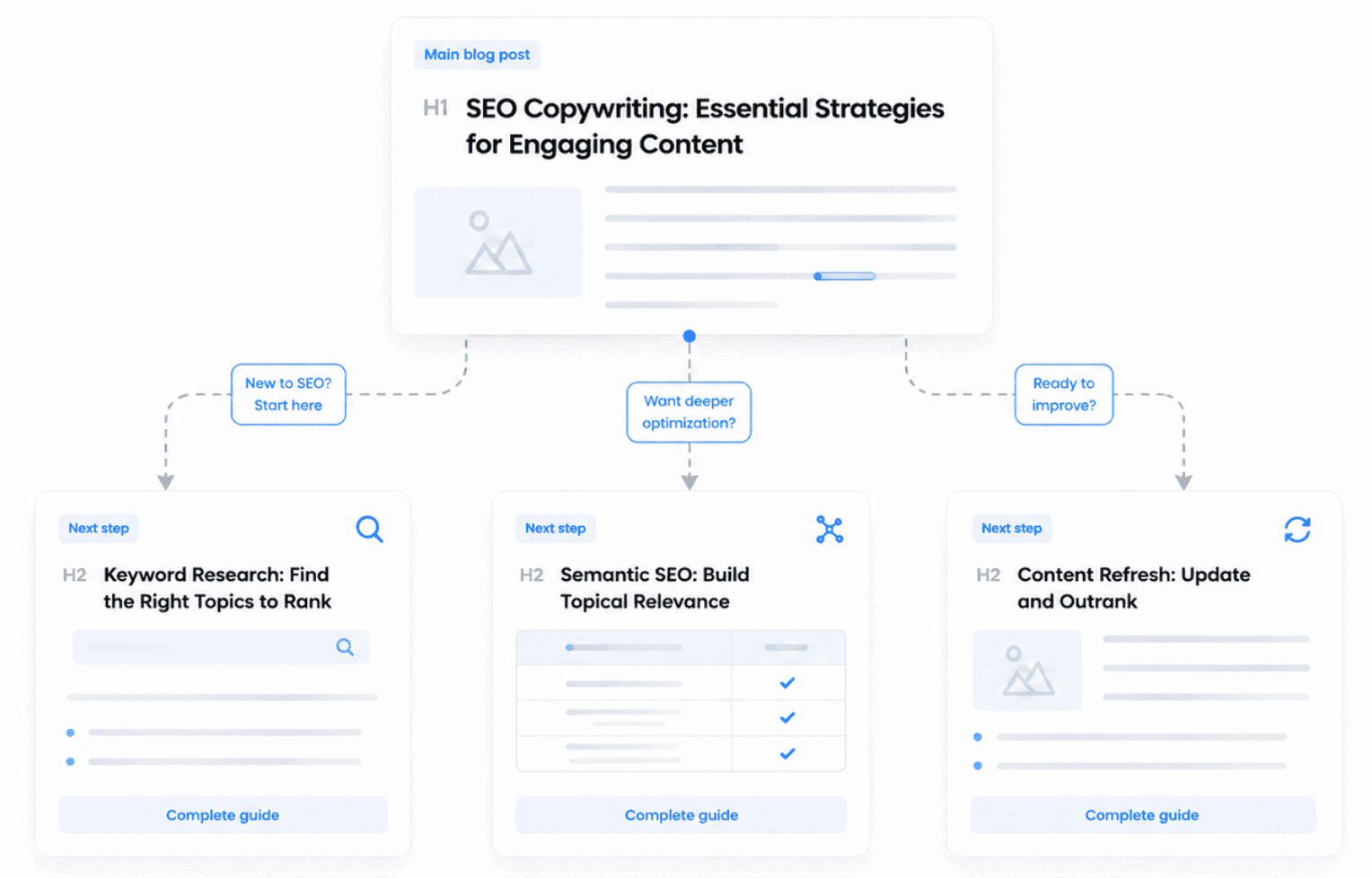
Make related blog posts part of the reader journey
Before publishing, review the outline and ask where the reader will need a deeper explanation.
That gives you natural anchors. It also prevents the common habit of adding three unrelated links near the conclusion because someone remembered internal linking at the last minute.
Related blog posts should extend the task, not interrupt it.
This approach also helps you find your content later. When pages link to each other around clear themes, your site becomes easier to navigate for users, writers and search engines.
Optimize older blog posts before you create more
Optimizing older blog posts often produces faster results than writing something new.
An existing blog may already have impressions, backlinks and rankings that put it close to page one. It might not need a rewrite. It might need a stronger title, better examples, a clearer answer near the top or links to newer content.
Start with Google Search Console and look for pages that:
- earn impressions but attract few clicks
- rank between positions five and 20
- appear for queries you did not expect
- use old examples or outdated screenshots
- cover the right topic but no longer match the current SERP
This is how you improve your SEO with evidence.
Know how to optimize an old page
Do not update the publication date and call the job done.
Compare the page with the live SERP. Check if the intent changed. Review the title and meta description. Look for sections that have become thin. Add fresh examples. Remove advice that no longer holds up. Strengthen the internal links around the page.
That work can affect SEO more than publishing another generic article.
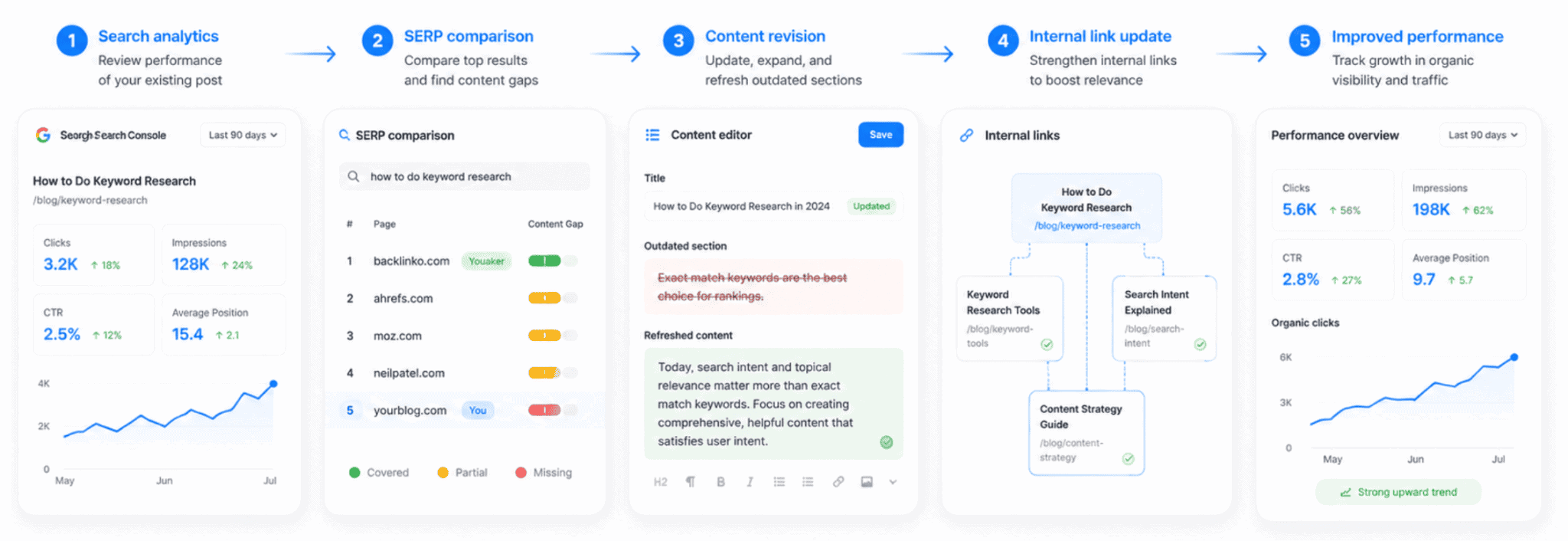
NEURONwriter’s WordPress workflow guide is useful for teams that need to edit, optimize and publish without moving between too many tools.
Track what helps your blog posts rank
Publishing a new post is the beginning of the feedback loop.
Search engine rankings are useful, but they are not the only signal. Watch impressions, clicks, click-through rate and the queries connected to the page. Those metrics tell you how Google is testing the content and how people respond when they see it.
A page may not rank in Google for the exact target phrase immediately. It may first gain visibility for related questions. That can show that search engines understand the topic, even if the page still needs stronger coverage or more authority.
Use this data to decide what to improve next.
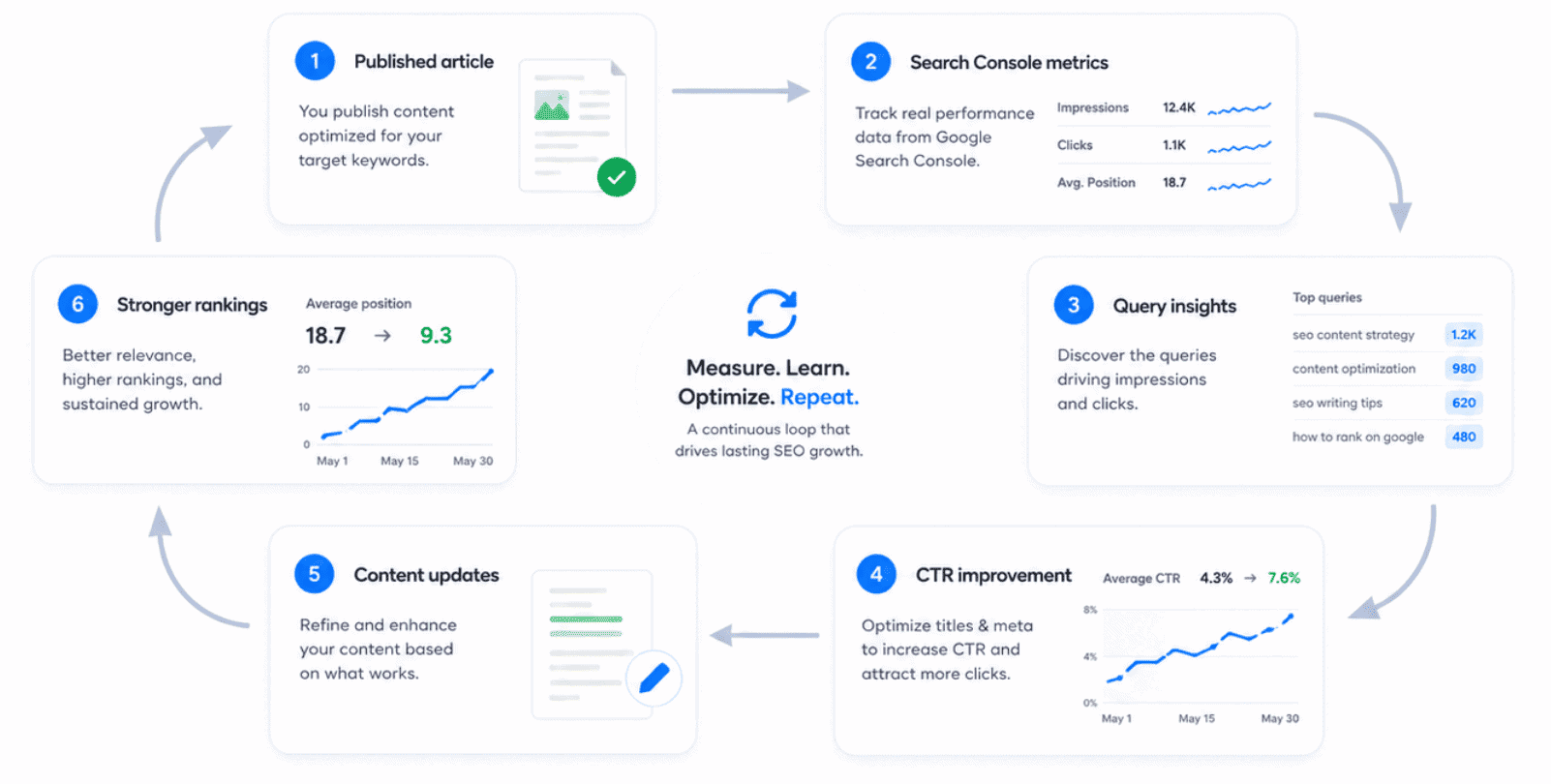
A simple review routine after publishing
Give the page time to settle, then check:
- Are impressions increasing for relevant terms?
- Is the page attracting clicks?
- Do the ranking queries match the article’s purpose?
- Are visitors moving to related blog posts?
- Has a title change improved click-through rate?
- Does the page need a deeper section, or a separate supporting article?
This is how you build strong SEO. You publish, learn and improve instead of treating every article as finished forever.
NEURONwriter’s AI Score guide can add another layer to this review, particularly when you want to see how clearly a page covers a topic for both Google and AI-driven search.
SEO writing mistakes that keep content from ranking
Writing for a phrase instead of a task
A keyword can guide the page. It cannot replace a useful outline.
This mistake usually starts early. Someone finds a phrase with enough volume, opens a blank document and begins trying to write blog content around it. The result may mention the target term in the title, H2s and introduction, yet still fail to answer the real question behind the search.
A better content strategy starts with the task. Ask what the reader wants to achieve after they click. Are they trying to choose a tool, fix a page, learn a process or compare approaches? That answer should shape the format, depth and examples in the article.
For SEO purposes, a keyword is only useful when it points you toward the right problem. You do not need to create content that’s built around every phrase a tool suggests. You need content to rank because it solves the job better than the pages already competing for attention.
Mistaking quality content for polished wording
Quality content is specific, practical and easy to verify. It gives the reader enough context to act.
A smooth introduction and clean grammar are useful, but they do not automatically create great content. Readers need examples, trade-offs and steps they can apply to their own situation. A post that says “improve SEO with better content” has not explained anything yet. A post that shows what to change, why it matters and how to measure the result has.
This is also where writers need to understand your content from the reader’s point of view. Does the article explain the next decision clearly? Does it answer the question in the heading? Could someone use the advice without opening five more tabs?
SEO writing earns its place when content is useful after the click. That is what separates posts that rank for a while from posts that become reliable resources people return to and link to.
Trying to optimize every blog post in the same way
A how-to guide, a comparison page and a product-led article need different structures. Do not use one template for every blog post.
A new blog post about a simple task may need a direct answer, a short walkthrough and a few screenshots. A comparison needs clear criteria, limitations and enough context for the reader to choose. A deeper guide may need examples, internal links and a section that helps readers apply the advice to their own work.
Your blog strategy should reflect those differences. SEO best practices give you a useful baseline, but they are not a rigid recipe. Headings, metadata, internal links and image optimization still matter, yet the way you use them should fit the page’s purpose.
This is why copying the structure of posts that rank can backfire. Ranking pages are useful evidence, not a template to reproduce. Use them to see what readers expect, then decide what your version can explain better.
Chasing a score instead of helping the reader
Scores can show useful gaps. They cannot make decisions for you.
Content tools can reveal missing concepts, weak structure or terms that appear across the live SERP. That is valuable. The problem starts when a writer treats every recommendation as mandatory and fills the article with phrases that do not add clarity.
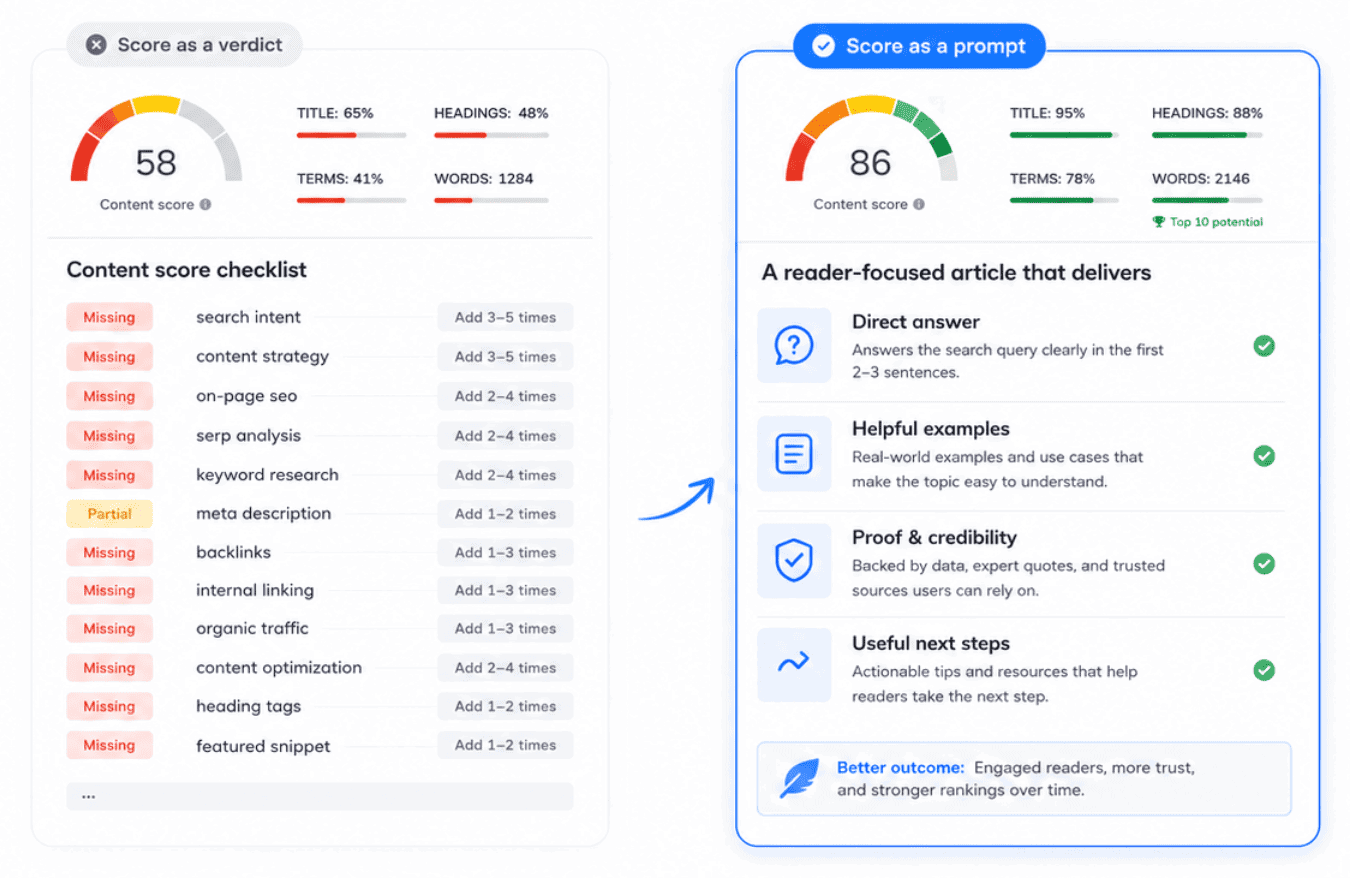
You can use the Yoast SEO plugin or a content optimization platform to catch basic gaps, but no tool can fully judge editorial relevance. A recommendation may point to a genuine missing topic. It may also reflect a competitor’s weak habit, an outdated trend or a concept that belongs in another article.
Before adding a suggestion, ask if it helps the reader complete the task. If it does, explain it properly. If it does not, leave it out.
The goal is not to maximize a score. The goal is to improve SEO by making the page clearer, more complete and easier to trust.
Leaving old content to decay
An article can lose relevance even if the keyword stays the same. SERPs change, examples age and reader expectations move.
Many teams focus all their energy on the next post while older pages quietly lose clicks. That is a missed opportunity. Existing content may already have backlinks, internal links and impressions. It may need an updated title, stronger examples, clearer on-page SEO or a section that reflects what readers now expect.
Review SEO performance regularly. Look for posts with declining clicks, rankings just outside page one or queries that no longer match the article’s current angle. Those are often easier wins than starting from zero.
Do not update the date and move on. Check the search results again, review the structure, refresh examples, add relevant internal links and optimize your images if the page relies on outdated screenshots or weak visuals.
A good blog for search is not a collection of finished articles. It is a maintained library. The strongest SEO practices treat publishing as the start of a feedback loop, not the end of the work.
Forgetting that clarity affects blog SEO
Writers sometimes assume SEO means adding more: more terms, more headings, more links, more paragraphs.
In reality, clarity can affect SEO just as much as volume. A page that makes the reader work to find the answer is less likely to perform well than one that explains the task in a logical order.
When you write your blog, make the main promise clear early. Use headings that describe the next step. Add examples where advice could feel abstract. Link to related resources when readers need a deeper explanation.
That is how you create strong SEO over time. You do not optimize every sentence for a crawler. You organize the page so readers can understand it, act on it and move through the rest of your content naturally.
Conclusion
To optimize your blog, do not start by asking where to put the keyword.
Start by asking what the searcher needs to accomplish. Build the page around that task. Use on-page SEO to make the answer easier to find and understand. Then review the live results and performance data to see where the article can become stronger.
That is how you create content that earns visibility, helps readers and keeps improving long after publication.

FAQ
How can I optimize my blog posts for SEO?
Start with keyword research and live search results. Create content based on search intent, structure the article around the reader’s task, improve on-page SEO elements, add useful internal links and review performance after publishing.
How do I know if a blog post is good for SEO?
A blog post is good for SEO when it matches the search intent, answers the main question clearly and gives readers a useful next step. It should also be easy for search engines to understand through clear headings, relevant internal links and useful context.
Should I update an existing blog or write a new post?
Update an existing blog when it already has impressions, backlinks or rankings close to page one. Write a new post when the search intent is different enough that the older page cannot answer the query properly.
Can AI-written blog content rank?
AI-assisted content can rank if it gives readers a useful, accurate and original answer. Raw AI copy that repeats generic advice rarely creates the kind of value that holds rankings.