
Image SEO for AI Vision Models: Beyond Basic Alt Text
📍 Semantic Summary
- Idea: For a decade, image SEO was just about compressing JPEGs and writing a descriptive sentence in the alt text. In 2026, multimodal search engines and AI vision models like GPT-4o and Gemini actually “read” the pixels inside your images.
- Challenge: Most marketers are still optimizing for legacy text crawlers. If an AI system cannot extract the visual context or parse the text within an image due to low contrast or heavy compression, it will hallucinate information or drop the image from AI Overviews entirely.
- Summary: To win in the multimodal AI era, you must optimize for the “machine gaze.” This requires high pixel-level quality for OCR, authentic original photography to build E-E-A-T, and precise structured data (like ImageObject schema) to connect your visuals to the Google Knowledge Graph.
Explore related topics: The Attribution Crisis · Google Discover Optimization
Imagine uploading a beautiful infographic to your blog. You carefully compress it to WebP format, add a keyword-rich alt tag, and hit publish. Ten years ago, you would be done.
Today, that is just the baseline.
When Google Lens, ChatGPT, or Gemini look at that infographic, they are not just reading your alt text. They are using computer vision to parse the actual pixels. They are reading the text inside the image using optical character recognition (OCR). They are evaluating the authenticity of the photo to determine if it is a cheap stock image or a real-world asset.
Here is a number that puts this in perspective: Google Lens now processes over 20 billion visual searches per month . That is not a niche feature anymore. It is a mainstream discovery channel, and most websites are completely invisible to it.
Welcome to the era of multimodal search. If you want your visual content to rank in 2026, you have to stop optimizing for text crawlers and start designing for the “machine gaze.”
How AI Vision Models Actually “See” Images.
To understand how to optimize, you first need to understand how large language models (LLMs) process visual data.
Think of it like this: when you look at a photo, your brain instantly recognizes shapes, colors, and objects. When an AI looks at the same photo, it does something surprisingly similar but in a very mathematical way.
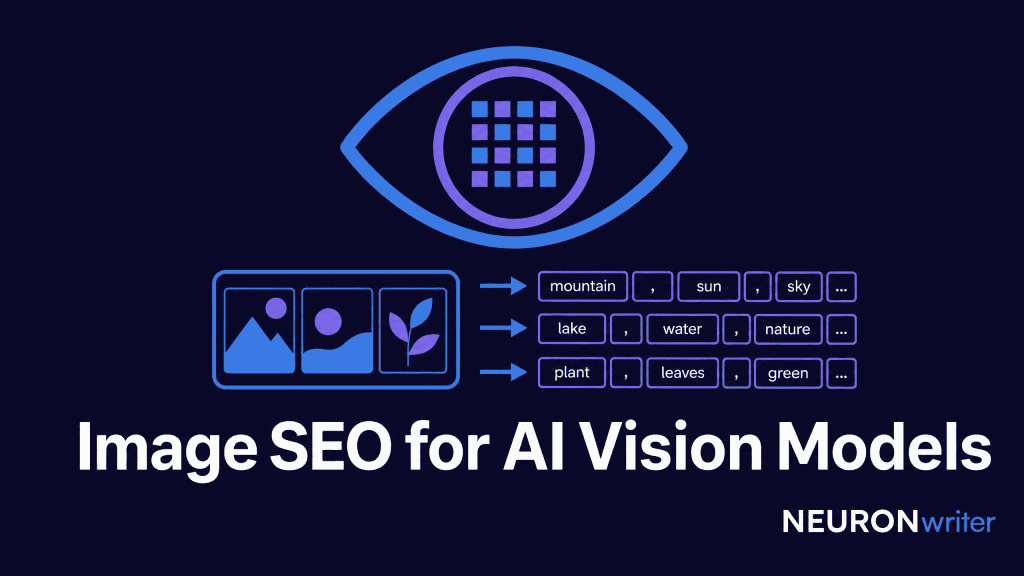
AI vision models do not see images as flat pictures. They treat images as a source of structured data. Through a process called visual tokenization, the model breaks an image down into a grid of patches (visual tokens). It converts raw pixels into a sequence of vectors, just like it does with words in a sentence .
“To large language models, images, audio, and video are sources of structured data. They use a process called visual tokenization to break an image into a grid of patches, or visual tokens, converting raw pixels into a sequence of vectors. This unified modeling allows AI to process ‘a picture of a [image token] on a table’ as a single coherent sentence.”
This means the AI parses an image exactly like it parses language. A high-quality image is like a well-written paragraph. A heavily compressed, pixelated image is like a paragraph full of typos.
If your image has lossy artifacts from over-compression, the visual tokens become noisy. When the tokens are noisy, the AI might hallucinate confidently describing objects that are not there because it misread the blurry pixels . This is not a theoretical edge case. It is the reason why a product image photographed against a shiny surface might generate completely wrong AI descriptions.
The OCR Audit: Making Text Machine-Readable.
One of the biggest shifts in image SEO is that text inside the image now matters just as much as the text around the image.
Search agents like Google Lens and Gemini use OCR to read ingredients on product packaging, data points on charts, and steps in a diagram. If the machine cannot read the text, it cannot use the image to answer a user’s query.
Here is a fascinating real-world implication: current food labeling regulations (FDA 21 CFR 101.2 and EU 1169/2011) allow type sizes as small as 0.9mm on compact packaging. That satisfies the human eye just fine. But the minimum character height required for reliable OCR extraction is far higher at least 30 pixels . In other words, your product packaging might be legally compliant but completely invisible to AI.
Here is how to ensure your images pass the OCR test:
- Minimum Pixel Resolution: Character height in your images should be at least 30 pixels for reliable OCR extraction.
- High Contrast: Ensure strong contrast between the text and the background (aim for at least 40 grayscale values of difference).
- Avoid Reflective Glare: If you are photographing physical products, glossy packaging can create glare that obscures text. Treat lighting as an SEO factor.
- Skip the Script Fonts: Stylized, cursive fonts confuse OCR systems. They might mistake a lowercase “l” for a “1” or a “b” for an “8.” Stick to clean sans-serif fonts for any critical text inside an image.
Authenticity as a Ranking Signal.
Here’s something most SEO specialists don’t talk about: AI systems can recognize if your photo is fake.
Modern vision models are incredibly effective at detecting manipulations, AI generation, and generic stock photos through advanced pattern recognition. If you use the same stock photo of “business people shaking hands” used by 10,000 other websites, the AI assigns it a very low ranking value. It’s seen that photo before.
On the other hand, a genuine photo provides strong trust signals E-E-A-T. It proves that you actually have the product in your hand, that you actually visited the location, or that you actually completed the process described.
Grounding Images with Structured Data.
While vision models are smart, they still appreciate a helping hand. Structured data acts as the bridge between the raw pixels and the semantic meaning in the Knowledge Graph.
Think of it as writing a caption for the AI. When you implement ImageObject schema, you are not just describing the image you are formally introducing it to the machine. You are saying: “This image belongs to this brand, depicts this product, and connects to these entities.”
For e-commerce sites, this is especially powerful. Product images marked up with price, availability, and review data are far more likely to appear in Google Shopping results and AI Overviews that answer product-specific queries. Visual markup supports entity recognition, teaching the AI exactly how this specific image relates to your brand and your products.
A practical tip: if you have not yet implemented ImageObject schema, start with your most important product or hero images. The lift in rich result eligibility is often visible within a few crawl cycles.
The NEURONwriter Advantage: Semantic Co-occurrence.
You can have the highest-resolution, most original image in the world, but if the text surrounding it lacks semantic depth, the AI will not trust it.
Vision models rely heavily on co-occurrence. They look at the image, extract the visual tokens, and then check the surrounding HTML text to verify the context. If you publish a photo of a sourdough starter but the surrounding text is about “fermentation processes in industrial settings,” the AI gets confused. The visual context and the textual context do not match.
This is where NEURONwriter becomes your secret weapon. By using NEURONwriter Content Editor to ensure your surrounding text is dense with highly relevant NLP entities, you provide the perfect semantic anchor for your images. When the AI’s visual analysis of the image perfectly matches the rich semantic entities in the surrounding paragraphs, your content achieves maximum topical authority.
Stop treating images as mere decoration. In 2026, every pixel is an opportunity to communicate with the machine and the machines are listening more carefully than ever.
FAQ
What is multimodal search?
Multimodal search refers to search engines and AI systems that can process and understand multiple types of input simultaneously such as text, images, audio, and video. Instead of relying solely on text keywords, these systems analyze the actual content of the media to deliver results. Google Lens, for example, now processes over 20 billion visual searches per month .
How do AI vision models like GPT-4o read images?
AI vision models use a process called visual tokenization. They break an image down into a grid of small patches (tokens) and convert the pixels into mathematical vectors. This allows the AI to “read” the image’s contents much like it reads a sequence of words in a sentence .
Does text inside an image count for SEO in 2026?
Yes. Search engines use optical character recognition (OCR) to extract text directly from within images. If you have text on an infographic, a chart, or product packaging, the AI will read it and use it to understand the context and relevance of the image. The minimum character height for reliable OCR is at least 30 pixels .
Why are stock photos bad for image SEO?
Modern AI systems use pattern recognition to identify duplicate and generic visual content. Because stock photos are used across thousands of websites, they provide very weak E-E-A-T signals. Original photography proves real-world experience and authenticity, which AI algorithms reward with better visibility.
What is the minimum font size for text inside an image?
To ensure that OCR systems can accurately read the text inside your images, the character height should be at least 30 pixels. You should also use high-contrast colors and avoid overly stylized or cursive fonts that can confuse the machine.
How does ImageObject schema help SEO?
ImageObject schema is a type of structured data that explicitly tells search engines what an image is about, who created it, and what it represents. This markup helps connect the visual asset to specific entities in the Google Knowledge Graph, improving its chances of appearing in rich snippets and AI summaries.
How should the text around an image be optimized?
Vision models use the surrounding text to verify the context of an image a process called co-occurrence analysis. Using NEURONwriter Content Editor, you should ensure the paragraphs immediately preceding and following the image contain highly relevant NLP entities that match the visual content, creating a strong semantic bond between pixels and meaning.