
The FAQ Strategy: Using NEURONwriter to Capture Long-Tail Voice Queries
Semantic summary
Idea: As voice search usage explodes in 2026, user queries are becoming increasingly conversational and question-based. The most effective way to capture this long-tail voice traffic is by implementing a targeted FAQ strategy within your content.
Challenge: Traditional keyword optimization fails to capture the natural phrasing of voice queries, which average 7 to 10 words in length. Furthermore, if your answers are buried deep within dense paragraphs, voice assistants and AI Overviews will struggle to extract them for spoken responses.
Summary: By leveraging NEURONwriter to identify semantic questions and structuring your content with direct, concise answers and FAQPage schema, you can dominate featured snippets and become the default answer for smart speakers and wearables.
Related reads:
Voice Search Optimization in 2026: Writing for Smart Speakers and Wearables
Why FAQPage Schema is Your Secret Weapon for AI Overviews
When we type into Google, we use shorthand. We type “best running shoes.” But when we speak to our smartwatches, phones, or home assistants, we use full sentences. We ask, “What are the best running shoes for flat feet under $100?”
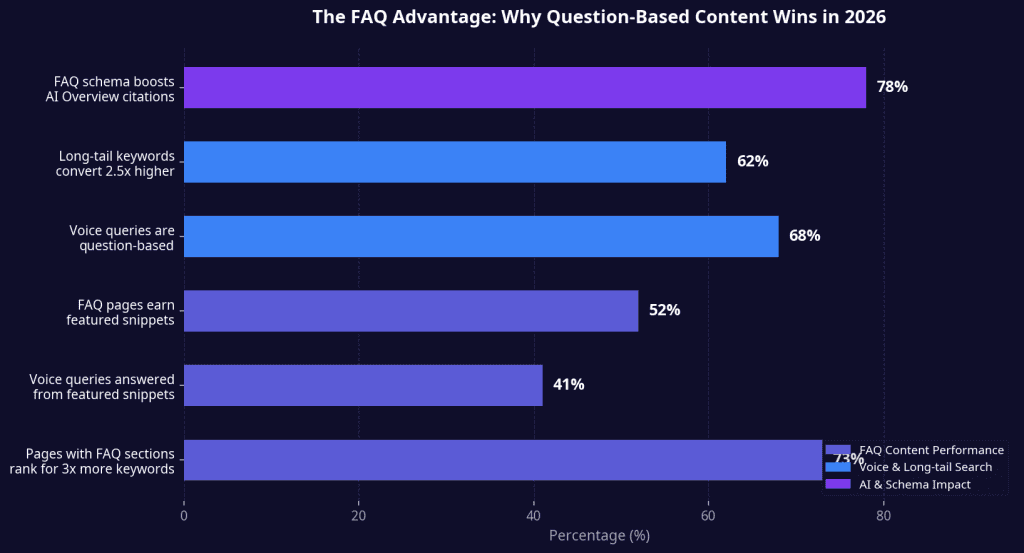
This shift toward conversational, long-tail queries is the defining characteristic of voice search in 2026. According to recent data, voice queries are typically three to five times longer than text searches, and the vast majority of them are phrased as direct questions.
If your SEO strategy is still focused solely on short-tail keywords, you are missing out on the massive volume of highly specific, high-intent traffic generated by voice search. The solution is surprisingly simple: a robust, semantically optimized FAQ strategy.
Why FAQs Are the Perfect Match for Voice Search
Voice assistants like Siri, Alexa, and Google Assistant rely heavily on featured snippets to answer user questions. In fact, over 40% of all voice search answers are pulled directly from a featured snippet.
To win those snippets, your content needs to match the exact structure of a voice query: a clear question followed immediately by a concise, direct answer.
“To optimize your FAQs for voice search, use conversational language that mirrors the way users speak when asking questions aloud. Voice search queries are typically longer and more natural than text-based queries, so your FAQ content should reflect this style.”
When you build a dedicated FAQ section at the bottom of your article or distribute FAQ blocks throughout your product pages you create the exact pre-formatted question-answer pairs that AI extraction models are looking for.
Traditional Content vs. FAQ-Driven Content
| Feature | Traditional Paragraph Content | FAQ-Driven Content |
| Query Matching | Broad topic targeting | Exact conversational question matching |
| Extraction Ease | AI must parse dense text to find the answer | AI extracts the direct answer immediately |
| Featured Snippet Potential | Low to moderate | Very high (especially for list/paragraph snippets) |
| Voice Search Suitability | Poor (too long for spoken responses) | Excellent (concise, 40-60 word answers) |
Using NEURONwriter to Build Your FAQ Strategy
The hardest part of an FAQ strategy isn’t writing the answers; it’s knowing which questions to ask. You cannot guess what your audience is asking their smart speakers. You need semantic data.
This is where NEURONwriter gives you a massive advantage over traditional keyword research tools.
Mining Semantic Questions
When you set up a query in NEURONwriter, the tool analyzes the top-ranking competitors and extracts the exact terms and concepts they are using. But more importantly, the Ideas section in NEURONwriter pulls in the most relevant “People Also Ask” questions and semantic queries related to your core topic.
Instead of relying on generic keyword volumes, NEURONwriter shows you the specific, long-tail questions that Google already associates with your primary entity.
Optimizing the Answer Density
Once you have your list of 5 to 7 questions, you must write answers that voice assistants love. The ideal length for a voice search answer is 40 to 60 words.
As you draft your answers in the NEURONwriter editor, you can ensure you are naturally weaving in the required NLP terms and entities without artificially inflating the word count. NEURONwriter’s real-time scoring ensures your short answers remain semantically dense and highly relevant.
Structuring for Extraction
Finally, the presentation matters. Use clear H3 tags for your questions and keep your answers direct. Avoid introductory fluff like, “That is a great question, many people wonder…” Just answer the question immediately.
The Technical Requirement: FAQPage Schema
Writing great questions and answers is only half the battle. To guarantee that voice assistants and AI Overviews can instantly identify your FAQ section, you must wrap it in FAQPage schema markup.
Structured data acts as a direct translation layer for search engines. It explicitly tells the crawler: “This text is a question, and this text is the exact answer.” Without schema, you are forcing the AI to guess. With schema, you are handing the algorithm a silver platter of extractable facts.
By combining the semantic depth of NEURONwriter with the structural clarity of FAQ schema, you create content that is perfectly engineered for the voice search era.
FAQ
How long should an FAQ answer be for voice search?
The optimal length for an FAQ answer targeting voice search is between 40 and 60 words. Voice assistants prefer concise, direct answers that can be read aloud quickly without losing the user’s attention.
Do I need a separate FAQ page or should I put FAQs on existing pages?
It is generally better to distribute FAQs across your existing product, service, and blog pages rather than creating one massive, disconnected FAQ page. This adds highly relevant, long-tail context directly to the pages you want to rank.
Can NEURONwriter help me find voice search keywords?
Yes. NEURONwriter analyzes top-ranking content and extracts semantic questions and “People Also Ask” data, which are excellent proxies for conversational, long-tail voice search queries.
Why is conversational language important for FAQs?
People do not speak to voice assistants the way they type into a search bar. They use natural, full sentences. Using conversational language in your FAQs ensures your content matches the exact phrasing of the user’s spoken query.
Does FAQPage schema still work in 2026?
Absolutely. While traditional rich snippets have evolved, FAQPage schema remains one of the strongest signals you can provide to AI Overviews and voice search algorithms to help them extract your answers.
Should I use bullet points in my FAQ answers?
Yes, if the question asks for a process or a list. Search engines frequently use bulleted and numbered lists for featured snippets, which are then read aloud by voice assistants step-by-step.
How many questions should I include in an FAQ section?
Aim for 3 to 7 highly relevant questions per page. Quality and semantic relevance are more important than quantity. Only answer questions that provide genuine value to the specific topic of that page.