
Voice Search Optimization in 2026: Writing for Smart Speakers and Wearables
Semantic summary
Idea: Voice search optimization is no longer a niche tactic. With 8.4 billion voice assistants active worldwide, optimizing for smart speakers and wearables is mandatory in 2026. Voice queries are fundamentally different they are longer, conversational, and highly dependent on featured snippets.
Challenge: Most content is written for short, typed keywords. When users ask conversational queries (averaging 29 words), traditional keyword-stuffed pages fail to provide the direct, snappy answers that voice assistants require. If you aren’t ranking in Position Zero, you are invisible to voice search.
Summary: To capture voice traffic, you must structure your content to answer natural language questions directly. By targeting long-tail question keywords, optimizing for featured snippets, and using tools like NEURONwriter to ensure high semantic relevance, you can make your content the default answer for AI assistants.
Related reads: Zero-Party Data: Asking Your Audience What They Want to Search For | The Death of the “10 Blue Links”: Preparing for the 2027 Search Interface
Typing is slowly becoming a secondary interface. When someone needs an answer while cooking, driving, or walking down the street, they don’t type they talk.
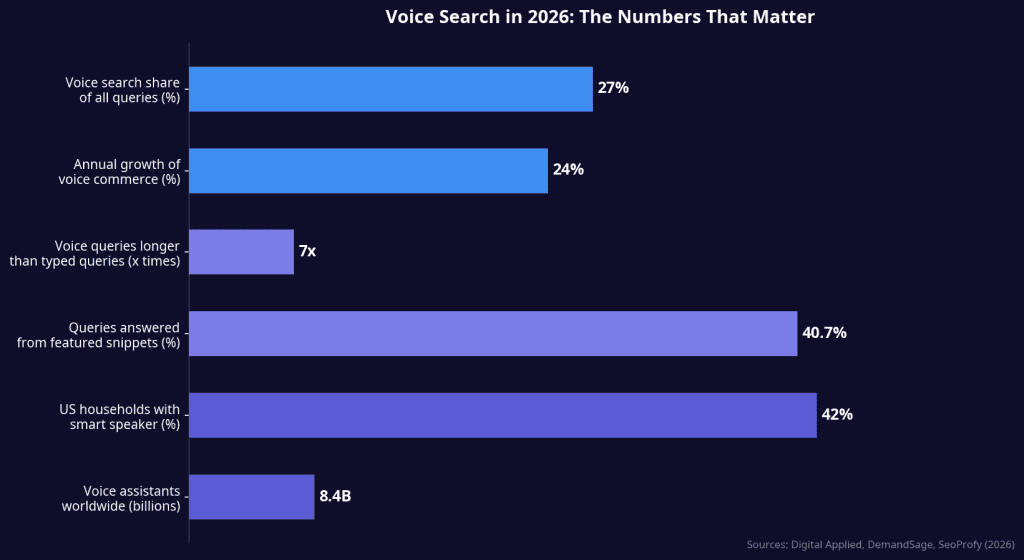
In 2026, the installed base of voice assistants has surpassed the global population, reaching 8.4 billion active devices. From smart speakers in 42% of US households to the smartwatch on your wrist, voice search is processing over 10 billion queries every single day.
If your SEO strategy is still focused exclusively on what people type into a search bar, you are missing out on 27% of all search queries. Here is how to adapt your content for the voice-first era.
Why Voice Search is Fundamentally Different
When we type, we use “caveman language.” We type “best pizza chicago.” But when we speak to an assistant, we use natural language: “Hey Siri, what’s the best deep-dish pizza place open near me right now?”
This shift from fragmented keywords to complete, conversational sentences changes everything about how content must be structured.
“The average voice query is 29 words — 7x longer than typed searches. Voice queries are fundamentally conversational. Users ask complete questions rather than typing keyword fragments. This shift demands a complete rethinking of keyword strategy, content structure, and on-page optimization.”
To win in voice search, you have to understand the mechanics of how voice assistants choose their answers.
Typed Search vs. Voice Search.
| Feature | Typed Search | Voice Search |
| Query Length | Short (1-3 words) | Long (Conversational, often 20+ words) |
| Intent | Often ambiguous | Highly specific and action-oriented |
| Results Provided | 10 Blue Links + AI Overviews | One single, definitive answer |
| Format Preference | Comprehensive guides | Snappy, direct answers (40-60 words) |
| Local Focus | Moderate | Very high (“near me” queries) |
The Golden Rule: Optimize for Featured Snippets
When you ask a smart speaker a question, it doesn’t read you a list of ten websites. It reads you one answer. Where does it get that answer?
In 40.7% of cases, voice search answers come directly from featured snippets (Position Zero) .
If your page earns a featured snippet, it is 40 times more likely to be selected as the voice answer than a page ranking in positions 2-10 Winning voice search means winning the snippet.
How to Capture the Snippet for Voice.
- Ask the question in an H2 or H3 heading: Literally write out the question exactly as a user would speak it (e.g., “How do I optimize for voice search?”).
- Answer immediately: Directly below the heading, provide a clear, concise answer in 40 to 60 words. This is the “snippet bait.”
- Elaborate below: After providing the short answer, you can expand on the topic in detail for users who actually click through to the page.
Structuring Content for Smart Speakers and Wearables
Voice assistants need content that is easy to parse and extract. They struggle with dense, unbroken walls of text.
1. Target Conversational Long-Tail Keywords.
Stop focusing on high-volume, short-tail keywords. Instead, target the “who, what, where, when, why, and how” questions. Use tools like AnswerThePublic or look at the “People Also Ask” section in Google to find the exact questions your audience is asking.
2. Keep Your Language Simple.
Voice answers are read aloud. If your content is full of complex jargon and convoluted sentences, the assistant will sound robotic and confusing. Write at a 9th-grade reading level. Use short sentences. Read your content out loud if you stumble while reading it, the voice assistant will too.
3. Implement FAQ Pages.
FAQ pages are a goldmine for voice search. They naturally follow the Q&A format that voice assistants love. Group related questions together and provide direct, concise answers.
Using NEURONwriter for Voice Search Dominance
To be the definitive answer for a voice query, your content must be highly relevant and semantically dense. This is where NEURONwriter gives you a massive advantage.
When a voice assistant evaluates a page, it looks for related entities and concepts to confirm the page’s authority on the topic. NEURONwriter analyzes the top-ranking content and tells you exactly which terms and entities you need to include to prove your relevance.
By using NEURONwriter to optimize your conversational content, you ensure that your answers are not only formatted correctly for snippets but are also semantically richer than your competitors. This combination of perfect structure and high semantic density is the key to dominating voice search in 2026.
FAQ
What is voice search optimization?
Voice search optimization is the process of updating and formatting your website content so that it is more likely to be selected and read aloud by voice assistants like Siri, Alexa, and Google Assistant when users ask conversational questions.
How long should an answer be for voice search?
The ideal length for a voice search answer is between 40 and 60 words. This length is concise enough for a smart speaker to read quickly, yet detailed enough to fully answer the user’s question.
Do featured snippets matter for voice search?
Yes, they are critical. Over 40% of voice search answers are pulled directly from featured snippets. If you optimize your content to win featured snippets, you drastically increase your chances of being the chosen voice answer.
How do voice queries differ from typed queries?
Voice queries are much longer and more conversational. While a typed query might be “best coffee shop,” a voice query is more likely to be a full sentence, such as “What is the best coffee shop open near me right now?”
Should I use schema markup for voice search?
Yes. Implementing structured data, particularly FAQ schema and Speakable schema, helps search engines understand the context of your content and identifies which parts are most suitable for audio playback.
Does local SEO matter for voice search?
Absolutely. A massive portion of voice searches are local, mobile queries looking for immediate solutions (e.g., finding a nearby restaurant or store). Ensuring your Google Business Profile is up-to-date is essential.
How can NEURONwriter help with voice search?
NEURONwriter helps you build semantic authority. By ensuring your content includes the right entities and related terms, you signal to search engines that your page is the most comprehensive and relevant answer to the user’s conversational question.