
Integrating User-Generated Content (UGC) into Your SEO Strategy

Semantic summary
Idea: In 2026, search engines and AI models prioritize information gain fresh perspectives and real-world experiences that standard articles lack. User-generated content (UGC) like reviews, comments, and community forums naturally provide this authentic layer, acting as a powerful SEO moat.
Challenge: Many brands treat UGC as a social media tactic rather than an SEO strategy. They lock valuable customer insights inside closed platforms instead of integrating them directly into their website’s architecture to boost topical authority and rankings.
Summary: By embedding authentic customer reviews, enabling structured comments, and building community-driven content, you can feed AI search engines the exact “Experience” signals they crave. Combining UGC with the semantic optimization of NEURONwriter creates pages that are both algorithmically perfect and deeply human.
Related reads:
How to Humanize AI Content for Google in 2026
Zero-Party Data: Asking Your Audience What They Want to Search For
You spend hours researching, writing, and optimizing the perfect article. You hit publish, wait a few weeks, and check the search results. Who is outranking you? A messy, unoptimized Reddit thread from three years ago.
This is the reality of search in 2026. Google and AI answer engines are aggressively prioritizing user-generated content (UGC). Why? Because algorithms can generate endless informational text, but they cannot generate real human experience.
If you want to protect your rankings, you need to stop fighting UGC and start integrating it directly into your own website.
Why UGC is the Ultimate SEO Moat.
The concept of information gain is the driving force behind modern SEO. Search engines evaluate how much new, unique value a page adds to the internet. If your article says the exact same thing as the top ten results, your information gain is zero.
User-generated content solves this problem automatically.
When a customer leaves a detailed review, asks a specific question in your comments section, or shares a unique use case on your community forum, they are adding proprietary information gain to your URL. They are using long-tail keywords you never thought of, and they are providing the “Experience” component of E-E-A-T.
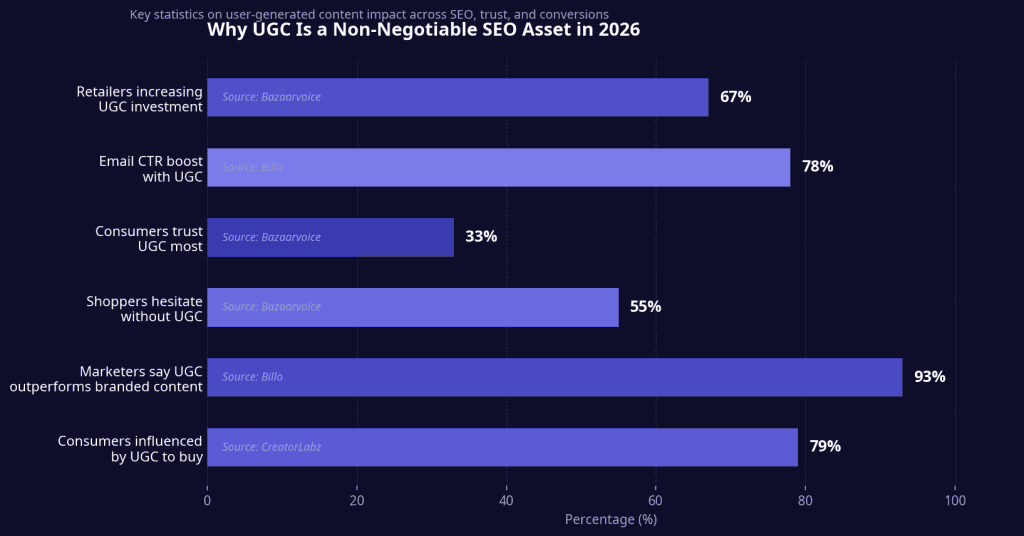
“93% of marketers leveraging user-generated content in their marketing efforts claim that it performs notably better than traditional branded content.”
Traditional Content vs. UGC-Enhanced Content
| Feature | Traditional Branded Content | UGC-Enhanced Content |
| Information Gain | Low (often repeats existing facts) | High (adds unique personal experiences) |
| Keyword Variety | Limited to planned target keywords | Expands naturally into long-tail voice queries |
| Trust Signals | Relies on author credentials | Validated by peer consensus and social proof |
| Update Frequency | Static until manually refreshed | Constantly updated with new comments/reviews |
| AI Search Preference | Treated as standard information | Highly cited for “real-world” context |
3 Ways to Integrate UGC into Your SEO Strategy.
You do not need to build a massive forum to benefit from UGC. Here are three practical ways to integrate it into your site today.
1. Embed Verified Reviews Directly on Product and Service Pages.
Do not hide your best reviews on third-party platforms. Bring them home. Embed authentic customer reviews directly onto your landing pages using proper Schema markup.
When users write reviews, they naturally use the exact phrasing that other potential customers are searching for. This organically enriches the semantic depth of your page without any extra writing on your part. According to recent data, 55% of shoppers hesitate to buy a product without user-generated content.
2. Turn Comments into Content Assets.
A healthy comments section is an SEO goldmine. When readers ask questions, they are giving you the exact long-tail queries that Google’s AI Overviews are trying to answer.
Instead of just replying with a quick “thanks,” use comments to expand your article. If a user asks a great question, update the main body of the article to include the answer, and credit the user. This creates a cycle of continuous information gain and keeps the page fresh in the eyes of search engines.
3. Create Community-Driven Case Studies.
Instead of writing a generic “how-to” guide, ask your audience how they solved the problem. Curate their responses into a single, comprehensive article.
This approach guarantees 100% original content. Because the insights come from real practitioners, the article will naturally contain the exact entities, related terms, and industry jargon that semantic search engines look for.
The Perfect Pair: UGC and Semantic Optimization
User-generated content provides the raw, authentic human experience. But raw UGC is often messy and unstructured. To rank, it needs a strong foundation.
This is where NEURONwriter comes in.
Before you start integrating UGC, use NEURONwriter to build the core structure of your page. Optimize the main headings, ensure the primary entities are covered, and establish a high NLP score. Once the semantic foundation is rock solid, let the user-generated content flow in to provide the unique information gain and long-tail relevance.
It is the perfect 2026 formula: NEURONwriter ensures the algorithm understands the page, and UGC ensures the human trusts it.
FAQ
What exactly counts as user-generated content for SEO?
User-generated content includes blog comments, product reviews, Q&A sections, community forum posts, and curated customer testimonials hosted directly on your domain.
Does Google actually index blog comments?
Yes. Google crawls and indexes the text within your comments section. High-quality, relevant comments add to the overall word count and semantic richness of the page.
How do I prevent spam from ruining my UGC strategy?
Strict moderation is essential. Use automated spam filters, require manual approval for first-time commenters, and never publish low-effort or irrelevant submissions. Bad UGC can hurt your rankings.
Can I just copy reviews from Google My Business to my site?
While you can display them, it is better to collect first-party reviews directly on your site. Unique reviews hosted on your domain provide the most exclusive information gain.
Why do Reddit and Quora rank so high right now?
They rank high because they are massive repositories of UGC. Search engines currently favor them because they provide raw, unfiltered human experiences rather than polished marketing copy.
How does UGC help with AI Overviews?
AI models look for consensus and real-world validation. When multiple users discuss a topic or confirm a solution in your comments or reviews, AI models are more likely to trust and cite that information.
Can NEURONwriter help me optimize UGC?
Yes. You can paste curated user quotes or reviews into the NEURONwriter editor to see how they impact your overall semantic score and identify which entities your community is naturally discussing.