
The Impact of User Behavior Metrics on 2026 Search Rankings
Semantic Summary
Idea: User behavior metrics dwell time, pogo-sticking, CTR, and the “Last Longest Click” are not just vanity analytics. They are the primary signals Google’s NavBoost system uses to determine whether your content truly satisfies search intent. In 2026, optimizing for user satisfaction is inseparable from optimizing for rankings.
Challenge: Traditional SEO focused heavily on keywords and backlinks. However, if users click your high-ranking page and immediately return to the search results (pogo-sticking), Google’s NavBoost system registers this as a negative signal, eventually demoting your content regardless of its backlink profile.
Summary: Google uses historical user interaction data to filter and prioritize search results. The ultimate goal is to capture the “Last Longest Click” the final destination where a user’s query is fully satisfied. By optimizing for readability, semantic relevance, and comprehensive answers using NEURONwriter, you can improve dwell time, reduce bounce rates, and send the exact behavioral signals Google requires for top rankings in 2026.
Related reads:
The End of Commodity Content: Why High-Friction SEO is the Only Way to Win in 2026
Brand Mentions vs. Backlinks: The New Playbook for Getting Cited by AI in 2026
The Truth About NavBoost and Click Signals
The revelation of Google’s internal systems, specifically NavBoost, confirmed what many seasoned SEOs had long suspected: user interactions matter immensely. NavBoost is a powerful ranking system that relies on a massive, historical repository of user interaction data storing up to 13 months of click data for individual pages.
NavBoost does not function as a simple “if CTR is high, rank higher” mechanism. Instead, it acts as a sophisticated user-behavior-driven filter that classifies clicks along a spectrum of satisfaction.
The Click Spectrum: From Pogo-Sticking to Ultimate Success
Google’s systems categorize user interactions to determine whether a page genuinely solved the searcher’s problem. These categories include:
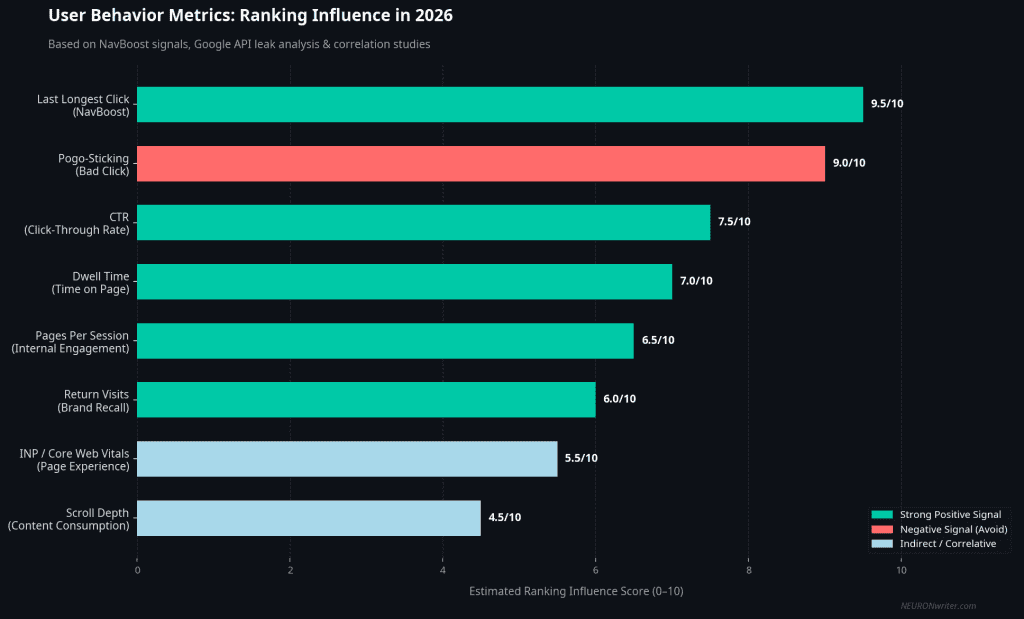
- Bad Clicks (Pogo-Sticking): This occurs when a user clicks on a search result, quickly realizes the content does not meet their needs, and immediately returns to the search engine results page (SERP). This immediate return is a strong signal of user dissatisfaction.
- Good Clicks: A positive interaction where a user clicks a result and remains on the destination page for a significant period. This indicates that the content is relevant and engaging.
- The Last Longest Click: This is the holy grail of user behavior metrics. It identifies the final result a user clicks on during a search session, where they dwell for an extended period without returning to Google. This interaction is interpreted as the ultimate signal of a successfully completed search task.
To prevent manipulation, such as click fraud or bot traffic, Google uses a data processing technique called “squashing.” This normalizes the data, preventing any single massive spike in clicks from artificially inflating a page’s long-term ranking stability.
Decoding the Core User Behavior Metrics in 2026
While Google may not use your specific Google Analytics dashboard data to rank your site, they gather parallel behavioral data through Chrome, Android, and SERP interactions . Here is how the most critical metrics influence your rankings today.
Dwell Time (Time on Page)
Dwell time is the duration a user spends on your page after clicking a link on the SERP, before returning to the search results. While Google has historically denied using dwell time as a direct ranking factor, correlation studies and leaked documents suggest it is a critical proxy for content quality.
In 2026, dwell time is closely tied to the concept of the “Good Click.” If your page consistently commands a high dwell time relative to competing pages for the same query, Google’s algorithms infer that your content is highly satisfying. However, context matters. For a query like “what is my IP address,” a short dwell time is expected. For a query like “how to implement semantic SEO,” a dwell time of ten seconds indicates a failure to meet user intent.
Pogo-Sticking and Bounce Rate
Bounce rate the percentage of visitors who leave your site after viewing only one page is a nuanced metric. A high bounce rate is not inherently bad if the user found their answer and closed the browser.
Pogo-sticking, however, is universally detrimental. When users rapidly bounce back to the SERP to click another result, they are explicitly telling Google, “This page did not answer my question.” NavBoost registers this “Bad Click” heavily. Pages with high pogo-sticking rates will inevitably see their rankings decay, regardless of their keyword optimization or backlink authority.
Click-Through Rate (CTR)
Organic CTR measures the percentage of searchers who click your link after seeing it in the SERP. While Google uses CTR data, it is normalized against expected averages for specific ranking positions.
If your page ranks in position four but consistently earns a CTR typical of position two, NavBoost interprets this as strong user preference. Conversely, if you rank in position one but users consistently scroll past your result to click position three, your tenure at the top will be short-lived. In 2026, optimizing meta titles and descriptions for search intent is just as important as optimizing the page content itself.
Scroll Depth and Internal Engagement
Scroll depth measures how far down a page a user scrolls. While not a confirmed direct ranking factor, it strongly correlates with engagement and satisfaction. Users who scroll deeply are consuming the content, which naturally increases dwell time.
Similarly, Pages Per Session indicates that your content successfully guided the user deeper into your website’s ecosystem. Strong internal linking keeps users engaged, preventing them from returning to the SERP and signaling high topical authority to search engines.
How AI Search Interprets Behavioral Signals
The integration of generative AI into search engines has amplified the importance of user behavior. AI-powered search experiences, such as Google AI Overviews, do not just scrape the web; they rely on historical search logs and ranking systems to select trusted sources.
When an AI model synthesizes an answer, it must choose citations from the most reliable pages. Pages that possess strong historical user engagement signals those that consistently earn the “Last Longest Click” are prioritized as primary sources for AI generation. In the AI era, user satisfaction signals are becoming just as critical as traditional backlinks for securing visibility.
Optimizing for the “Last Longest Click” with NEURONwriter
Understanding that Google ranks pages based on user satisfaction changes how we must approach content creation. It is no longer enough to simply include the right keywords; the content must be structured to capture and hold attention.
This is where NEURONwriter provides a distinct competitive advantage over basic AI text generators.
- Matching Exact Search Intent: NEURONwriter advanced NLP analysis does not just suggest keywords; it reveals the semantic entities and related questions that users expect to find. By comprehensively covering these entities, you ensure the user does not need to return to Google to search for follow-up information. You become the final destination.
- Structuring for Readability: Users abandon walls of text. NEURONwriter encourages structured content with clear H2 and H3 tags, making it easy for users to skim and find their answers quickly. This reduces pogo-sticking and improves overall dwell time.
- Building Topical Authority: Through strategic internal linking recommendations, NEURONwriter helps you guide users from a single article into a broader cluster of relevant content. This increases pages per session and solidifies your domain as a comprehensive resource.
By focusing on semantic depth and comprehensive intent fulfillment, NEURONwriter helps you engineer the exact behavioral signals Good Clicks and long dwell times that systems like NavBoost require to elevate your rankings.
Conclusion: Stop Chasing Algorithms, Start Satisfying Users
The debate over whether user behavior metrics impact SEO is officially over. In 2026, Google’s systems are highly sophisticated filters designed to measure human satisfaction.
If your SEO strategy relies on manipulating technical signals while ignoring the actual user experience, your rankings will inevitably suffer. The path to sustained organic visibility requires creating content that answers questions so thoroughly and engagingly that the user’s search journey ends on your page. By leveraging semantic optimization tools like NEURONwriter, you can stop guessing what the algorithm wants and start delivering exactly what the user needs.
FAQ: User Behavior Metrics and SEO in 2026
Does Google use dwell time as a ranking factor in 2026?
While Google officially denies using “dwell time” as a direct ranking signal, leaked internal documents from the DOJ antitrust trial and the Google API leak confirm that user-behavior signals including clicks, time spent on page, and pogo-sticking are evaluated through systems like NavBoost. In practice, dwell-time-like behavior matters enormously for rankings, even if Google does not label it as such.
What is pogo-sticking and why does it hurt rankings?
Pogo-sticking occurs when a user clicks a search result, quickly realizes the content does not meet their needs, and immediately returns to the SERP to click another result. Google’s NavBoost system classifies this as a “Bad Click” a strong signal of user dissatisfaction. Pages with consistently high pogo-sticking rates will see their rankings decay over time, regardless of their backlink profile or keyword optimization.
What is the Last Longest Click?
The Last Longest Click is a key metric within Google’s NavBoost system. It identifies the final result a user clicks on during a search session the page where they dwell the longest and from which they do not return to Google. This interaction signals that the user’s query was fully satisfied, making it the most valuable behavioral signal a page can earn.
Can I optimize my content to improve user behavior signals?
Yes. The most effective strategies include: matching search intent precisely so users find what they expect, structuring content with clear headings and short paragraphs to reduce pogo-sticking, answering the core question early in the article, and using strong internal linking to increase pages per session. Tools like NEURONwriter help identify semantic gaps and structure content in a way that keeps users engaged and on-page longer.
Does scroll depth directly affect Google rankings?
Scroll depth is not a confirmed direct ranking factor. However, it correlates strongly with engagement quality users who scroll deeply are consuming the content, which naturally increases dwell time and reduces pogo-sticking. Improving content structure and readability to encourage deeper scrolling indirectly strengthens the behavioral signals that do influence rankings.
How does CTR influence search rankings?
CTR (Click-Through Rate) measures the percentage of searchers who click your result after seeing it in the SERP. Google normalizes CTR against expected averages for each ranking position. If your page consistently earns a higher CTR than expected for its position, NavBoost interprets this as strong user preference and may reward it with a higher ranking. Conversely, a page in position one with an unusually low CTR signals to Google that users find other results more relevant, which can trigger a ranking demotion. Optimizing meta titles and descriptions for search intent is therefore just as important as on-page content optimization.
How do user behavior signals affect visibility in AI Overviews and AI search?
AI-powered search experiences like Google AI Overviews rely on historical search logs and ranking signals to select trusted sources for citation. Pages that consistently earn strong behavioral signals particularly the Last Longest Click are interpreted as highly authoritative and satisfying resources. As a result, they are more likely to be selected as primary sources in AI-generated answers. In the AI era, user satisfaction signals are becoming as important as traditional backlinks for securing visibility in both organic search and AI-synthesized results.