How to Get Cited by AI: From Citation Gap to Content Brief
Semantic Summary
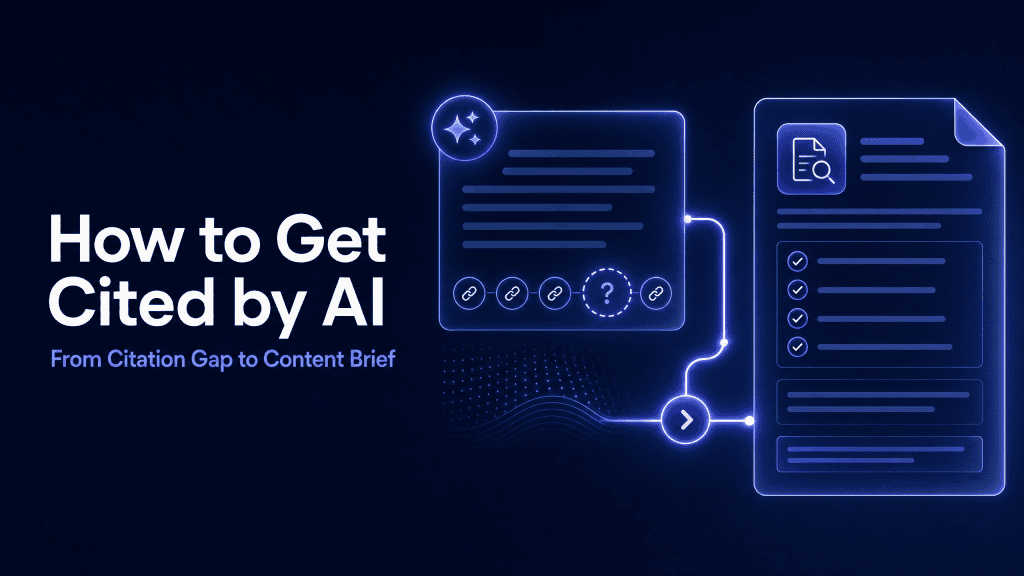
Idea: An AI citation gap becomes useful only when a team turns one observed missing source into a documented content decision, an evidence-backed brief, and a re-checkable publishing action.
Challenge: Teams often see that a competitor is cited in ChatGPT, Perplexity, or Google AI Overviews, then jump straight to rewriting a page without recording the prompt, understanding the user’s decision, or identifying the missing contribution.
Summary: This seven-step workflow moves from an observed citation gap to a responsible brief. It preserves the evidence, distinguishes content gaps from technical or entity issues, assigns an owner, and tests a defined hypothesis after publication rather than promising a citation.
Related reads:
- How to Check If ChatGPT or Perplexity Is Citing Your Site: A Step-by-Step Checklist
- The Atomic Answer Framework: How to Write Paragraphs AI Overviews Actually Lift
- The Anatomy of a Perplexity Citation: How to Structure Content for Answer Engines
Bottom line: You do not fix an AI citation gap by adding a few generic “AI-friendly” phrases to a page. Start with a repeatable observation, determine what the cited answer is actually helping the user decide, identify the missing information or trust signal, and write a brief with a specific evidence requirement and re-check rule.
What is an AI citation gap?
An AI citation gap is the difference between the sources that appear in an AI-generated answer for a relevant audience question and the source you expected or needed to appear. The gap might be that your domain is absent, a competitor is cited instead, your brand is mentioned without a source link, or the answer describes your product or expertise inaccurately.
A gap is not a verdict on one page. AI responses can change with the wording of a prompt, platform, location, date, available sources, and whether the system is using live web retrieval. Treat the observation as a hypothesis to investigate, not proof that one ranking factor is missing.
| Observed outcome | What it may mean | First question to ask |
| Your domain is absent | The user question may be unanswered, unclear, inaccessible, or not yet associated with your expertise. | Do we have an authoritative page that directly serves this decision? |
| A competitor is cited | The competitor’s source may provide a clearer answer, stronger evidence, a better-known entity, or a different content type. | What useful information does the cited source provide that our audience still needs? |
| Your brand is mentioned but not cited | The brand may be recognized, but the answer does not treat an owned page as a supporting source. | Which sourceable page could substantiate this mention? |
| Your brand is described inaccurately | Product facts, entity information, or public explanations may be incomplete or inconsistent. | Where is the clearest source of truth, and is it crawlable and current? |
Why a citation gap should become a content brief.
Bottom line: A citation observation becomes productive when it produces an accountable next action. A content brief is the bridge between a vague “we are not cited” complaint and a page that a writer, editor, subject-matter expert, or product marketer can actually improve.
Google’s current guidance for generative AI features remains rooted in its core Search ranking and quality systems. It emphasizes unique, helpful, non-commodity content, crawlable pages, and clear technical foundations rather than special AI-search hacks. That means a strong brief should begin with the audience need and the evidence gap, not an attempt to force an AI model to produce a particular answer.
For the diagnostic input to this workflow, first use a documented citation check. Our guide to checking whether ChatGPT or Perplexity is citing your site explains how to collect the observation across platforms. This article begins after that check: when you need to decide what to create, improve, or defer.
The 7-step workflow: from citation gap to content brief.
Step 1: Freeze the observation before interpreting it.
Bottom line: Capture enough context that someone else can understand what you saw. A screenshot alone is not a usable input for a content brief.
Log the exact prompt, platform, date, locale if relevant, browsing or retrieval context when visible, the answer summary, all displayed sources, the presence or absence of your brand, and the immediate business reason the prompt matters. If the response is personalized, unstable, unavailable, or unsafe to reproduce, flag it rather than treating it as a clean data point.
| Required log field | Example | Why it matters |
| Audience prompt | “How should an agency create a content brief for AI search?” | Preserves the actual user job, not a generic keyword label. |
| Platform and context | Perplexity, August 2026, standard web answer | Prevents false comparisons across different AI platforms or sessions. |
| Observed sources | Three cited domains; no owned domain | Creates the source set to inspect without copying. |
| Business relevance | High-intent agency workflow question | Stops a team from prioritizing interesting but low-value gaps. |
Record the platform and retrieval context
Bottom line: AI systems do not cite sources in the same way, so a citation gap has meaning only in its platform context. An AI engine may choose to cite a source, name a brand without a link, or provide an answer with no visible citation source at all.
Record the AI platform and mode that produced the answer: for example, ChatGPT, a Google AI Overview, Perplexity, or another AI tool. Note whether the answer used live web retrieval when that is visible, because AI models can respond differently when they rely on current web sources. Do not convert a single response into a rule about all AI search engines, all AI platforms, or all AI systems.
This context also helps a team avoid misleading language in its brief. A writer can aim to make content clear enough for a reader and a search engine to understand; they cannot make an AI platform cite content on demand. The useful question is whether the page gives a relevant AI-powered search experience a more accurate, sourceable answer to the audience’s decision.
Step 2: Classify the gap before choosing a remedy.
Bottom line: Do not assume every missing citation needs a new blog post. The same observation can point to a content gap, product-information gap, technical issue, entity inconsistency, or a low-priority question.
Assign one primary gap type. You can note secondary factors, but one primary classification keeps the work focused. A page that already answers the question but is inaccessible needs a different owner than a page that lacks evidence. A brand that is mentioned inaccurately may need documentation or product marketing work before editorial content.
| Primary gap type | Signal | Likely owner | Possible response |
| Question gap | No owned page answers the user’s specific decision. | Content strategist | Create a new focused guide, template, comparison, or FAQ. |
| Evidence gap | Existing content makes a claim without a source, example, method, or usable detail. | Writer plus subject-matter expert | Add primary sources, examples, data, constraints, and a review trail. |
| Entity or product-information gap | The answer misstates what a brand, product, feature, or expert is. | Product marketing or documentation owner | Correct and consolidate source-of-truth pages, facts, and named entities. |
| Technical accessibility gap | The right page exists but is not indexable, crawlable, or clearly rendered. | Technical SEO or engineering | Investigate indexing, robots rules, rendering, canonicalization, and page experience. |
| Authority-distribution gap | The page is useful but lacks credible independent context or audience reach. | Content marketing, PR, or community owner | Earn relevant, genuine editorial references; do not pursue inauthentic mentions. |
Step 3: Identify the user decision behind the prompt.
Bottom line: The best brief answers the decision behind the query, not merely its wording. Ask what the user is trying to decide, compare, fix, or verify at this point in the journey.
For example, “how to get cited by AI” can hide several distinct jobs: learning what a citation is, checking whether a site is already cited, improving a particular article, choosing a monitoring approach, or explaining results to a client.
The citation source may satisfy one of these jobs while your existing content serves another. This distinction is how a team avoids creating a near-duplicate page.
Step 4: Inspect cited sources for information patterns, not copy targets.
Bottom line: Study what a cited source contributes to the answer, then create an original response to the unmet decision. Do not turn competitor headings into your brief.
For each displayed source, record the source type, apparent audience, answer format, evidence used, entities explained, and any limitation it acknowledges. Look for consensus across several sources. If every cited page defines the same concept but none gives a usable workflow, a checklist, a template, or an evidence standard, that missing contribution may be your opportunity.
Google advises creators to make content that is useful, reliable, and non-commodity, and specifically warns against producing pages only to cover every possible query variation.
A content brief should therefore identify an original contribution such as an explicit decision rule, sourced example, reusable worksheet, subject-matter-expert perspective, or transparent limitation not a paraphrase of the source set.
Check technical availability and outcome data separately
Bottom line: Content quality, technical availability, and business outcomes are different diagnostic layers. A page may be useful yet unavailable to an AI crawler, or it may be visible in a traditional search engine without producing attributable AI traffic.
Before asking a writer to optimize a page, confirm that it can be discovered and rendered appropriately. Review crawl and indexing signals, canonicalization, robots controls, and the relevant Google Search Console evidence.
Organic search performance and search volume can help prioritize the question, but they do not prove that an AI model will cite your content or that an AI overview appears for every related query.
Keep outcome reporting equally precise. AI referral traffic, traffic from AI platforms, and other AI performance signals can be useful context, but a missing click does not prove that no AI answer mentioned the brand.
Conversely, a citation does not by itself establish conversion value. Record these outcomes beside the observation rather than merging them into a single unsupported AI visibility score.
Step 5: Write a diagnosis statement that a team can test.
Bottom line: A usable diagnosis names the audience, prompt, missing contribution, page action, and evidence standard in one short statement.
Use this pattern: For [audience] asking [prompt or job], our current content does not provide [missing question, evidence, entity clarity, or accessible source]. We will [create, refresh, consolidate, or fix] [asset] with [specific proof or source standard], then re-check [defined prompt cluster] after [reasonable review window].
A diagnosis is not “add more AI keywords.” It describes a concrete reason that an audience may find the current information incomplete. The page action may still be to defer work if the question is low-value or the team lacks credible evidence.
Step 6: Choose the smallest credible page action.
Bottom line: Create a new page only when the user decision and contribution are genuinely distinct. Otherwise refresh, consolidate, fix documentation, or route the work to a technical owner.
| If you observe… | Choose this action when… | Avoid… |
| A missing question with no relevant owned asset | The user job is material and the team can add original evidence or a useful workflow. | A thin page that repeats a broad GEO definition. |
| A weak but relevant existing page | The intent, URL, and internal-link position are already correct. | Publishing a second page for the same user decision. |
| Inaccurate product or company information | The answer depends on facts that should live in documentation or a commercial page. | Using a blog post to patch a source-of-truth problem. |
| A technical availability issue | The content exists but cannot be reliably discovered or served. | Rewriting content before diagnosing the technical cause. |
| A low-value or noisy observation | The sample is unstable, the prompt has little business relevance, or the gap cannot be credibly addressed. | Creating work simply because a competitor appeared once. |
Step 7: Build the brief, assign the work, and re-check the hypothesis.
Bottom line: A citation-oriented brief should contain an evidence requirement and a re-check rule, not a promise that a page will be cited. Publish the best helpful page you can justify, then assess the same defined question again.
Google’s guidance on generative-AI-assisted content similarly emphasizes accuracy, quality, relevance, and care with metadata, structured data, and image alt text. These are quality controls, not special levers that guarantee inclusion in an AI answer.
Copy-ready AI citation content brief template.
Bottom line: Keep the brief short enough to assign, but detailed enough to preserve the original observation and prevent a writer from guessing at the goal.
| Brief field | What to record |
| Audience and decision | The reader, the job they need to complete, and why it matters commercially or editorially. |
| Observed citation gap | Prompt, platform, date, answer summary, source set, and whether the gap is absence, inaccuracy, or weak context. |
| Primary gap type | Question, evidence, entity/product information, technical accessibility, authority/distribution, or defer. |
| Existing-asset decision | Refresh, consolidate, create new, update documentation, technical fix, or no action. |
| Original contribution | A template, expert explanation, first-party example, decision tree, verified source set, or documented limitation. |
| Evidence standard | Named primary sources, internally verified product facts, subject-matter-expert review, and any exclusions. |
| Structure and internal links | Direct answer, distinct H2 sections, relevant existing guides, feature or documentation destination, and a clear next action. |
| Owner and review date | Named writer, reviewer, publisher, and a sensible re-check date for the same prompt cluster. |
Brief acceptance criteria for citation readiness.
Bottom line: A content brief is ready when it describes a useful contribution a reader can verify, not when it contains a long list of AI SEO phrases. The question is not whether a writer can make a page get cited by ChatGPT on demand; it is whether the finished asset improves the answer, evidence, and source trail for a real audience decision.
| Acceptance criterion | What the editor checks | Why it supports the workflow |
| Clear answer | The opening answers the user’s question in plain language, including the difference between a mention and a citation where relevant. | Makes the content easier to assess as a potential source for AI answers without treating passage style as a guarantee. |
| Traceable evidence | Important claims cite sources, explain limitations, and distinguish observed AI responses from general rules. | Creates a citation source that a reader can inspect and an editor can defend. |
| Right content type | The asset fits the decision: a comparison, checklist, product explanation, workflow, troubleshooting page, or original research—not a generic rewrite. | Prevents thin comparison content and helps a team decide whether content restructuring is needed instead of a new page. |
| Current and accessible information | Named entities, product facts, links, technical availability, and dates have been checked before publication. | Improves the quality of the source without making unsupported claims about how major AI platforms or AI agents weight pages. |
| Measured follow-up | The brief names the prompt cluster, review date, and the observation that will count as a directional change. | Shows whether visibility in AI, AI overview citations, or AI search traffic changes over time without collapsing all outcomes into one score. |
Use this checklist when a team wants to get your content cited, earn AI references, or improve search visibility across ChatGPT and Google AI Overviews. It keeps the work grounded in reader value and makes the resulting brief useful even when an AI overview does not appear or a cited source changes between search results.
Worked example: turning a missing source into an actionable brief.
Bottom line: The goal of an example is to show the decision path, not to pretend that one content change guarantees visibility.
Imagine a content team runs a buyer-style prompt about selecting an SEO content-optimization workflow for an agency. The answer cites several generic list articles. The team’s domain does not appear, even though it has separate pages about content planning, content optimization, and team management.
| Brief element | Example decision |
| Observed gap | The answer names generic tools but no source that explains the agency workflow from research through approval and refresh. |
| Diagnosis | The site has feature pages but no practical, role-based guide that helps an agency compare workflow stages and assign owners. |
| Page action | Create a new agency workflow guide only after checking that an existing guide cannot be refreshed to serve the same job. |
| Original contribution | A role matrix, approval gates, a content-brief example, and documented limits for when automation should not be used. |
| Evidence standard | Verified feature documentation, an editorial review by a practitioner, and no invented client results or causal claims. |
| Re-check rule | After publication and routine indexing, revisit the same high-intent prompt sample and report the result as directional evidence. |
The outcome may be a more useful source page, a stronger internal-link path, and a clearer product explanation even if the original AI answer does not immediately change. That is why the workflow measures quality of the action as well as the citation observation.
What not to put in an AI citation brief.
Bottom line: Remove any request that asks a writer to manipulate an AI system rather than help a reader. It is safer and more durable to specify the answer, evidence, and user decision.
- Do not write “make the page rank in ChatGPT” or “guarantee a Google AI Overview citation.” No credible brief can promise that outcome.
- Do not treat an exact keyword count, a special AI text file, or excessive schema as a citation guarantee. Google says it does not need special AI-specific files or markup for its generative AI features.
- Do not copy a cited competitor’s headings, claims, tables, or examples. Record the information pattern, then contribute something original and sourced.
- Do not create another definition page when an existing guide can be refreshed and linked better. This creates duplicate content and makes the site harder to navigate.
- Do not send a writer into a product or technical issue without a source-of-truth owner. A blog article is not the remedy for inaccurate documentation or blocked crawling.
How NEURONwriter fits the citation-gap workflow.
Bottom line: The workflow works best when diagnosis, briefing, writing, optimization, and monitoring are connected rather than handled as unrelated tasks in separate documents.
Use AI Visibility to observe brand presence, citations, competitors, and opportunities across a documented set of discussions. Use query analysis and competitor research to understand the search and information landscape without copying it.
Use content planning to assign the resulting brief, Content Writer to structure and optimize the draft, and team-management practices to preserve review responsibility. After publication, return to the defined prompt set and log what changed.
This is a workflow for learning, not a shortcut. It helps a team move from “a competitor was cited” to “we understand the reader’s missing decision, we have assigned an evidence-led page action, and we know how we will evaluate it.”
Frequently asked questions about getting cited by AI.
What is the difference between an AI mention and an AI citation?
An AI mention means the answer names a brand, product, or person. An AI citation usually means the response visibly links to, identifies, or uses a specific source. Record them separately because a mention can be accurate but unsupported, while a citation can point to a page without recommending the brand.
Does ranking well in traditional search guarantee an AI citation?
No. Traditional SEO remains important for discovery and Google’s generative features are rooted in core Search systems, but one ranking position does not guarantee an appearance in every AI answer or platform. Evaluate the actual prompt and source set rather than assuming the relationship is automatic.
How do I check whether my site is cited by ChatGPT or Perplexity?
Start with a documented buyer-intent prompt, then inspect the displayed answer and source list across relevant platforms. Use the linked NEURONwriter citation checklist to record the exact prompt, context, source list, and variations before you interpret the result.
What should I do if a competitor is cited instead of my site?
Inspect what the source contributes to the user decision: a direct answer, evidence, an entity explanation, a comparison, a technical detail, or a clear format. Turn the missing contribution into a brief for an original page action rather than copying the competitor’s wording or structure.
Should I create a new page for every AI citation gap?
No. First determine whether an existing page can be improved, whether the issue belongs in product documentation, whether a technical owner must act, or whether the prompt is too low-value to prioritize. Create a new page only when the user decision and original contribution are distinct.
Does schema markup make content get cited by AI?
Structured data can remain useful as part of a broader SEO strategy, but it is not a special citation guarantee. Google says there is no special schema markup required for its generative AI features. Focus first on accurate, helpful, accessible information.
How quickly can a content change affect AI citations?
There is no reliable universal timeline. Changes depend on crawling, indexing, platform behavior, the prompt, source availability, and the strength of the new information. Set a documented re-check date and report directional observations rather than promising a result.
Do AI crawlers and technical SEO matter for citations?
They can matter because a page that cannot be crawled, indexed, or rendered reliably is a poor candidate for discovery. Review technical accessibility as a separate gap type, then address it with the appropriate technical owner instead of asking a writer to compensate with more copy.
Can AI-generated content be part of a citation strategy?
AI tools can help research and structure a draft, but the published work must remain accurate, relevant, and useful to readers. Google cautions that using generative AI to make many pages without added user value may violate its scaled-content-abuse policy. Add verified sources, original contribution, and human editorial review.