AI Search Attribution: A Conservative Model from Citation to Qualified Pipeline
Semantic Summary
Idea
An AI citation can be a useful discovery signal, but it becomes business evidence only when a team connects it to a documented journey and states what remains unknown.
Challenge
Teams often combine citations, mentions, referral visits, form fills and revenue in one dashboard, then treat a timing pattern as proof that AI search created pipeline.
Summary
Use a chain of evidence that keeps observation, association and causal proof separate. It will not make every AI interaction trackable, but it will make reporting more useful and more credible.
Related Reads
- AI Visibility Measurement Framework for Content Teams
- AI Citation Tracking: How to Build Source Maps for AI Answers
- AI Visibility Data Governance: How to Store, Audit and Defend AI-Answer Evidence
AI search attribution should be a disciplined evidence chain, not a promise that a citation created pipeline. Start with what you directly observed: an answer, a visible source, a visit or a self-reported discovery. Then connect that evidence to a defined business stage, record the alternative explanations, and use language that matches the strength of the record.
This matters because a person can read an AI answer, remember a brand and arrive later through a different channel. Another person can click a visible source and leave without becoming a prospect. Both journeys are meaningful, but neither permits the same conclusion. The useful question is not, “Can we prove every citation caused revenue?” It is, “What can this evidence reasonably help us decide next?”
A citation is not a pipeline event
A citation is a visible source signal inside a particular AI answer; pipeline is a business record created later in a sales process. They sit at different points in the journey. Treating them as one metric hides the evidence that connects them and the uncertainty between them.
Use clear definitions before reviewing results. A citation is a source link or attribution visibly shown with an answer. A mention is the name of a brand or product in the answer without a source link. A referral visit is a measurable click that reaches the site. A qualified-pipeline event is a lead or account that meets the organization’s agreed sales criteria and is recorded in its customer relationship system.
| Signal | What it can establish | What it cannot establish alone |
| Visible citation | An AI answer displayed an owned or third-party source for one documented prompt and context. | That the source was recommended, clicked, or commercially valuable. |
| Brand mention | The answer named the brand in the recorded answer. | That the description was accurate, positive, source-backed, or seen by a buyer. |
| Identifiable referral visit | A visitor reached the site with an available referring source or tagged campaign context. | That an earlier citation was the sole reason for the visit or that the visitor was qualified. |
| Engaged visit or form completion | A visitor took a defined on-site action. | That the action was caused by an AI answer rather than another touchpoint. |
| Qualified pipeline record | A lead or account met the team’s documented qualification rule. | That AI search deserves all or even most of the credit for the opportunity. |
Google Analytics describes attribution as assigning credit to ads, clicks and other factors on the path to an important action. Its reporting models can distribute fractional credit across contributing interactions, which is useful for analysis but should not be mistaken for a direct observation of every influence on a buyer. The model in this article uses the same caution: the closer a signal is to the commercial outcome, the more context it needs.
Build a chain of evidence, not a single score
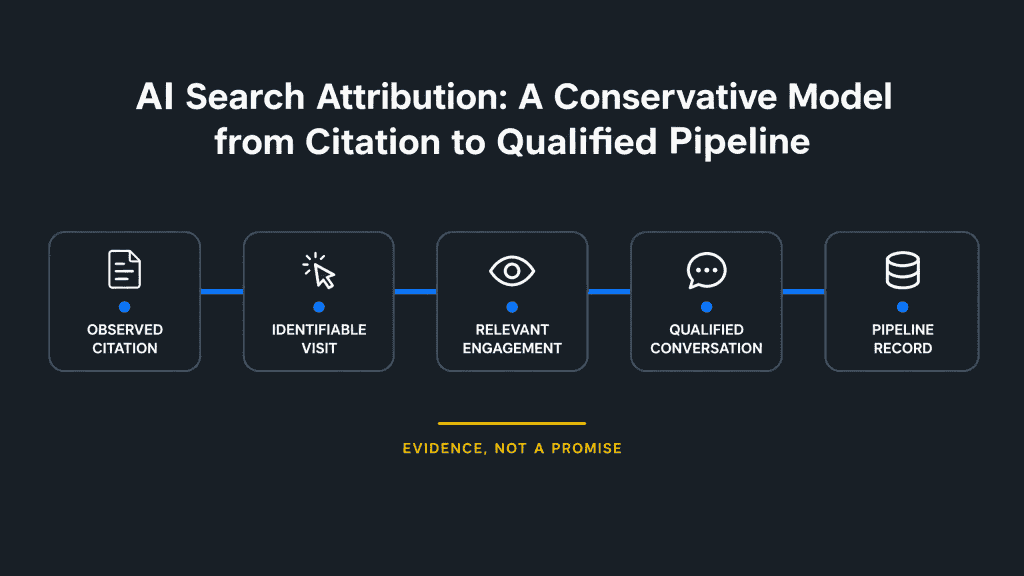
A conservative AI search attribution model follows one possible journey from an observed answer to a qualified business record, while leaving every unobserved step visible. The purpose is not to make the chain look complete. It is to show where evidence ends and where a reasonable hypothesis begins.
1. Capture the AI-answer observation
Record the exact prompt, platform, date, language, market, visible answer, cited sources and brand context. A screenshot can support the record, but it should not replace the prompt or source list. When the answer changes later, the team needs to know what was actually checked before it interprets the change.
Classify the observation in plain language. For example: “An owned guide was visibly cited inline for a comparison question,” or “The brand was mentioned without an owned source for an implementation question.” Do not begin with “AI created demand” or “the model preferred us.” Those are explanations that the observation does not yet prove.
2. Verify the source and the landing-page path
If a visible citation points to an owned page, open the page. Confirm that it is live, current, accessible and genuinely answers the relevant question. Then inspect the available analytics context for identifiable referral visits, landing-page behavior and any campaign or source information.
Current channel rules can help, but they are not a complete map of buyer discovery. Google Analytics defines an AI Assistant channel for matching identifiable referrers, while Google AI Overviews and AI Mode traffic is included in Organic Search.
It also retains Direct and Unassigned categories for traffic that does not meet another rule. That is a reason to document the channel definition used in a report, not a reason to relabel every direct visit as AI influence.
3. Record meaningful engagement without inflating it
A visit matters more when it performs an action related to the page’s job. The action could be reading a methodology section, using a product resource, returning to a pricing page, starting a trial or submitting a high-intent form. Choose one primary engagement signal in advance and keep it tied to the reader’s task.
Do not turn time on page, a scroll, or a generic form fill into pipeline evidence. They are useful context. They can support a hypothesis that the page helped a relevant visitor, but the commercial interpretation belongs later in the chain.
4. Confirm the qualification rule separately
“Qualified” must have an agreed definition before the team looks at AI-search data. In one organization it may mean a sales-accepted lead. In another it may mean a named account with a verified need, market fit and next meeting.
The exact rule can differ, but it must be controlled by the business process rather than changed to make a channel look successful.
Attach the qualification date, account or lead identifier permitted by internal policy, current status and the evidence source. If the sales conversation includes a self-reported discovery answer such as “I first heard about you through an AI answer,” record it as first-party context. It is stronger than a guess based only on channel timing, but it remains self-report rather than a complete journey log.
5. Review the pattern across a defined sample
One citation and one opportunity may be an interesting case. They are not a channel conclusion. Review a stable prompt cluster, a clear observation period and a defined group of pages.
Look for repeated relationships: citations to useful pages, identifiable referrals to the same pages, qualified conversations that reference the same buyer problem, or a lack of any downstream evidence despite growing citation activity.
The goal is directional learning. If the pattern repeats, it may justify a larger content, product-information or distribution action. If it does not, keep the useful content but do not report a return that the evidence cannot support.
Start with a decision question, not a revenue claim
The best AI search attribution question is small enough to answer with the evidence a team can actually collect. “How much pipeline did AI create?” is usually too broad for a first review. It contains many different journeys, sources and assumptions.
Use a decision question instead. A content leader might ask: “Do high-intent implementation prompts cite a page that gives readers a useful next step?” A demand-generation lead might ask: “Do identifiable AI-referred visitors to this guide reach a qualified conversation at a rate worth monitoring?” A product marketer might ask: “Are AI answers describing the feature accurately before prospects arrive?”
| Avoid this claim | Use this review question | Possible next action |
| “Our citations generated pipeline.” | “What evidence connects the cited prompt cluster to qualified conversations, and what is still missing?” | Preserve the record and add a re-check rule. |
| “AI traffic is converting.” | “Which identifiable AI-referred landing pages produce relevant engagement or qualification signals?” | Review page fit, forms and sales follow-up. |
| “Direct traffic came from AI.” | “Did direct traffic change alongside other discovery signals, and do self-reported answers support the hypothesis?” | Label the result as a possible association, not a fact. |
| “A citation proves authority.” | “What question did the citation appear to support, and is the page accurate and useful for that reader?” | Refresh the source or build a source map. |
Use an evidence register that keeps facts and interpretation apart
An evidence register lets several teams inspect the same journey without turning an anecdote into a dashboard claim. Keep observation, interpretation and decision in separate fields. That one design choice makes reporting easier to review and correct.
| Field | What to record | Why it matters |
| Business question | The decision the team is trying to support. | Prevents collection for its own sake. |
| Prompt observation | Exact prompt, platform conditions, date, answer summary and visible sources. | Preserves the AI-search evidence. |
| Source and page record | Cited URL, source type, landing page and factual review. | Shows whether the page is a credible destination. |
| Downstream signal | Referral context, relevant engagement, form data or self-reported discovery. | Separates measurable behavior from the citation. |
| Qualification record | Agreed status, date, owner and permitted business context. | Keeps qualification consistent across channels. |
| Confidence and limitation | What was observed, what is inferred and what could also explain the result. | Stops a directional signal becoming false certainty. |
| Next action | Named owner, evidence needed and re-check date. | Turns measurement into a useful decision. |
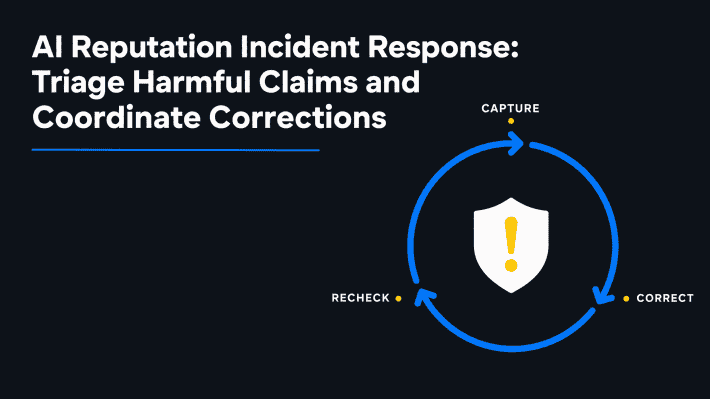
The AI Visibility Data Governance workflow is a useful companion for this record because it focuses on preserving prompt context, sources, confidence and a change log. When the question is why an AI answer showed a particular source, use an AI Citation Source Map before proposing a content change.
Apply a conservative conclusion ladder
Use the strongest statement the evidence supports, and no stronger. A conclusion ladder gives leaders a clear vocabulary for describing progress without pretending that every touchpoint is deterministic.
| Level | Safe reporting language | Evidence needed |
| Directly observed | “The documented answer visibly cited this page.” | Prompt record, answer context and visible source. |
| Observed downstream behavior | “An identifiable referral reached the cited landing page and completed the defined action.” | Referral or campaign context plus event record. |
| Supported association | “The prompt cluster, page activity and qualified conversations moved together in the stated period.” | Repeated sample, stable definitions and alternative explanations noted. |
| Plausible contribution | “The evidence supports continued investment and a re-check; it does not isolate AI as the cause.” | Several aligned signals, plus qualitative context such as self-report. |
| Not established | “The current record does not show that AI search created this pipeline.” | Use whenever the link is inferred only from timing, a single screenshot or one channel label. |
A conservative conclusion is not a weak conclusion. It tells a decision-maker what has been learned, what still needs testing and whether the next action is justified. This is more useful than a large attribution score whose formula mixes unlike signals.
Worked example: one citation becomes a reviewable hypothesis
Imagine that a team sees an owned implementation guide cited for several buyer questions in a defined monthly prompt sample. The page receives some identifiable referral visits. A few visitors move from the guide to pricing, and one later becomes a sales-accepted lead. The timing is encouraging, but it does not prove that the citation created the opportunity.
The right record starts with the source observations. The team saves the prompts, visible citations and dates. It verifies that the guide contains the answer the AI result seems to use.
It then records the referral context and relevant page actions without assigning a revenue value. Finally, it checks the lead record against the pre-agreed qualification rule and captures any permitted self-reported discovery context.
The resulting statement might be: “During the recorded period, the implementation guide appeared as a visible source for three defined prompts. Identifiable referral traffic reached the guide, and one later sales-accepted lead had a related landing-page path.
This is a directional association; other discovery routes and touchpoints may also explain the outcome. Keep the guide current, improve its next step for the documented reader question, and repeat the prompt sample next month.”
That is an actionable conclusion. It does not overpromise. If later reviews show the same source, audience path and qualification pattern, the team can raise confidence or run a tightly scoped content experiment. If they do not, the team still has a better source page and a clear record of what it learned.
Run a small monthly review before scaling the programme
A monthly review is usually long enough to complete actions and short enough to retain the source context. Begin with a small number of high-value prompts and a limited set of buyer pages. More volume does not create more truth if the team cannot inspect the records.
First, use the AI Visibility Measurement Framework for Content Teams to define prompt clusters, coverage and answer-quality rules. Second, log material citations and source context. Third, review identifiable referral, engagement and qualification records against the same time window. Fourth, list confounding factors such as a launch, a campaign, a pricing change, a new review or a site migration. Finally, select one contained action and a re-check date.
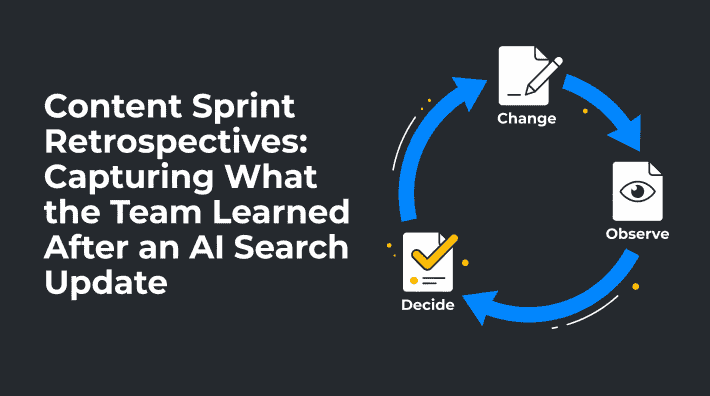
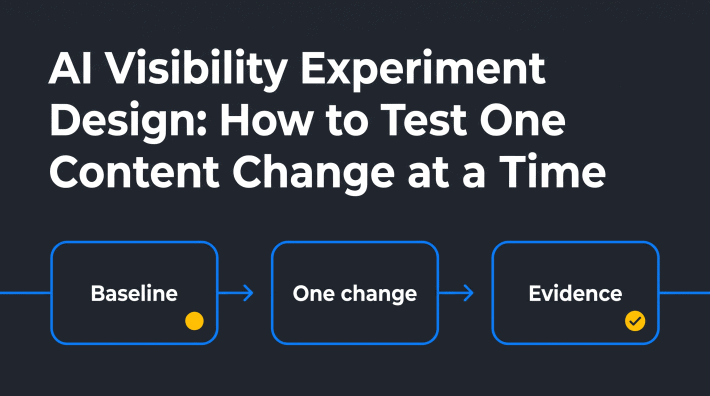
When a page needs a change, the AI Visibility Experiment Design guide helps a team change one meaningful element at a time. This does not turn a live page into a controlled trial, but it makes the next observation easier to interpret. For leadership or client review, use the AI Visibility Report Template to separate the working evidence log from the decision-ready summary.
Common AI search attribution mistakes
Counting every mention as a business outcome
A mention may be useful visibility, but it is not automatically accurate, trusted or commercially relevant. Record whether it is a mention, recommendation or visible source. Then check the answer’s context before including it in a business report.
Using direct traffic as a substitute for evidence
Direct traffic can be a useful signal to investigate, not a label for unobserved AI influence. Treat it alongside self-reported discovery, branded search, identifiable referrals and the wider campaign calendar. A report should state the limitation rather than fill the missing source with a convenient explanation.
Changing the qualification rule after results appear
A qualification definition that changes to fit a channel makes comparison impossible. Keep the existing sales or revenue-operations rule. If it is inadequate, revise it for all channels and document the effective date.
Creating a new page for every citation gap
A missing citation can point to a content gap, a product-information issue, a technical blocker or a question that does not matter enough to pursue. Inspect the source, the user decision and the best existing canonical page before creating another URL.
Letting the dashboard choose the conclusion
A composite score can help organize a queue, but it cannot replace raw observations and business definitions. Keep the prompt denominator, platform context, source list and conclusion ladder beside the summary. This creates a measurement practice that can withstand an honest review.
How NEURONwriter supports a conservative attribution workflow
NEURONwriter can help a team collect and organize the visibility evidence that begins an attribution review, but it does not turn a citation into revenue proof.
Use AI Visibility to monitor a documented prompt set and spot changes in brand presence, sources and opportunities. Use query analysis and content planning to investigate the user question behind a gap, then strengthen the smallest credible owned asset.
The business layer remains a human responsibility. Content, product, sales and revenue-operations owners must define qualification, approve source facts, interpret the context and decide which action is proportionate. This division keeps AI visibility useful without asking an editorial tool to make a commercial claim it cannot verify.
Google’s people-first guidance gives the same practical boundary: useful content should provide original value, clear evidence and a satisfying answer for the reader, rather than exist mainly to attract search traffic. The best attribution model supports that work by showing what to improve next, even when a direct return cannot be proven.
FAQ
What is AI search attribution?
AI search attribution is the practice of connecting documented AI-answer observations, such as a visible citation or brand mention, to later website and business signals. A responsible model keeps citations, visits, engagement, qualification and pipeline as separate stages rather than treating them as one metric.
What is the difference between an AI citation and a referral visit?
An AI citation is a source visibly shown with an answer. A referral visit is a measurable click that reaches a website with an identifiable referring context. A citation may create an opportunity for a visit, but it does not prove that anyone clicked.
Does an AI citation mean that a page was recommended?
No. A citation can indicate that an answer displayed a source for a claim or section. Record recommendation, mention and citation as separate labels because they describe different kinds of visibility and can lead to different actions.
Can a team prove that AI search created qualified pipeline?
Sometimes a team can build strong evidence of contribution through documented prompts, referral records, self-reported discovery and repeated patterns. In most B2B journeys, however, several touchpoints may contribute, so the safer conclusion is that AI search may have contributed rather than that it solely created pipeline.
How should a team track AI referral traffic?
Review available referral and campaign data at the landing-page level, then record the channel definition and collection period. Keep in mind that some AI-related visits may arrive through Organic Search, Direct or an unassigned category, so do not assume those labels reveal every prior discovery touchpoint.
Is direct traffic evidence of AI influence?
Not by itself. Direct traffic shows that the analytics system did not assign the visit to another defined channel. It may be worth reviewing alongside self-reported discovery, branded search, identifiable referrals and campaign timing, but it should remain a hypothesis rather than a relabelled fact.
What should count as a qualified pipeline signal?
Use the organization’s existing definition, such as a sales-accepted lead or an account meeting agreed fit and intent criteria. Document the rule before reviewing channel data, identify the owner of the status, and apply the same rule to every channel.
How often should an AI search attribution review run?
For most teams, a monthly review of a stable, high-value prompt sample is practical. Use an extra check only for a material launch, incident or major content change, and keep the prompt, platform conditions and business definitions stable enough for later comparison.
Why not use one AI attribution score?
A single score can hide meaningful differences between a citation, a mention, a click, an engaged visit and a qualified opportunity. If a summary score is useful, publish its formula and retain the underlying prompt, source and business records so a reviewer can inspect what it means.