The 2027 Content Operations Roadmap: People, Permissions and Semantic Governance
Semantic Summary
Idea
A content operations roadmap turns annual content ambition into visible decisions about who owns the work, who may approve it, and how every page continues to mean the right thing.
Challenge
Many teams have a publication calendar but no shared rule for a changed product claim, a new contributor, a blocked review, or two pages that now give readers different answers.
Summary
Build the 2027 plan around four commitments: name accountable people, separate access from approval, maintain a semantic ledger, and review the system on a fixed rhythm. The roadmap should make routine work easier without moving consequential decisions into a queue with no owner.
Related Reads
- Content Planning
- Team Management
- Project permissions for team members
- Human Review Gates for Agentic Content Operations
A useful 2027 content operations roadmap is an annual decision system, not a longer editorial calendar. It tells the content team what must be true before work moves from idea to draft, from draft to public page, and from published page to maintained content. It also gives people a clear way to stop, verify, approve, or escalate when a change affects a customer promise, a policy statement, or a topic cluster.
Content operations, often called content ops, is the practical layer behind content strategy and content marketing. Strategy decides the audience, purpose and priorities.
Content operations decides how people plan, create, manage, review, publish and maintain the work. A roadmap makes those decisions durable for the year ahead. It helps a team handle more content volume without assuming that faster content production is the same as better content.
What is content operations? A roadmap and its main components
A content operations roadmap is a time-bound plan for the people, processes, permissions, content assets and review rules that support the full content lifecycle. It should show how a content idea becomes an approved asset, how the asset reaches the right channel, and how the team decides whether to refresh, merge, re-scope or retire it later.
It is not a list of blog titles, a new software purchase, or a promise to publish at a fixed pace. Those may be useful parts of a content plan. They do not answer the operational questions that cause most friction: who can resolve a conflicting claim, who can create a new analysis, who can change a live page, and how the team knows two pages still serve different reader questions.
Content operations vs. content strategy and content management
| Layer | Primary question | Useful output |
| Content strategy | Who are we helping, and what should the content achieve? | Audience definition, goals, themes and priorities. |
| Content management | Where are content assets stored, versioned and published? | Content management system, asset library, metadata and publishing process. |
| Content operations roadmap | Who makes each decision, what evidence do they need, and when is the system reviewed? | Annual decision map, role rules, permission matrix and maintenance rhythm. |
A roadmap does not replace daily judgment. It reduces avoidable uncertainty. When an editor knows the approved source, the relevant owner and the next review date, the team can review content and protect high-quality content without reopening the same question in every content workflow.
How to build a content operations framework for 2027
Before assigning dates, decide the few rules that apply to every meaningful piece of content. A calendar shows when a page may be published. An operating map shows how the team protects reader value, business accuracy and a clear content structure throughout the year.
Begin with five decisions. First, name the reader outcomes and business questions that make a content type worth maintaining. Second, identify the person accountable for each type of decision.
Third, distinguish ordinary working access from authority to approve a consequential action. Fourth, define how shared terms, claims and page roles remain coherent. Fifth, set a review rhythm that catches problems early enough to fix them safely.
| Decision | Question to settle in Q1 | Evidence or record |
| Reader purpose | What question should each major content type answer? | Brief, audience need and defined page role. |
| Decision ownership | Who is accountable when a claim, scope or release is disputed? | Named role and backup role. |
| Permission boundary | Who may create, edit, verify, authorize or publish? | Permission matrix and access settings. |
| Semantic governance | How will approved facts, terminology and cluster roles stay aligned? | Semantic ledger with evidence owner and review trigger. |
| Operating rhythm | When does the team review work, risks and future content? | Weekly working review, monthly decision review and quarterly roadmap check. |
These decisions apply to existing content as well as new content. A mature content operation does not only decide what to create. It makes it possible to manage content that already exists, reuse a useful content asset, and retire a page that no longer has a clear job. It also helps a content strategist identify what content needs to change before a team produces more of it.
Who needs content operations? Name decision owners before assigning work
Every meaningful content action needs one accountable owner, even when many people contribute. Collaboration is valuable, but a vague committee cannot approve a factual statement or resolve a blocked content process. Name a contributor, verifier, authorizer and publishing owner where those responsibilities differ.
A small team may combine several roles in one person. The distinction still matters. A subject owner can verify that a product statement is current. An editor can decide whether it is clear for readers.
A publishing owner can authorize the public change. Treating all three as one undefined “review” step makes the content workflow slow and leaves responsibility unclear when something goes wrong.
| Role | Accountable decision | Typical contribution |
| Content lead | Priorities, content strategies and the annual roadmap. | Sets the purpose, capacity and review rhythm for the content team. |
| Editor | Reader clarity, structure, tone and editorial acceptance. | Reviews drafts, links, content types and content quality. |
| Subject owner | Accuracy of a product, policy, legal or performance claim. | Supplies current evidence and identifies conditions or exceptions. |
| Search specialist | Search demand, discoverability and internal-link context. | Connects a page to a reader question, search intent and content structure. |
| Publishing owner | Release, redirect, major live revision or removal. | Checks the final destination, timing and rollback path. |
| Analyst | Definitions for content performance and reporting. | Maintains measures that help the team iterate and improve. |
Use the role names that fit the organization. The essential rule is simpler than a formal organization chart: if a decision can change what a reader believes, a customer receives, or another team must support, the accountable owner should be visible before the work begins.
Permissions: make authority visible and proportionate
Permission is not the same as seniority, and access is not the same as approval. A person may have access to a content management system without authority to change a policy claim. A person may verify an approved fact without authority to publish it. Separating these permissions helps the team move low-risk work quickly while reserving high-impact decisions for the people who own their consequences.
This approach is consistent with risk-proportionate governance. The NIST Generative AI Profile describes governance, documentation, monitoring and human moderation as actions that should be selected for the organization’s context and risk tolerance, rather than applied equally to every use.
For a content team, that means a routine formatting update should not follow the same path as a new legal statement or a material live-page change.
| Action | Who may do the work | Who verifies or authorizes | Minimum record |
| Organize public research or create a draft | Content creators and editors working within an approved brief. | Editorial review before the draft leaves the working area. | Brief, source list and draft status. |
| Create a new analysis or manage connected project settings | People with explicitly assigned project access. | Workspace owner checks the intended scope and settings. | Task link, owner and project note. |
| Change a product, policy, price, legal or performance claim | Editor may prepare the proposed wording. | Named subject owner verifies evidence; appropriate owner authorizes use. | Exact wording, current source, decision and review date. |
| Save an internal revision | Assigned writers and editors in the designated draft space. | Editor checks scope and version history. | Revision name and change note. |
| Publish, unpublish, redirect or materially change a live page | Publishing owner or a named delegate. | Final approval from the owner of the action and any required subject owner. | Final copy, destination, approval and rollback option. |
Project permissions can support this model, but they do not define it by themselves. For example, a shared project may allow a person to create analyses or manage integrations and content synchronization, while another contributor only writes and edits within existing work. Project permission settings are useful when they reflect an agreed operating rule.
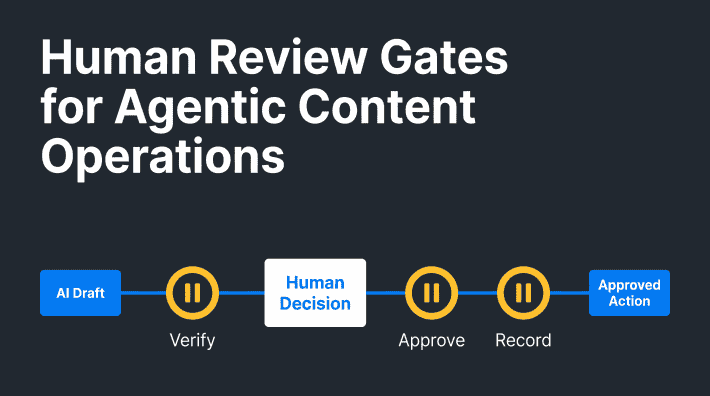
When a team uses artificial intelligence or automation, keep the same boundary. Automation can organize research, propose structure or prepare a draft. It does not own a product fact, a public promise, a release decision or an escalation. The human review-gate model offers a detailed way to record those moments without turning every task into a committee meeting.
Semantic governance: keep the site’s claims and content roles coherent
Semantic governance means keeping the meaning of important content stable across the site as products, teams and pages change. In plain language, it is how a team makes sure that a capability, audience, process or term is not described in conflicting ways on different pages.
It also protects the role of each content asset. A guide, hub, comparison, help page and product page can all discuss a related topic. They should not all answer the same reader question in the same way.
When two pages have the same purpose, the team may create duplicate content in function even if the wording differs. That makes future content harder to maintain and can confuse readers.
Google’s people-first guidance encourages content that is useful, reliable, source-backed and created to benefit an intended audience, not primarily to attract search visits. Semantic governance is one practical way to protect that standard. It asks a simple question before a page changes: will this update make the overall site easier or harder for a reader to understand correctly?
| Field | What to record | Why it matters |
| Reader question and page role | The one question the page answers and whether it is a hub, guide, help page or another role. | Prevents a page from becoming editorially orphaned or redundant. |
| Approved claim or term | The current wording for a material capability, process, audience or limitation. | Creates a stable reference for content creators and reviewers. |
| Evidence and owner | The source of truth and the person who can confirm it. | Separates remembered wording from approved facts. |
| Risk and review trigger | The consequence if wrong, plus events such as a launch, policy change or new market. | Focuses review time where an outdated claim could matter most. |
| Next action | Retain, correct, clarify, re-scope, merge, link or retire. | Turns a finding into accountable work instead of a note that disappears. |
Do not try to audit every page at once. Start with one cluster, a product area or a high-risk content type. The Semantic Debt Audit explains how to compare claims, reader questions and cluster roles in detail. The roadmap’s job is to reserve capacity, name the owners and set the re-check rhythm for that work.
Implementing a content operations roadmap in four quarters
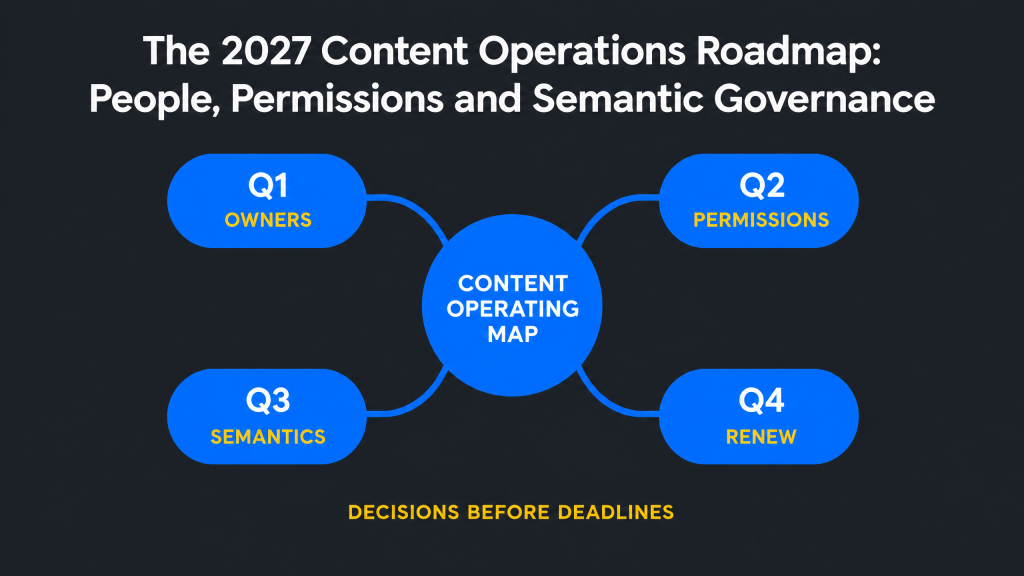
A yearly roadmap becomes usable when each quarter has a small, visible operating outcome. Do not make every team run a full transformation. Choose the next decision that removes the most uncertainty, record the result, and use the following quarter to apply it to live work.
| Quarter | Main decision | Useful output | Review signal |
| Q1: establish ownership | Which decisions need one accountable owner and backup? | Role map, top content types, initial decision-rights list and baseline of existing content. | Blocked reviews, repeated ownership questions and unclear content priorities. |
| Q2: set permissions | Which actions can proceed with working access, and which require verification or authorization? | Permission matrix, review-gate records and documented project access. | Unauthorized changes, approval by silence or high-risk work delayed by vague handoffs. |
| Q3: align semantics | Which claims, terms and topic clusters need a single source of truth? | Semantic ledger for one priority cluster, correction queue and internal-link decisions. | Conflicting claims, duplicate reader questions and content that has no clear role. |
| Q4: renew the system | What should be retained, simplified or changed for the next year? | Maintenance backlog, updated measures, capacity decision and 2028 assumptions. | Work that repeatedly escalates, content reuse rate, unresolved risks and lessons from the year. |
This sequence gives content operations a practical shape. It lets a team start with people and permissions before it asks technology to solve an unclear process. It also makes semantic governance an ongoing part of content management, rather than an emergency project after a large site has become inconsistent.
Put the roadmap into a weekly and monthly working rhythm
The annual plan works only when it changes the next week of work. Use a short weekly operating review to confirm priorities, owners, blockers, upcoming claims and content delivery. The goal is not to inspect every draft. It is to identify the work that needs an owner, evidence or a decision before it becomes late.
Use a monthly decision review for the patterns that cannot be solved in a single task. Review whether approval requests are reaching the right person, whether a recurring claim needs a stronger source of truth, whether content reuse has created a new overlap, and whether the team is measuring content performance in a way that helps it improve future content.
A planning workspace can make that rhythm visible through deadlines, assignments, milestones, statuses and projects. Content Planning and Team Management can support the mechanics of assigning work and monitoring progress. The roadmap remains the operating rule: a status should show what is happening, not substitute for the person who must decide what happens next.
How to measure content operations without chasing volume
Content performance matters, but a content operations roadmap should also show whether the system is becoming easier to run safely. Publishing more pages can hide a weak process if the team is creating conflicting claims, losing useful content assets or waiting for decisions that nobody owns.
| Measure group | Example question | What the answer can help decide |
| Delivery | Where does work wait between brief, draft, verification and publication? | Whether capacity, ownership or the content workflow needs adjustment. |
| Quality and coherence | How many high-risk claims have a current source, owner and review date? | Which clusters need semantic review before more content is created. |
| Maintenance | Which existing content is reused, refreshed, merged or retired with a documented reason? | Whether the content lifecycle is reducing waste or building semantic debt. |
Keep the measures small enough to inspect. A dashboard can summarize activity, but it cannot decide whether a content asset is still accurate, useful or distinct. Pair measures with a named decision and a review date. That keeps analytics useful to content operations rather than turning it into another report that does not change work.
Common mistakes that weaken a content operations roadmap
Using one vague “review” step for every action
A universal review label hides different kinds of work. Editorial clarity, factual verification, authorization and publication are separate decisions. Combine them only when the same person genuinely owns all of them and can document the outcome.
Giving broad access before defining boundaries
Access should follow an agreed responsibility, not solve an urgent deadline. Temporary access may be necessary, but it needs an owner, scope and end point. Otherwise a short-term workaround becomes an undocumented permission model.
Auditing meaning only after a contradiction appears
Semantic governance is cheaper when it is routine. Add a claim owner and review trigger when a page is created or materially changed. That prevents a future reviewer from reconstructing the source of truth from old conversations.
Measuring output instead of decisions
More content is not proof of a stronger operation. Review whether the team can find an asset, identify its role, confirm a claim and move a decision to the right owner. Those are the conditions that make content faster to maintain without weakening content quality.
How AI and automation support content operations with NEURONwriter
NEURONwriter can support the planning and coordination layer of a content operations roadmap, but it does not replace accountable human decisions.
Use its content plan to organize a publication calendar, projects, milestones, tasks, deadlines and statuses. Use team-management features to assign responsible people and make progress visible. Use shared-project access deliberately so that analysis creation and integration settings match the team’s documented permissions.
For content creation, use analysis and planning tools after the team has defined the reader question, evidence boundaries and page role.
For updates, use the roadmap to decide whether the right next action is a refresh, a new supporting guide, a clearer internal link, a merged page or a paused request for a subject owner. This creates a content operations strategy that respects both productive workflows and reader trust.
Finally, connect this roadmap to the broader content engine. Production, distribution, feedback and reuse are important. They work best when the team also knows who owns the decisions that keep the system accurate, coherent and sustainable.
FAQ
What is content operations, and what is a roadmap?
Content operations is the practical system for planning, creating, managing, reviewing, publishing and maintaining content. A content operations roadmap is its annual plan for people, processes, permissions and review rules; it explains who decides what, how evidence is checked and how pages are maintained after publication.
How is content operations different from content strategy?
Content strategy defines the audience, goals and priorities for content. Content operations defines how the team creates, manages, reviews, publishes and maintains content in order to carry out that strategy. The roadmap connects the operating decisions to a time-bound plan.
Who should own content operations?
A content lead often owns the overall operating model, but several people may own particular decisions. An editor may own editorial acceptance, a subject owner may verify a factual claim, and a publishing owner may authorize a live change. The important rule is that each consequential decision has one visible accountable owner.
What permissions should a content team define?
Define who may create or edit work, who may manage shared project settings, who verifies high-risk facts, and who authorizes publication or a material live-page change. Separate tool access from approval authority so that a person can help with content without being asked to accept a decision they do not own.
What is semantic governance in content?
Semantic governance is the practice of keeping important claims, terms, reader questions and page roles coherent across a site. It uses an approved source, named owner and review trigger to prevent two pages from giving readers incompatible answers about the same topic.
How often should a content operations roadmap be reviewed?
Review working priorities weekly, recurring decision patterns monthly and the roadmap itself each quarter. Add an earlier review when a product, policy, positioning statement, market or high-risk process changes. The right timing depends on the consequence of outdated content, not on a fixed publishing count.
Do small teams need a separate content operations manager?
Not necessarily. A small team can share the responsibilities among existing roles. It should still distinguish who sets priorities, who verifies facts and who authorizes live work, because unclear ownership creates more delay than a short written operating rule.
Can artificial intelligence improve content operations?
Artificial intelligence can help organize research, prepare drafts, find patterns and support routine content management tasks. It should work inside a clear brief and permission model. Human owners remain responsible for factual claims, public releases and decisions with legal, customer or reputation consequences.
Which measures show that content operations are improving?
Look beyond content volume. Useful measures include where work waits, whether material claims have a current source and owner, whether content assets have a distinct role, and whether the team can document why a page was refreshed, merged or retired. Use the results to improve a specific process rather than to create a generic activity score.