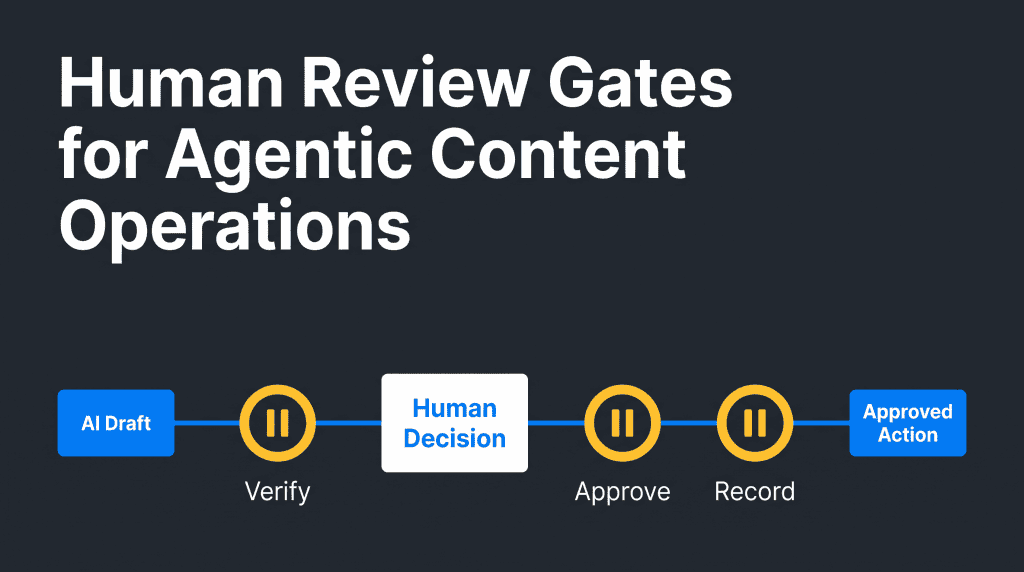
Human Review Gates for Agentic Content Operations
Semantic Summary
Idea
Give every agent-assisted content action a clear path: proceed, stop for a named person, or escalate when the evidence or consequence is unclear.
Challenge
Teams often treat a generated draft, a factual change, a saved revision, and a public publication as if they carry the same risk.
Summary
Use a small review-gate matrix to match each action to an owner, the evidence they need, the decision they can make, and a record that makes the outcome visible.
Related Reads
- Content Governance in 2026: How to Audit, Update, and Retire Pages at Scale
- Content Verification: How to Check Claims, Sources and Product Facts Before Publishing
- Content Optimization Workflow for SEO: Research, Brief, Write, Refresh, Measure
AI assistance can speed up research, planning, drafting, and routine editing. It should not make a team lose track of who is responsible when content changes a customer promise, becomes public, or affects another system. Human review gates are the decision points that keep those responsibilities clear.
A review gate is not a request for someone to reread every sentence. It is a short pause before a meaningful action. The person with the right knowledge checks the evidence, chooses an outcome, and leaves a record. That record can be a short note in a brief, editorial task, or approved change log. What matters is that the decision is visible and can be understood later.
Review gates should follow consequences, not the fact that AI was used
The right question is not “Was an agent involved?” The right question is “What changes if this action is wrong?” Reading public documentation has a different consequence from publishing an unsupported product claim or sending a public response in a brand’s name.
Start by sorting work into action classes. Low-consequence work can continue with ordinary editorial checks. Higher-consequence work stops at a named human decision point. A useful gate does not slow safe work; it directs attention to the moments where judgment, accountability, or specialist knowledge matter most.
This approach is consistent with risk-based governance. The NIST Generative AI Profile notes that different uses can require different levels of human oversight, review, tracking, documentation, and management oversight. For a content team, that means adjusting review to the action’s impact, not treating every output as equally risky.
Use a review-gate matrix before connecting agents to a content workflow
A short matrix makes boundaries usable. It tells team members what an agent may help with, when to pause, and who can release the next step. Adapt the names of the roles to your team; do not copy them as job titles if they do not fit.
| Action | Review gate | Named decision owner | Minimum evidence | Record |
| Summarize public, approved source material or organize research notes | No pre-approval; use normal source and scope checks | Content owner | Source list and task scope | Task link or research note |
| Draft a new article, outline, title, or internal brief | Editorial review before the draft leaves the working area | Editor or content lead | Approved brief, audience, sources, and scope limits | Draft status and reviewer note |
| State or revise a product, policy, price, legal, safety, or performance claim | Specialist verification and explicit approval | Product, policy, legal, or subject owner | Current approved source and exact proposed wording | Source, decision, owner, and review date |
| Save an internal content revision | Allowed only in the designated draft space; no public release | Editor or workspace owner | Scope of the change and retained version history | Revision name, author, and change note |
| Create or materially edit a CMS draft | Editorial acceptance before the draft is scheduled or handed over | Editor | Approved copy, links, metadata, and verification status | Draft URL, checklist, and owner |
| Publish, unpublish, redirect, or materially change a live high-value page | Named final approval; stop if facts, destination, or impact are uncertain | Publishing owner plus relevant subject owner | Final copy, factual checks, intended destination, and rollback plan | Approver, time, decision, and change summary |
| Send a public statement, contact a customer, spend money, or accept a contract | Always require explicit authorized human approval | Authorized communications, budget, or legal owner | Exact final payload and relevant business context | Approval reference and final sent version |
The table is deliberately based on actions, not on software features. It remains useful when a team changes writing tools, adds a connector, or introduces a new workflow. It also avoids a common mistake: assuming that an action is safe simply because it is reversible. A reversible live edit can still confuse readers, break a conversion path, or cause a product team to handle avoidable support work.
Separate verification from authorization
Verification and authorization answer different questions. A content verifier asks whether a claim is accurate, current, and supported. An approver decides whether the team is allowed to take the next action with that evidence. One person may perform both roles in a small team, but the two decisions should still be visible.
For example, an editor may verify that a statement matches an approved product note. The publishing owner then authorizes the change to a live page, considering timing, audience impact, and whether other channels need the same update. If the evidence is weak, neither person should treat the gate as a formality.
Use the Content Verification process for checking the claim itself. Use the review-gate model in this article to decide who may accept the risk of using that claim in a particular content action. Keeping these tasks separate prevents “the text looks correct” from becoming an accidental approval to publish it.
Define four practical outcomes at every gate
A gate is easier to use when the decision options are clear. The owner should not have to invent a process each time a draft raises a question.
| Outcome | When to use it | What happens next |
| Approve | The evidence is sufficient and the action stays within the agreed scope. | Release the next permitted workflow step and record the decision. |
| Request changes | The idea is sound but wording, evidence, links, scope, or context need work. | Return a specific change request; do not make the agent guess what is missing. |
| Reject | The action is outside the brief, conflicts with a known fact, or is not appropriate now. | Close the request with a short reason and, where useful, name the safe alternative. |
| Escalate | The decision crosses functions, lacks an accountable owner, or has legal, financial, customer, or reputation consequences. | Stop the action and send the exact proposed change and evidence to the appropriate authority. |
“Escalate” is especially important. It gives people a safe response when a request falls between teams. An editor should not have to decide a policy question simply because a campaign deadline is close. Likewise, an agent should not treat an unclear approval path as permission to continue.
Assign one accountable owner instead of a vague committee
Every gate needs a single person or role accountable for the decision. Several people may provide input, but unclear ownership creates delays and silent workarounds.
Choose the owner based on the type of consequence. An editor owns reader clarity and editorial quality. A product owner owns a current feature description. A policy or legal owner decides whether a sensitive statement is acceptable. A communications owner decides whether a public response speaks for the brand. A publishing owner accepts the operational step of making an approved page live.
Write these choices in the brief or operating guide. A short rule works well: “If the agent changes a product capability statement, the product owner approves the wording before publication.” This is more useful than saying “review important changes” because it tells the team who acts and what triggers the pause.
Use a backup owner and a response window
Gates fail when no one is available. Name a backup role and a reasonable response window for common requests. If the owner does not respond in time, the work should remain a draft or follow a defined escalation route. Silence should never be interpreted as approval.
Keep the evidence pack small and decision-specific
A review gate works best when the owner sees only what they need to decide. Do not send a product owner an entire 2,000-word draft if one sentence is the issue. Send the exact proposed wording, the source, where it will appear, the intended action, and the question that needs an answer.
For a live-page update, the evidence pack may include the before-and-after copy, the reason for the change, links to affected pages, and a rollback option.
For a public response, it may include the exact message, audience, context, and approved alternatives. Good evidence makes a fast decision more likely because it removes the need to reconstruct the problem from chat history.
Google’s people-first guidance asks whether content is helpful, reliable, and supported by clear sourcing and expertise.A small evidence pack supports that standard by letting the appropriate person see the basis for a high-impact claim before it reaches readers. It does not guarantee a ranking, but it helps a team preserve accuracy and trust.
Record the decision so future work does not start from zero
The record should be short enough to create every time. It needs to show what action was proposed, who decided, what evidence they used, the outcome, and when the decision should be reviewed again. Add the final approved wording when the decision concerns a claim or public message.
| Field | Example question |
| Action proposed | What would the agent or team do next? |
| Scope and impact | Which page, audience, channel, or business process could change? |
| Evidence | Which current source, brief, or approved note supports the action? |
| Decision owner | Who is accountable for approve, reject, request changes, or escalate? |
| Outcome and rationale | What was decided, and what is the shortest useful reason? |
| Review date | When should this decision be checked again if the source or context changes? |
The record is not paperwork for its own sake. It is a reusable explanation when the same question returns during a refresh, campaign, release, or new market launch. It also helps a team identify patterns. If the same claims repeatedly require escalation, the underlying source of truth or content brief may need improvement.
Build gates into the existing content workflow
Do not create a parallel process that writers forget to open. Add the review gates to the moments already present in a content optimization workflow: brief acceptance, factual verification, editorial acceptance, CMS draft creation, publication, and post-publication changes.
For example, research and early drafting may be agent-assisted within a clear brief. An editor accepts the draft’s scope and reader value. The relevant owner verifies product or policy claims. The publishing owner checks the final page, destination, and timing. A later refresh uses the same record to identify whether a past approval needs review.
This model complements, rather than replaces, broad content governance. Governance defines the overall roles and standards. Review gates make those roles usable at the point where an action could change what readers see or what the business commits to.
Use connected workflows without giving up accountability
Connected systems can reduce manual copying between research, drafting, and review. The NEURONwriter MCP overview describes how a connected content workflow can support research and draft work. A team should still decide its own action boundaries before using any connected workflow.
In practical terms, let an agent support the work inside defined limits: retrieve approved material, organize a brief, propose a draft, or prepare a change summary. Keep the final decision with the role that owns the consequence. The more public, permanent, costly, or sensitive the outcome, the clearer the human gate should be.
This is also why a content-operations stack needs more than fast output. The AI-Powered Content Operations Tool Stack guide explains the wider need for ownership, approval, and publishing controls. Review gates supply the specific decision point that prevents an automated sequence from moving beyond the team’s agreed authority.
Start with the next three actions, not a perfect policy
You can start without a long AI policy. Pick the next three agent-assisted actions your team performs. For each one, write the action, consequence, owner, evidence, outcome options, and record location. Test the rules on one real content task, then adjust unclear language.
Most teams should begin with the points closest to publication: factual claims, live-page changes, public communication, and spending or contractual commitments. These are the actions where missing ownership creates the greatest avoidable risk. Expand to lower-risk steps only after the high-impact gates are clear and used consistently.
The aim is not to make every workflow slower. It is to let safe work move quickly while giving the right person an unmistakable pause before a consequential change. That balance makes AI assistance more useful because people know where judgment still belongs.
FAQ
What is a human review gate in content operations?
A human review gate is a defined decision point before an agent-assisted action moves forward. It names the responsible person, the evidence they need, the decision options, and where the result is recorded.
Do all AI-generated drafts need human review?
Drafts should receive an editorial review before they leave the designated working area or become a CMS draft. The level of review should increase when a draft makes product, policy, legal, safety, or performance claims.
What is the difference between verification and approval?
Verification checks whether information is accurate and supported. Approval authorizes the next action, such as adding the information to a live page or publishing it. A small team may combine these roles, but should still record both decisions.
Which actions should always require explicit human approval?
Publishing or unpublishing important live pages, sending public communications, spending money, accepting contracts, and making material product, policy, legal, safety, or customer commitments should always have an explicit authorized human approval. If the accountable owner is unclear, the action should stop and escalate.
Can an agent save a draft or content revision?
A team may allow this in a designated internal draft space when version history and scope are clear. Saving a draft should never be treated as permission to publish, contact a customer, or make a live change.
Who should own a review gate?
The owner should be the person or role accountable for the action’s consequence. An editor owns editorial acceptance, a product owner owns current product claims, and an authorized publishing or communications owner accepts a public release.
What should be included in a review-gate record?
Keep the proposed action, scope, evidence, decision owner, outcome, short rationale, time, and review date. For a public message or factual claim, include the exact final wording that was approved.
How do review gates avoid slowing down a small team?
Use gates only where the consequence is meaningful. Let low-risk research and early drafting proceed inside a clear brief, then concentrate human time on claims, live changes, public communication, and other decisions that require accountability.
Is a review gate a technical security control?
No. A review gate is an operating rule for a content team. It explains who decides whether a content action may proceed; technical access controls are a separate implementation concern.