The In-House Content Escalation Model: Resolving SEO, Product and Legal Content Conflicts
Semantic Summary
Idea
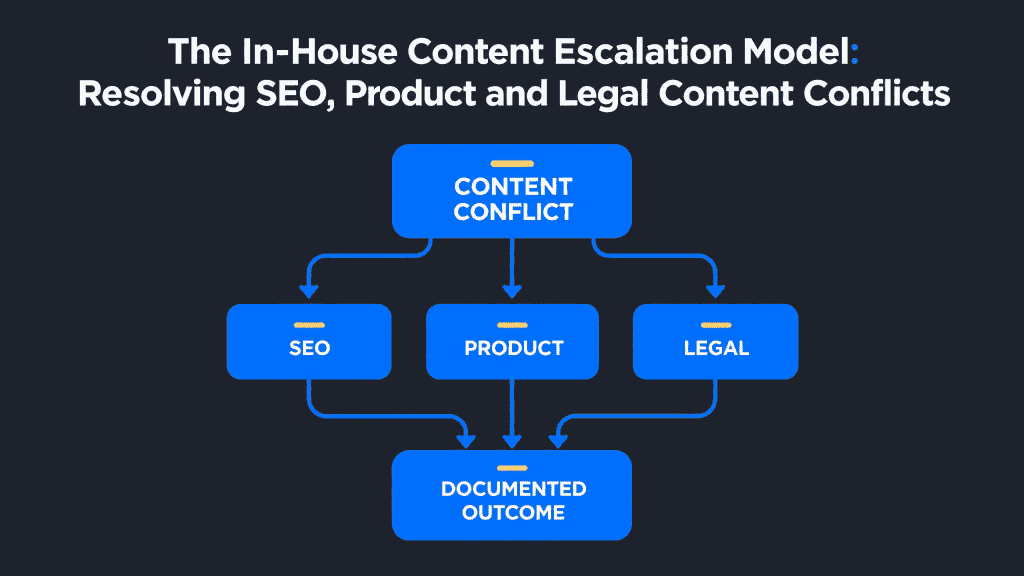
Resolve a content conflict by giving the decision to the role that owns the consequence, not to the loudest person in the meeting.
Challenge
SEO, product and legal teams can each be right about part of a page while still blocking a publishable answer for the reader.
Summary
Use a short escalation record, a named decision owner and a documented outcome to move a disputed claim or page change forward without hiding the trade-off.
Related Reads
- Content Governance in 2026: How to Audit, Update, and Retire Pages at Scale
- Human Review Gates for Agentic Content Operations
- Content Verification: How to Check Claims, Sources and Product Facts Before Publishing
An in-house content escalation model gives a disputed content decision a short, accountable route to resolution. It should identify the exact statement or page change, the evidence each team needs, the person who can decide and the record that explains the outcome. It is not a way to make every edit more formal. It is a way to stop a high-impact disagreement from becoming an invisible delay or an accidental promise.
This article is about conflicts between SEO, product and legal or compliance owners. It is not a customer-service, IT-ticket or generic approval guide. The central question is simple: when one team wants a page to say or do something that another team cannot support, who decides what happens next?
Content escalation is a decision problem, not a seniority contest
Escalate a content issue when the teams disagree about an outcome that one person cannot safely decide alone. The escalation should resolve a defined decision, such as whether to keep a claim, change a title, redirect a high-value URL or publish a comparison statement. It should not become a meeting about every opinion on the draft.
A useful distinction is between review and escalation. Review asks, “Does this draft meet the agreed standard?” Escalation asks, “Which standard controls when two legitimate standards point in different directions?” An SEO lead may need a page to preserve a search-relevant meaning.
A product owner may know that the proposed wording overstates a capability. A legal reviewer may see a regulatory or contractual risk that neither of the other roles can accept.
None of these roles should win by default. The decision should go to the owner of the consequence. If the issue is the truth of a product capability, the product owner owns that decision.
If the issue is whether a substantiated claim is legally acceptable in a named market, the legal owner owns that decision. If the issue is how an approved, accurate statement is structured for discovery without changing its meaning, the SEO owner can decide within the agreed guardrails.
Know which content conflicts need escalation
Most content edits do not need escalation; they need an ordinary editorial decision. Escalate only when the change crosses a defined decision right, creates a material reader expectation or cannot be resolved from the approved brief and source record.
| Situation | Why it needs a named decision | Likely decision owner |
| A page describes a feature, result or limitation differently from the current product source. | The wording can create a buyer expectation that product must support. | Product owner, with legal input if the claim is sensitive. |
| An approved product statement weakens a ranking page or changes its search intent. | The team must protect accuracy while choosing the best page, wording or redirect action. | SEO owner for the search implementation; product owner for factual meaning. |
| A claim is accurate in one market but needs qualification in another. | The page may create a compliance or contractual risk if the scope is unclear. | Legal or compliance owner. |
| A deadline creates pressure to publish before evidence or ownership is clear. | Speed cannot turn missing approval into approval. | Publishing owner decides to hold the change and routes the unresolved question. |
| Two live pages now make incompatible promises. | The conflict affects readers already using both pages and may require a coordinated correction. | Content lead coordinates; each owner decides within their area. |
“Material” does not mean dramatic. A small phrase can be material when it affects price, availability, security, performance, legal status or a buyer’s expectation. The Content Verification workflow is the right companion when the first question is whether the statement is true and current. An escalation starts when a verified fact still leaves a cross-functional choice unresolved.
Assign decision rights before a conflict appears
A workable model separates input from authority. Many people may need to contribute evidence, but the content record must name one role that can choose the outcome for each type of consequence. A committee can advise; it cannot be the final owner.
| Decision area | What the owner decides | What the owner does not decide alone |
| Editorial clarity | Whether the page is understandable, scoped and consistent with the approved brief. | Whether an unverified product or legal claim may be made. |
| Search implementation | Page structure, internal links, title alternatives, canonical treatment and search-intent fit for approved meaning. | Whether the product meaning may be broadened to gain traffic. |
| Product truth | Current capabilities, limits, supported use cases and the source that confirms them. | Whether a legally sensitive claim is acceptable in every jurisdiction. |
| Legal or compliance acceptance | Whether the proposed statement, qualification or omission is acceptable for the stated audience and market. | Whether the article serves the reader’s search question or earns a dedicated URL. |
| Publication release | Whether an approved page change is ready to go live, including timing and rollback readiness. | Whether unresolved evidence should be treated as approved. |
Small teams can assign more than one right to the same person. The point is not to create job titles. The point is to make the decision boundary visible. The Human Review Gates for Agentic Content Operations article explains the same principle for higher-consequence content actions: verification confirms the evidence; authorization permits the next action.
Start every escalation with a one-page record
The fastest escalation is one that gives the owner a decision-ready packet rather than a long thread of opinions. Before a meeting, the requester should prepare a short record that frames the choice. This prevents a product owner from having to infer the search issue, or a legal reviewer from reading an entire draft to find one sensitive sentence.
| Field | What to record |
| Decision requested | One sentence: what must be kept, changed, removed, redirected or published? |
| Exact proposed wording or page change | Show the before-and-after text, title, URL action or page location. |
| Reader and business consequence | Explain what readers may infer and what could change if the decision is wrong. |
| Evidence and known limits | Link the current product source, policy, research or approved record. State what the evidence does not establish. |
| Options | Offer the practical choices, including holding the change or using narrower wording. |
| Decision owner and response window | Name the accountable role, a backup role and the time by which the work needs a decision. |
| Outcome record | Capture the decision, rationale, approved wording, date and next review trigger. |
The record does not need to look like a legal form. A brief, task or change log is enough when it preserves the decision. NIST’s Generative AI Profile recommends governance practices that align AI use with legal requirements, determine risk management activities and document incidents or impacts. For content operations, a decision record is a proportionate way to apply that discipline to an AI-assisted or human-written page.
Use a four-stage path to resolve the conflict
A content escalation should move from a specific conflict to a recorded outcome in four stages. The model below is designed for an in-house team. It creates enough structure for a consequential decision without importing a customer-service tier system into editorial work.
1. Declare the conflict precisely
State the disagreement in neutral language. “SEO wants an aggressive title” is not precise enough. “The proposed title says the feature is available to all customers; the current product source says it is limited to one plan” is a usable conflict statement. It distinguishes the search goal from the product fact.
2. Separate facts, preferences and constraints
List what each party knows, wants and cannot accept. The product source may establish a capability limit. The SEO review may show that the affected page answers a valuable reader question. Legal may require a qualification or prohibit a claim in a given context. A preference, such as a preferred headline style, should not be treated as a blocking constraint.
3. Give the decision to the consequence owner
Route the decision to the role whose domain bears the consequence. The owner should choose among stated options, request a narrow revision or escalate further if their authority ends. They should not be asked to solve unrelated work such as page design, campaign timing or a new product roadmap.
4. Record the outcome and release rule
Write the final decision in plain language. Include the approved wording or page action, the owner, the evidence used and what must happen before publication. If the page is held, say what information would allow it to proceed. This closes the current issue and gives the next editor a reliable starting point.
Worked example: a useful page with an unsupported promise
Imagine a page that ranks for a valuable question but now includes a broad performance promise. The SEO lead wants to preserve the page’s relevance. The product owner confirms that the underlying capability is available only in a defined configuration. Legal says the promised outcome cannot be stated without a condition. The editor needs a publishable answer rather than three incompatible comments.
The escalation record should contain the exact live sentence, the current product source, the affected audience and a limited set of options. One option may be to replace the promise with a narrower capability statement and keep the existing URL.
Another may be to split an unsupported claim into a separate page only after the needed evidence exists. A third may be to remove the statement and add an approved explanation of the condition.
In this example, the product owner decides what the capability supports. The legal owner decides the required qualification. The SEO lead then decides how to preserve the reader question through the title, heading, internal links and page structure without changing the agreed meaning. The publishing owner releases the change only after the record contains the final wording and the appropriate approval.
This is not slower than an argument conducted across several tools. It is faster because the team stops asking one role to make another role’s decision. It also gives readers a clearer answer: what the capability does, when it applies and what they should not assume.
Keep escalation from becoming a bottleneck
Escalation becomes a bottleneck when it is vague, overused or directed to an unavailable owner. The remedy is not to remove decision rights. It is to make their triggers and handoffs small enough to use.
Start with a light path for ordinary work. Editors should resolve wording, readability and routine source questions inside an approved brief. Product and legal owners should see only the decisions that depend on product truth, policy, market scope or a meaningful promise.
Give each decision type a named backup owner and a response expectation that reflects its consequence. If no one can decide within the necessary window, the default outcome is to hold or narrow the change, not to publish by silence.
Watch for two opposite failures. Escalation avoidance happens when a writer or editor changes a risky claim because asking feels slow. Escalation overuse happens when every stylistic preference is sent to senior stakeholders. A short trigger list and an escalation record reduce both problems.
Measure the process without turning it into a vanity dashboard
A content escalation process is working when it creates clear, repeatable decisions with less rework. It does not need a large performance score. Review a small set of operational signals once the team has enough cases to learn from.
- Decision time: How long does a materially disputed change wait for a named owner?
- Return rate: How often does an approved change come back because the wording, evidence or scope was incomplete?
- Recurrence: Which facts or content areas cause the same conflict repeatedly?
- Outcome clarity: Can a new editor understand why the team chose the current wording without reopening the whole debate?
These signals help a team improve the source of truth, brief or approval rule. They do not prove that one escalation caused a traffic, conversion or revenue change. Treat them as process diagnostics, then investigate the underlying issue before changing the model.
Build the model into the existing content workflow
Escalation should be a controlled branch of the normal content workflow, not a separate bureaucracy. Add the trigger check to brief acceptance, claim verification, editorial QA and material updates to live pages. The Content Optimization Workflow for SEO: Research, Brief, Write, Refresh, Measure provides the wider lifecycle: research establishes the reader decision, the brief names evidence and owners, creation checks the draft, and publication records the next review point.
Use NEURONwriter to investigate search context, organize a structured brief and identify questions a page should answer. Do not use a content score, a term list or an AI-generated draft as permission to broaden a product or legal statement. The search evidence can show what readers ask. It cannot decide what the business can accurately and responsibly promise.
Google’s people-first guidance makes the same practical point from the reader’s side: useful content should provide original value, clear sourcing and trustworthy expertise rather than merely pursue search traffic. A documented escalation outcome helps preserve that standard when a fast answer and a defensible answer initially seem to conflict.
Make the next conflict easier than the last
Start with the next recurring disagreement, not a company-wide policy rewrite. Choose one content area where SEO, product and legal or compliance already lose time. Agree on the trigger, decision owner, backup owner, escalation record and default hold rule. Use the model for several real cases, then update the source material or brief fields that repeatedly create disputes.
The goal is not to remove healthy disagreement. Different roles see different risks, and that is useful. The goal is to turn disagreement into a clear decision that protects readers, respects expertise and lets the content team move forward.
FAQ
What is an in-house content escalation model?
An in-house content escalation model is a documented route for resolving a content decision that crosses functions. It names the issue, evidence, accountable decision owner, options and final record so that SEO, product and legal or compliance teams can resolve the conflict without guessing who has authority.
What should trigger a content escalation?
Escalate when a proposed change creates a material reader expectation, contradicts a current product or policy source, affects a high-value URL or cannot be resolved within the approved brief. Routine wording, formatting and ordinary editorial choices should stay with the editor.
Who has the final say when SEO, product and legal disagree?
The final decision belongs to the role that owns the consequence. Product owns the truth of a capability, legal or compliance owns whether a sensitive claim is acceptable, and SEO owns the search implementation of approved meaning. A publishing owner decides whether all required decisions are complete before release.
What is an escalation matrix for content?
An escalation matrix is a compact map of issue types, decision owners, evidence requirements, backup owners and response expectations. It helps a requester send the right question to the right person instead of asking a broad group to debate every draft.
What should be documented before escalating a content issue?
Document the exact decision requested, the proposed wording or page change, the affected reader and business consequence, supporting evidence, known limits and realistic options. Add the named decision owner and the deadline by which the content needs an answer.
Can an editor resolve a product or legal content conflict?
An editor can clarify the conflict, collect the record and resolve matters that fall within editorial scope. The editor should not decide an unverified product fact or waive a legal or compliance constraint. Their role is to make the decision ready for the appropriate owner.
Does every content change need legal review?
No. Legal review should focus on changes that create a sensitive claim, alter a required qualification, affect a regulated market or create a material contractual or policy implication. Teams should define these triggers in advance so normal editorial work does not wait unnecessarily.
What happens when the responsible owner does not respond?
The model should name a backup owner and a default rule. For a consequential unresolved change, the default should be to hold the change or use already approved narrower wording; silence is not approval. The content lead can then record the block and route it through the agreed management path.
How can a team prevent escalation overuse?
Keep the trigger list narrow and give editors authority for routine work. Review completed cases to find repeated questions, then improve the source of truth, content brief or approved wording so that the same issue does not return as a new escalation.
Is a content escalation model a technical permission system?
No. It is an operating model for decision rights and documented outcomes. Technical access controls may enforce parts of the workflow, but they do not replace the human judgment needed to decide whether a content claim, page change or public message should proceed.