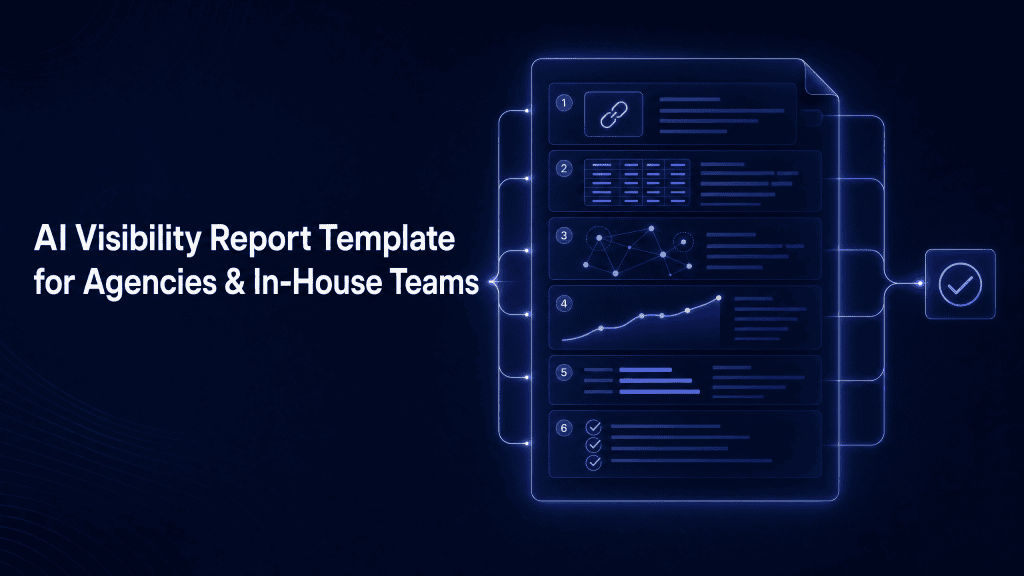
AI Visibility Report Template for Agencies and In-House Teams
Semantic Summary
Idea: An AI visibility report should turn a defined set of AI-search observations into a decision-ready record: what was checked, what appeared, what changed, what remains uncertain, and which action has an owner.
Challenge: Teams often combine mentions, citations, rankings, screenshots, and tool scores into one headline number. Without a prompt log, sampling rules, and a next-action queue, that number cannot reliably explain performance or guide work.
Summary: This template gives agencies and in-house teams six report sections, a practical field map, audience-specific readouts, and an evidence standard that separates observed AI visibility from unsupported business claims.
Related reads: How to Check If ChatGPT or Perplexity Is Citing Your Site; How to Get Cited by AI: From Citation Gap to Content Brief; and Understanding GEO Audits: The 2026 GEO Audit Checklist.
Bottom line: a useful AI visibility report records evidence and decisions, not a single score
An AI visibility report is useful when a reader can see the exact prompt set, platform, date, observed mention or citation, source context, and assigned next action. A standalone visibility score may be a convenient summary, but it is not an explanation and should never replace the underlying evidence log.
Use this AI visibility report template to report direction and priorities, rather than to promise rankings, traffic, pipeline, or revenue. AI answers can change with the prompt, platform, model, retrieval context, and time of collection. The report should make those limits visible.
What should an AI visibility report answer?
A report should answer a small set of decisions, not merely display visibility data. It must show where a brand appears in AI-generated answers, whether its own domain is cited, which questions and pages matter, and what a team should do next.
| Decision question | Evidence to show | What not to claim |
| Where is our current visibility? | Prompt coverage by AI platform, date, market, and collection mode. | That one sample represents every buyer question or every AI model. |
| Is the brand appearing or being cited? | Separate fields for brand mentions, domain citations, cited pages, and no-visible-citation responses. | That a mention is equal to a citation or a click. |
| What changed? | A stable prompt set, a period-over-period comparison, and an annotated change log. | That a single changed answer proves an optimization caused the result. |
| What should happen next? | A gap classification, an accountable owner, evidence required, a due date, and a re-check rule. | That reporting itself improves AI visibility. |
Google’s guidance frames generative AI visibility as part of the wider search experience, not a separate guarantee. It recommends foundational SEO, useful non-commodity content, crawlable pages, and careful evaluation of third-party claims; it also provides a Generative AI performance report in Search Console for Google-specific discovery data.
Set sampling rules before filling in the template.
Every AI visibility report begins with a method statement. If the team changes the prompt set, platform mix, country, logged-in state, browsing mode, or collection date without recording it, an apparent trend may be a sampling change rather than a performance change.
Define the metrics before anyone sees a score
Define each label in the report. Brand visibility is the observed presence of a named brand in the stated sample; AI citations are visible attributions or links to a source; and search visibility is a wider concept that may include traditional SEO and AI search results but should not be silently blended. Use the same definitions for every AI model and reporting period.
For practical AI visibility reporting, show the current visibility, prompt denominator, platform context, and the relevant visibility metrics beside every composite score. This makes brand visibility tracking and AI visibility trends interpretable, even when AI systems produce different answers to the same question.
Use a small, stable prompt universe.
Group prompts by buyer job and journey stage, such as category discovery, comparison, implementation, and problem solving. Record the exact wording and retain a core set for trend reporting. Add exploratory prompts in a separate tab so they do not distort the recurring sample.
Capture the platform context.
ChatGPT, Perplexity, Google AI Overviews, and other AI search platforms can expose sources differently. A response with no visible citation is not evidence that no retrieval occurred; label it as no visible citation observed. The existing citation checklist explains why buyer-intent prompts, multiple variations, and engine-specific checks matter.
| Field | Example value | Why it matters |
| Reporting period | 1–31 August 2026 | Creates a fixed comparison window. |
| Prompt set version | Core buyer prompts v1.2; 24 prompts | Prevents silent changes to the sample. |
| Platforms checked | ChatGPT, Perplexity, Google AI Overviews, AI Mode | Prevents a blended figure from concealing platform differences. |
| Collection conditions | Country, language, signed-in state, browsing/retrieval setting, collector | Documents conditions that can affect AI responses. |
| Confidence note | Directional observation; not a ranking or causal claim | Protects the report from false precision. |
The six-section AI visibility reporting template.
The following reporting template works as a spreadsheet, a document, or a dashboard export. Keep the summary concise, but retain the evidence appendix so a strategist, client, or leader can inspect how the conclusion was reached.
1. Scope and evidence header
Start with the reporting period, audience, business context, prompt-set version, AI platforms checked, number of completed observations, collection limitations, and report owner. This section is deliberately plain: it tells a reader what this AI visibility audit covered before they interpret any visibility metrics.
| Template field | What to enter |
| Objective | For example, monitor category and comparison demand for a product launch. |
| Scope | Markets, language, platforms, prompt count, and reporting period. |
| Evidence completeness | Completed checks divided by planned checks, plus reasons for missing observations. |
| Method note | Manual, automated, or mixed collection; whether citations were visibly available. |
2. Executive readout.
The executive readout should contain three to five sentences: observed direction, the most material opportunity or risk, the key limitation, and the decision requested. Avoid a generic “good AI visibility” statement. A good AI visibility report names the evidence and the action.
Example: Across the fixed 24-prompt sample, the brand appeared more often in comparison prompts than in implementation prompts. Two owned pages were visibly cited in the period, while competitor and third-party sources dominated seven high-intent prompts. This is a directional observation from a small, repeated sample; approve the proposed content-brief and readiness-audit actions, then re-check the same prompts next month.
3. Prompt and platform observation table.
Show the detailed observation behind any AI visibility score. The table should preserve whether the brand appears in AI-generated answers, whether an owned domain is cited, and which platform produced the result.
| Prompt group | AI platform | Brand in answer | Owned-domain citation | Observed source context | Interpretation |
| Category discovery | ChatGPT | Observed | Not visibly observed | Third-party comparison page | Consider an authority or comparison-content action; do not equate a mention with a citation. |
| Implementation | Perplexity | Observed | Observed | Owned guide, cited inline | Protect and refresh the cited page; check whether the answer remains accurate. |
| Problem solving | Google AI Overviews | Not observed | Not visibly observed | Competitor and publisher sources | Classify the gap before deciding whether to create, improve, or defer a page. |
Do not sum unlike outcomes into a single number without definitions. If the team uses an AI visibility score, report the formula, the prompt denominator, the platforms included, and the period beside it.
4. Page and source map.
A page and source map connects an answer to the work that could change it. Tag sources as owned, competitor, earned, partner, directory, publisher, or unknown. Then record whether the gap is primarily a content, entity, product-information, technical, or authority issue.
| Source or page | Source type | Gap classification | Evidence required before action |
| Owned implementation guide | Owned | Content freshness | Check date, technical accessibility, answer accuracy, and missing decision questions. |
| Competitor comparison page | Competitor | Intent or evidence gap | Document the question it answers, evidence it provides, and whether an owned page addresses the same need. |
| Publisher or directory page | Earned / third party | Authority or information gap | Verify source relevance and a legitimate route for correction, inclusion, or partnership. |
5. Prioritized action queue.
A report is only useful when it creates a managed workflow. Convert each material visibility gap into one accountable action, not a vague recommendation to “improve AI SEO.” The action may be a content brief, a product-information correction, an AI readiness check, a source update, or a decision to defer.
| Observed gap | Proposed action | Owner | Evidence standard | Re-check rule |
| High-intent prompt has no owned citation | Create or update a page only after intent, entity, and source gaps are documented. | Content strategist | Brief includes prompt, existing sources, missing evidence, page action, and internal links. | Re-run the unchanged core prompt set after publication and a reasonable crawl/update interval. |
| Brand appears but information is inaccurate | Correct authoritative product information and related owned pages; document external sources that need correction. | Product marketing | Approved source of truth and change log. | Check the original prompt and note whether the response changed. |
| AI crawlers or page access are blocked | Run a technical readiness review before expanding content production. | Technical SEO owner | Robots, indexability, page access, and structured-data evidence. | Verify the technical change separately from any citation outcome. |
For a detailed way to turn a documented missing citation into an evidence-backed content action, use the AI citation gap to content brief workflow.
6. Methodology and change-log appendix.
Keep the raw prompt log, screenshots or exported responses where permitted, source URLs, platform metadata, and a change log in an appendix. This lets a client report remain readable while giving a specialist enough context to reproduce the observation.
Include a plain-language caveat: AI systems can vary results across time and contexts. A report can document what was observed in the stated sample; it cannot establish that a single content change caused a future AI answer, or that an AI mention created a business outcome.
Worked example: turn a report finding into a content decision.
Suppose an agency sees that an in-house client’s brand is mentioned in several category prompts but its domain is not visibly cited in implementation prompts. The correct next step is not to rewrite every page or chase a higher composite score. First, compare the cited sources, the unanswered user question, the page’s current evidence, technical accessibility, and owner.
| Report observation | Decision | Output |
| Three implementation prompts cite a competitor guide and no owned page. | Check whether the owned site has a page matching the implementation intent. | Existing-page update or a new content brief, not both by default. |
| Owned page exists but lacks named steps, sources, and a direct answer. | Document the source and evidence gap. | Brief with an answer-first section, original evidence requirement, internal links, owner, and re-check date. |
| Page is blocked or not indexable. | Resolve the technical blocker before measuring content impact. | AI readiness task with a separate verification record. |
This boundary matters. Google says eligibility for its generative features still depends on the ordinary requirements of being indexed and eligible to appear with a Search snippet, and it warns against unsupported “hacks” or tools claiming internal metrics.
How should a team use an AI visibility score?
An AI visibility score can help a team prioritise work, but it is not a universal measure of strong AI visibility. State whether the formula includes mentions, citations, answer position, sentiment, or other observations; show the denominator; and keep the source visibility data available in the appendix.
Do not use an AI visibility score to claim a better business outcome, and do not treat AI visibility as a replacement for traditional SEO. A useful AI visibility report compares evidence from AI search platforms with relevant SEO context, then identifies the action that could improve AI search performance. That may be an AI SEO audit, a content brief, a product-information fix, or a technical check.
Should you use a monthly or quarterly report?
Use a monthly report for a stable operating rhythm and a quarterly report for leadership decisions, budget, and strategic changes. Daily monitoring may be appropriate for an active incident or a narrowly defined high-intent launch, but daily score movement is often too noisy to become an executive metric.
| Cadence | Best use | Required framing |
| Monthly AI visibility report | Content operations, agency retainers, and action tracking. | Use a stable core prompt set, changes since last period, and a prioritized action queue. |
| Quarterly report | Leadership, client review, investment, and scope decisions. | Summarize trends, major changes, unresolved risks, learning, and next-quarter decisions. |
| Weekly check | Time-sensitive launches or active remediation. | Label as a directional operational signal, not a durable performance conclusion. |
How do you make AI visibility reporting practical?
AI visibility is harder to report than a standard traffic metric because AI search behavior varies by platform, prompt, model, and retrieval context. Make AI visibility reporting practical by separating the monthly AI visibility report from the working log: leaders see the decision, while the working team retains the prompt, observed sources, no-data state, and re-check history.
Use AI tools to collect observations where they help the workflow, but preserve a human review of material changes. The report should say when a team observed a result from major AI platforms, not imply that it has measured every AI engine or every future response. This is how a team can report AI visibility with useful confidence rather than false precision.
How should agencies and in-house teams present the same data differently?
Agencies and internal teams can share the same evidence table, but their executive readouts should answer different decisions. An agency client report should clarify scope, what was delivered, what the client needs to approve, and what will be checked next.
An in-house report should clarify resource allocation, cross-functional dependencies, and the business owner responsible for the next action.
| Audience | Lead with | End with |
| Agency client | Scope, observed change, material opportunity, limitation, and decision required from the client. | Approved action list, owner by side, delivery date, and re-check date. |
| In-house leadership | Coverage of strategic prompts, risk to key journeys, resource trade-off, and current confidence. | Decision request: prioritise a content, product, technical, or authority workstream. |
| Working team | Raw prompt log, cited-source map, current status, and blockers. | Task acceptance criteria and the evidence required to close each action. |
What should you leave out of an AI visibility report?
Leave out screenshots with no prompt, date, or platform label; an AI visibility score with no formula; unverified source lists; and revenue claims based only on AI mentions or AI citations.
Do not treat traditional SEO rankings and AI search results as interchangeable metrics, although they can be reviewed alongside one another.
Also avoid presenting technical assertions as a content result. For example, a report can include an AI readiness or crawler-access check, but it should record that technical verification separately from whether a brand appears in AI-generated answers.
The GEO audit checklist is the appropriate adjacent workflow for a broader technical and content-readiness assessment.
How NEURONwriter fits the reporting workflow.
NEURONwriter AI Visibility module can support the evidence layer of this reporting template by monitoring selected discussions across Google AI Overviews, AI Mode, ChatGPT, and Perplexity; showing measures such as Share of Voice, Brand in Answers, Domain Citations, and Google TOP10; and surfacing competitor, opportunity, and AI-readiness views.
The report should still preserve the human decisions around scope, prompt selection, confidence, and action ownership. Use the data to decide which page to improve, which cited source to investigate, or which readiness blocker to verify not to make automatic promises about being cited.
Frequently asked questions
What is an AI visibility report template?
An AI visibility reporting template is a repeatable structure for documenting how a brand appears across a defined set of AI-search prompts and platforms. It should capture method, observed mentions and citations, source context, limitations, and next actions rather than only a headline score.
What is the difference between an AI mention and an AI citation?
An AI mention means the response names the brand. An AI citation means the response visibly attributes or links to a source, such as an owned domain or page. Record them separately because they represent different observations and may require different actions.
How many prompts should an AI visibility report include?
Start with a manageable, representative core prompt set grouped by buyer intent, then keep it stable for recurring measurement. The right number depends on the business, but a small documented sample is more useful than a large, constantly changing list.
Can a free AI visibility report be useful?
A free AI visibility report or manual spot-check can help establish a first observation. It becomes more useful when the team records the prompts, platform, collection conditions, citations, and limitations, then repeats the same core sample over time.
Should an agency send an AI visibility report every month?
Monthly reporting is a practical default for most agency AI work because it creates enough time to complete actions and re-check a stable sample. The report should distinguish normal platform variation from a material change in the evidence log.
What is a good AI visibility score?
There is no universal good AI visibility score without a documented formula, prompt set, platform mix, and comparison period. Report the underlying coverage, mentions, citations, and priority gaps alongside any composite score so a reader can interpret it responsibly.
Can an AI visibility report replace a visibility audit?
No. A recurring report documents what was observed in the selected prompt sample and connects it to accountable actions. Visibility audits and an AI visibility audit examine a wider set of content, entity, authority, and technical conditions; use the report to decide which audit or action is worth running next.
Should an AI visibility report include SEO metrics?
Yes, an AI visibility report can include relevant SEO context, such as indexed-page status or Search Console discovery data, but it should not blend unlike measures into a single conclusion. Keep the source, definition, and reporting period clear for every metric.
How do you improve AI visibility after a report?
Start with the evidence behind the reported gap. Improve AI visibility by choosing one justified action such as updating an existing answer, creating an evidence-led brief, correcting product information, checking AI crawlers, or strengthening a legitimate external source not by chasing a score in isolation.
How do you turn an AI visibility gap into a content action?
Document the prompt, cited sources, missing user question, entity or evidence gap, current page state, owner, and re-check rule. Then choose one action improve an existing page, create a brief, correct product information, resolve a technical blocker, or defer rather than rewriting content by default.