Content Prioritization Matrix: How to Choose AI Visibility Tasks by Business Risk
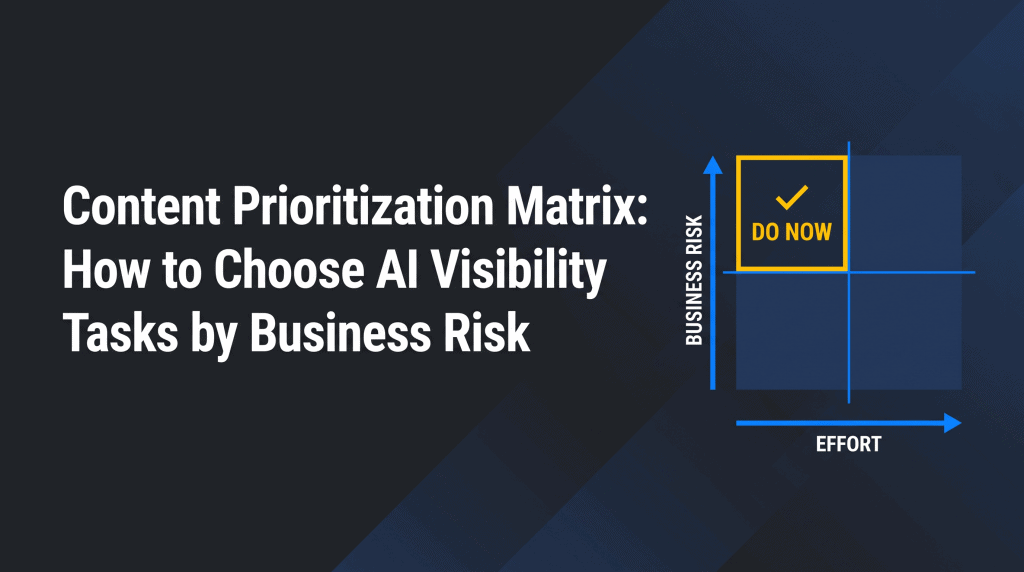
Idea: A content prioritization matrix helps you choose the AI visibility task that deserves attention first. It replaces a long, stressful list of “important” ideas with a simple score based on business risk, buyer relevance, missing evidence, and effort.
Challenge: Teams often give priority to the task with the most mentions, the loudest stakeholder, or the newest AI answer. That can mean fixing a small issue while a high-value buyer question still contains a wrong or weak answer.
Summary: Score each task on the same four factors, discuss the result with the right people, and turn the top score into one clear next action. The matrix will not predict rankings. It will help your team make a more consistent, evidence-based choice.
Related Reads
- AI Visibility Measurement Framework for Content Teams
- How to Get Cited by AI: A Content Brief Workflow
- AI Visibility Report Template for Agencies and In-House Teams
What a Content Prioritization Matrix Is
A content prioritization matrix is a small decision table. You use it when several content tasks look important, but your team has time for only one or two.
Each task is judged with the same criteria. That makes the conversation clearer. Instead of saying, “This feels urgent,” you can say, “This task affects a high-value buyer question, has a clear evidence gap, and can be fixed quickly.” A matrix is a way to make an informed decision; it is not a promise that a task will improve rankings or revenue.
For AI visibility work, a task might be checking a wrong product description, improving a weak answer on an important buyer question, or adding a source to an article that AI systems repeatedly use. The goal is to choose work with the best reason to do it now.
Why AI Visibility Work Needs Clear Priorities
Mention volume is not a priority rule. A brand may appear often in AI answers and still be described incorrectly when a buyer asks the most important question.
Imagine two findings. The first is a missing brand mention in a broad, early-stage question. The second is a wrong claim about your main product feature in a question asked just before purchase. The first finding may have more search volume. The second may carry more business risk.
A simple priority matrix gives your team a shared way to explain that difference. It also makes stakeholder discussions less personal. Everyone can see the criteria, the score, and the action proposed. Clear criteria and shared understanding are core benefits of using prioritization matrices in team decisions.
The Four Criteria for an AI Visibility Priority Matrix
Start with four simple scores. Use a scale from 1 to 5, where 1 is low and 5 is high. Do not pretend these numbers are perfectly scientific. They are a practical way to compare tasks fairly.
Business Risk
Business risk asks: “What happens if this answer stays wrong or incomplete?” Give a high score to an issue that could confuse buyers, create an inaccurate product expectation, or affect an important market. Give a low score to a small wording difference with no clear downside.
Buyer Relevance
Buyer relevance asks: “Would the person asking this question be close to a real decision?” A question about product fit, price, security, or alternatives often matters more than a general definition. This is not about chasing every query. It is about serving the questions that matter to your audience.
Evidence Gap
An evidence gap means the AI answer has little, weak, old, or unclear support. For example, the answer may include an outdated page, leave out an important source, or make a claim your own content does not explain well. A large gap is a reason to investigate, not proof that changing one page will change the AI answer.
Effort to Fix
Effort asks how much work the next action will take. A correction may be as simple as updating a paragraph and verifying the source. Another task may need a new article, product input, legal review, or several content updates. High effort does not mean “do not do it.” It simply helps the team plan realistically.
How to Build a Content Prioritization Matrix
A good matrix is simple enough to use in a short weekly review. The following table is a content prioritization matrix template for AI visibility tasks.
| Criterion | Ask this question | Score 1 | Score 5 |
| Business risk | If this stays unchanged, how serious is the downside? | Little or no buyer impact | A high-value claim may mislead buyers |
| Buyer relevance | Does the question matter to a likely customer? | Broad curiosity | Strong decision-stage question |
| Evidence gap | How weak, missing, old, or unclear is the support? | Clear, current support exists | Major evidence is missing or inaccurate |
| Effort to fix | How much work is needed for the next useful step? | Small edit and check | Multi-page or cross-team work |
Choose a Simple Format
Choose a format your team will actually use. A shared spreadsheet is enough for most content teams. Use one row per task, one column per criterion, and a short note explaining the proposed action. You do not need a complicated prioritization chart to make a useful decision matrix.
Make One List of Tasks
First, collect tasks from your AI visibility review. Keep each item specific. “Improve AI visibility” is too broad. “Check the price claim in the answer to ‘How much does X cost?’” is clear enough to score.
Write each task as one action, not one ambition. Good examples include: update an old comparison statement, add a missing product explanation, request a correction to an inaccurate public source, or prepare a content brief for a missing buyer question.
Agree the Rules Before Scoring
Before you score, agree what a 1 and a 5 mean. This gives every stakeholder the same starting point when you weigh options. If one person thinks “business risk 5” means lost revenue and another thinks it means a minor typo, the total will not help.
You do not need a long meeting. A short written definition next to the table is usually enough. If there is disagreement, record it rather than hiding it. That is often the most useful result of the review.
Score the Tasks and Choose One Next Action
Add the first three scores, then subtract effort. This gives more weight to risk, relevance, and missing evidence while recognising the team’s time and resources.
Priority score = Business risk + Buyer relevance + Evidence gap − Effort
| Example AI visibility task | Risk | Buyer relevance | Evidence gap | Effort | Total | Recommended action |
| Wrong feature claim in a decision-stage answer | 5 | 5 | 4 | 2 | 12 | Do now: verify facts and improve the relevant page |
| Missing source for a comparison question | 3 | 4 | 4 | 3 | 8 | Plan next: create or refresh supporting content |
| One weak mention in a broad definition answer | 1 | 1 | 2 | 2 | 2 | Park for later: revisit when evidence changes |
The numbers are not the answer by themselves. They help you weigh options and explain why one task is a top priority. If two tasks tie, choose the one with higher business risk or lower effort, then note why.
How to Read the Four Priority Levels
After scoring, place each task in one of four plain-language groups. This is your action plan.
| Priority level | Typical score | What it means | Next step |
| Do now | 10 or more | High-risk, high-relevance issue with a realistic fix | Assign an owner and a review date |
| Plan next | 7–9 | Valuable work that needs preparation or more evidence | Add it to the next content cycle |
| Keep watching | 4–6 | A real issue, but not yet important enough to act on | Recheck on a fixed date |
| Park for later | 3 or less | Low priority or not enough evidence | Record it; do not let it crowd out critical tasks |
This approach avoids a common problem: treating every task as urgent. A matrix can help teams see relative importance, not just a crowded list of competing requests.
A Short Content Prioritization Matrix Example
Suppose a team has four tasks: refresh an old pricing page, correct an inaccurate feature claim, write a broad thought-leadership article, and check a missing citation. The inaccurate feature claim may receive the highest risk and buyer-relevance scores, even if the broad article has more potential reach. This matrix example keeps the team focused on the task with the clearest downside if it is ignored.
Start with a simple model when you create a prioritization matrix. Add a more complex matrix only when it helps the team make a clearer choice. A larger table is not automatically a better decision tool.
Benefits of Using a Content Prioritization Matrix
The main benefit is clarity. The matrix helps a team see which tasks carry more relative importance when time and resources are limited. It gives stakeholders one shared view of the top priorities.
It also creates a written action plan: what to do now, what to plan next, and what to review later. The purpose is not to predict return on investment. It is to make a transparent decision with the best information available.
When to Use a Content Prioritization Matrix
Use a prioritization matrix when you have more useful tasks than available time. It works especially well after a monthly AI visibility review, before planning a new content cycle, or when several teams ask for changes at once.
Do not use it to rank every tiny edit on a page. Use it for meaningful tasks or projects: a new buyer guide, a major refresh, a missing source, an inaccurate product claim, or an important page that needs clearer evidence. This keeps the matrix simple enough to revisit and use.
Common Mistakes When You Prioritize Content Tasks
The first mistake is using too many criteria. A complex matrix can look precise while becoming too hard to use. Four clear scores are usually more helpful than twelve vague ones.
The second mistake is changing the rules after the scores are known. If the definition of “high risk” changes whenever a favourite task scores badly, the matrix loses trust. Keep a short record of the rules and change them only for the next review.
The third mistake is treating a score as a guarantee. A high score tells you where to look first. It does not guarantee a higher ranking, an AI citation, or a revenue result. You still need to make a helpful change, publish accurate information, and check what happens over time.
Finally, do not ignore context from stakeholders. A content manager may see a missing source. A product expert may know that the claim is outdated. A customer-facing colleague may know that buyers ask the same question every week. The best decision uses all three views.
How NEURONwriter Helps Turn a Matrix into Content Work
NEURONwriter can help move a high-priority task from observation to a clear content action. Once your matrix identifies a buyer question with a meaningful evidence gap, use the question to build a focused content brief, check the related search context, and give the writer a clear purpose.
For example, if a high-risk answer is incomplete because a product page does not explain a feature in plain language, the next action is not “do more SEO.” It is a specific brief: explain the feature, include the approved facts, answer the buyer’s question near the top, add appropriate internal links, and ask a subject expert to review the claim.
A useful matrix keeps this workflow focused. It helps the team spend time on the content task that can make the clearest difference for readers and potential customers.
Frequently Asked Questions
What is a content prioritization matrix?
A content prioritization matrix is a table that compares content tasks using the same criteria. It helps a team decide what to do first instead of choosing based only on opinion, urgency, or the loudest request.
Which criteria should an AI visibility matrix include?
Start with business risk, buyer relevance, evidence gap, and effort to fix. These four criteria are simple enough for a small team and connect a content task to a practical decision.
Should mention volume decide what we do first?
No. Mention volume can be useful context, but it does not show whether the mention is accurate or important to a buyer. A wrong answer on a high-value question may deserve more attention than many low-value mentions.
How often should we update the matrix?
Review it weekly if your product, market, or AI visibility data changes quickly. A monthly review may be enough for a smaller, more stable content program. Update the score when the evidence or business context changes.
Can we use this matrix for existing articles?
Yes. You can score an existing article that is outdated, incomplete, or linked to a weak AI answer. The matrix can help you decide whether to refresh the page now, plan a larger update, or keep watching.
What if two tasks receive the same score?
Look first at business risk. If that is also equal, choose the task with lower effort or the one that supports an active business goal. Record the reason so the team understands the decision.
Does a high score guarantee an AI citation or better rankings?
No. The score is a way to decide where to work first. It does not control how a search engine or AI answer will respond. Use it to guide useful work, then monitor the results without making guarantees.
Can a small team use a content prioritization matrix?
Yes. A small team can begin with a shared spreadsheet and five tasks. The goal is not a complicated system; it is a clear, repeatable way to choose the next useful action.