
AI Search Engine Market Share in 2026: Where to Focus Your Effort
Semantic Summary
Idea: There is no single, reliable figure for AI search market share. Published estimates differ widely because they measure different things, so the useful question is where your own audience looks.
Challenge: Headlines compare incompatible metrics such as sessions, searches, and users. Teams then chase the biggest name or ignore the channel entirely.
Summary: Treat third-party share data as a rough map. Use your own analytics and prompt tests as the compass. Keep one shared foundation, and add platform-specific work only where the evidence justifies it.
Related reads: Google AI Mode vs. AI Overviews · How ChatGPT Actually Chooses Sources · GEO vs. AEO vs. SEO
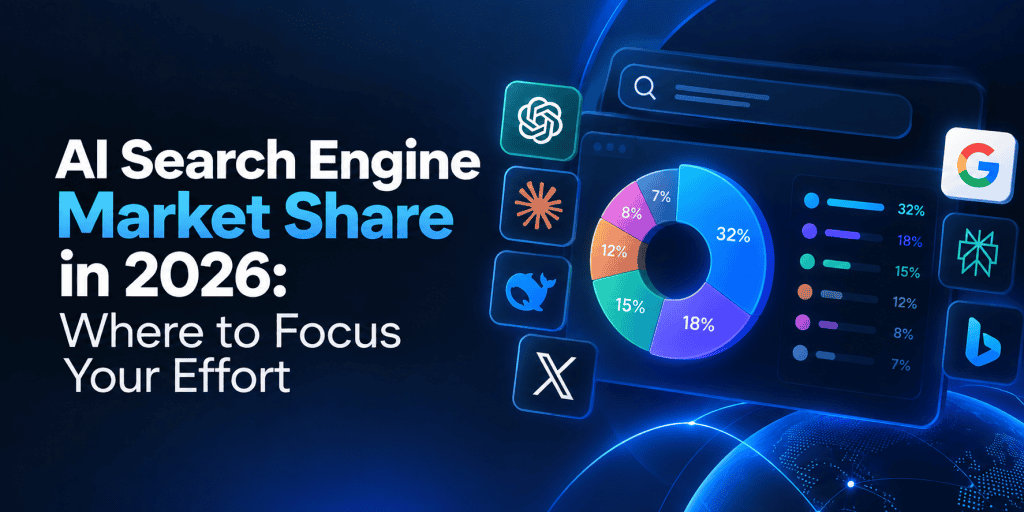
No single number answers “AI search market share.” Published estimates differ by many multiples because they count different things. The practical answer is simpler. Google still dominates traditional search, ChatGPT is the largest AI platform in most reports, and your best focus depends on your own referral data and audience.
What counts as “AI search” in the first place?
The label covers several different things. Mixing them is the main reason share numbers clash.
- AI assistants. Chat tools such as ChatGPT, Claude, and Gemini that answer in conversation.
- AI answer engines. Products such as Perplexity that cite sources by default.
- AI features inside search engines. AI Overviews and AI Mode inside Google, and similar features elsewhere.
- Generative AI inside apps. Assistants built into phones, browsers, and social platforms.
Decide which of these your question is about. Online search through an AI assistant is a different behavior from reading an AI Overview. Each produces different traffic and different search intent.
When you read a report, find its definition first. If it does not give one, do not trust its totals. When your own team talks about AI search traffic, write down what you include. Then everyone measures the same thing and visibility in AI becomes comparable from month to month.
Why do AI search market share numbers disagree?
Each study measures a different activity. One counts sessions on AI apps. Another counts searches. A third counts referral visits to websites. These are not the same thing.
The gap is large. A Search Engine Land report summarized a study that put AI assistant activity at about 56% of global search engine volume, measured in sessions. An seoClarity report estimated roughly 10–15% of all searches happen on LLMs. Both can be honest. They simply define “search” differently.
Always check four things before you trust a figure:
- The metric. Sessions, queries, users, or referral visits.
- The sample. Which countries, devices, and panels.
- The date. AI adoption moves fast, so a 2025 figure may already be stale.
- The seller. Vendors often publish data that supports what they sell.
Where do market share figures come from?
Most figures come from five kinds of sources. Each has a typical weakness.
| Source type | What it measures | Main limit |
| Web traffic panels | Visits to AI tools and search sites | Estimates, weak on mobile apps |
| Browser and device trackers | Usage share among tracked devices | Sample bias |
| Company disclosures | Reported active users | Definitions vary and are not audited |
| Surveys | Self-reported habits | People misremember what they use |
| Your own analytics | Referral visits to your site | Misses unclicked mentions |
The last row matters most. It is the only source that describes your audience.
What do most reports agree on?
Despite the noise, three points appear across most sources.
- Google remains the largest search destination. Its AI Overviews and AI Mode now sit inside Google Search, which blurs the line between AI and traditional search.
- ChatGPT is usually the largest AI platform. Several reports, including seoClarity’s, describe it as the biggest source of AI traffic to websites.
- AI referral traffic is still small but growing. Many reports describe it as a thin slice of organic traffic, with fast growth and strong engagement.
Treat these as directional. The exact percentages vary by study.
Why “market share” is the wrong first question
Market share tells you where people are in general. It does not tell you where your buyers are. A niche B2B tool can get most of its AI mentions from one platform that is small overall.
Share also hides the overlap. Google’s AI features are part of Google. A person who uses AI Overviews has not left Google Search. Our guide to Google AI Mode vs. AI Overviews explains the two surfaces.
A better question: which AI tools do my customers use, and do they cite my pages?
How do you decide where to focus?
Use data from your own business first. Follow these five steps.
- Check your referrals. In your analytics, look for visits from known AI referrer domains. Note which platforms send traffic and what those visitors do.
- Ask your buyers. Add one question to sales calls or onboarding: “Which AI tools did you use to research us?” Our guide to turning customer feedback into content shows how to collect this at scale.
- Test prompts. Run ten buyer-intent prompts across the main engines. Log which domains each one cites. Use the method in our citation-checking checklist.
- Fix the shared foundation. Crawlable pages, direct answers, and clear entities help on every platform.
- Add platform work only where data points. If one engine already cites competitors and ignores you, invest there.
Which AI platforms should different audiences prioritize?
These are starting hypotheses, not rules. Verify each with your own data.
| Audience | Likely priority | Why |
| General consumers | Google AI features, ChatGPT | Largest reach in most reports |
| B2B and SaaS buyers | ChatGPT, Perplexity, Google AI Mode | Research-heavy buying journeys |
| Developers and technical users | ChatGPT, Claude, DeepSeek | Early adopters of newer tools |
| News and current events | Grok, Google, Perplexity | Strong real-time retrieval |
| Audiences in China or nearby | Regional engines and assistants | Local indexes and rules |
What does a sensible effort split look like?
This is an example, not a formula. Adjust it to your data.
- About 70% on the shared foundation. Content quality, technical health, authority, and entity clarity.
- About 20% on the one or two platforms where you have evidence. For example, citation fixes for the engine that already sends traffic.
- About 10% on monitoring. A monthly prompt log across the other engines.
Review the split every quarter. Move effort when your own numbers change.
What should you know about each major platform?
Each engine has quirks. These guides go deeper on each one.
- ChatGPT: a retrieval pipeline with search mode. See how ChatGPT chooses sources.
- Google AI Overviews and AI Mode: built on Google’s index and ranking signals.
- Claude: fewer, more precise citations. See Claude and content discovery.
- DeepSeek and regional engines: worth monitoring first. See DeepSeek and non-US AI search engines.
- Grok: blends X posts and web search. See Grok and X’s search integration.
How do people use search and AI engines differently?
People use each tool for different jobs. Many use AI chatbots to explain topics, compare options, and plan tasks. They still use classic search to find a specific site, check a price, or complete a purchase.
This matters for share data. A person can start in an AI assistant, then finish in Google Search. The AI tool influenced the decision, but the visit shows up as a branded search result. Counting only referral clicks misses that influence.
Three patterns appear often in reports:
- Longer, conversational questions. AI users ask full questions instead of short keywords.
- Research before the click. AI summaries answer part of the question first.
- Verification afterward. Many people check AI answers in a traditional search result.
Treat these as common patterns, not guarantees. Audiences differ, so test your own.
How does AI adoption change what you should measure?
AI adoption is uneven. Some audiences use AI every day. Others barely use it. Adoption also differs by age, job role, and country.
So avoid one global number. Segment your own audience instead. Compare AI use among your best customers, new leads, and casual visitors. A gap between those groups shows where AI matters most.
Also expect change. Many 2025 figures are already out of date. Review your data every quarter, and mark the date on every chart you keep.
What do AI Overviews change on the search results page?
AI Overviews add an AI summary above the usual links on the search results page. For some queries, searchers get an answer without clicking. Several studies report fewer clicks to organic results on those queries, although the size of the effect varies.
The effect depends on intent. Simple fact queries are the most exposed. Complex or commercial queries often still send clicks. Check Search Console for your top queries, and compare click-through rates for queries that show an Overview.
Search visibility now has two parts. One is your ranking. The other is whether the AI summary cites you. Track both.
What should you track every month?
Keep the list short. Five metrics are enough for most teams.
- AI referral visits. Traffic from known AI platforms, by platform.
- Citation appearances. How often your domain is cited across a fixed set of prompts.
- Answer accuracy. Whether AI engines describe your brand correctly.
- Branded search trend. A rise can signal AI-driven discovery.
- Conversions from AI visits. Compare them with organic search.
Record the date, the prompt, and the engine each time. A simple spreadsheet works. Consistent logs beat clever dashboards.
A worked example: choosing platforms for a B2B SaaS team
This is a hypothetical example. Imagine “ReportKit”, a reporting tool for agencies.
- The team checks analytics. ChatGPT sends the most AI referrals, and Perplexity sends a smaller, engaged group.
- Sales calls reveal that many leads used ChatGPT and Google AI features to build a shortlist.
- A ten-prompt test shows competitors cited in Google AI Mode but ReportKit absent.
- The team fixes its comparison and pricing pages, then adds direct answers at the top of each section.
- It keeps a monthly log for Claude, Grok, and DeepSeek, without building separate programs.
The method matters more than the outcome. The team spent effort where its own evidence pointed.
What may change over the next year?
Three shifts are worth watching. None is certain.
- More AI assistants inside other products. AI-driven search will appear in browsers, phones, and apps.
- Better measurement. Platforms and analytics tools are adding AI traffic reporting.
- More agent-style tasks. Users will ask AI systems to compare and shortlist, not only to answer.
Build for flexibility. Strong, clear content works across AI models even as the leaders change.
Common mistakes when reading market share data
- Comparing different metrics. Sessions are not searches, and users are not visits.
- Using stale data. A 2024 chart can mislead a 2026 plan.
- Chasing the biggest platform. A smaller engine may drive your best leads.
- Ignoring Google. Its AI features still sit inside the largest search destination.
- Skipping your own data. Third-party charts cannot replace your referral logs.
- Treating one study as fact. Look for agreement across several sources.
How does NEURONwriter help with this?
NEURONwriter supports the research and the content steps above. Its SERP analysis for a keyword shows what readers actually get today. For this topic, the analysis found a fully informational intent, and about half of the top results were statistics listicles. That tells you readers expect sourced, dated numbers.
The analysis also lists competitor headings, suggested terms with usage ranges, and related questions. You can use them to plan a page that covers what searchers ask. The content editor and score then help you check coverage before you publish.
For monitoring, NEURONwriter AI visibility features are designed to track how your brand appears across AI engines. Check which engines your plan covers. Treat any score as a guide, not a guarantee of citations. You can run a keyword analysis in NEURONwriter before you decide how much effort a platform deserves.
FAQ
What is the AI search engine market share in 2026?
No single reliable figure exists. Estimates vary because studies measure sessions, searches, users, or referrals differently. Check the metric, sample, and date before you cite any number.
Which AI search platform is the most popular?
ChatGPT is usually reported as the largest AI platform. Google’s AI Overviews and AI Mode also reach very large audiences inside Google Search. Perplexity, Gemini, Copilot, and Claude follow with smaller shares in most reports.
Is AI search replacing Google?
Not by most measures. Google remains the largest search destination. AI tools are growing and changing how people research, so many users now use both.
What is the most accurate AI search tool?
No tool is accurate on every question. Accuracy depends on the query, the sources retrieved, and the mode in use. Verify important facts by opening the cited sources.
How does AI search affect website traffic and click-through rates?
Several studies report fewer clicks on queries that trigger an AI Overview. Effects differ by topic. Check your own Search Console data rather than relying on averages.
Does AI search traffic convert better than Google organic traffic?
Some reports say yes, because visitors arrive with clearer intent. Evidence is mixed and often comes from vendors. Compare conversion rates in your own analytics.
What is the best AI tool for statistics?
Use AI to find leads, then verify each number in the original source. Official reports, published datasets, and named research are safer than an AI summary alone.
How many people use AI search?
Figures vary widely by study and definition. Look at adoption data from several independent sources, and prefer ones that explain their method.
What is the “30% rule” for AI?
It is an informal idea with several versions, usually about how much work to hand to AI. There is no standard definition. Treat any claim about it as opinion, not a measured rule.