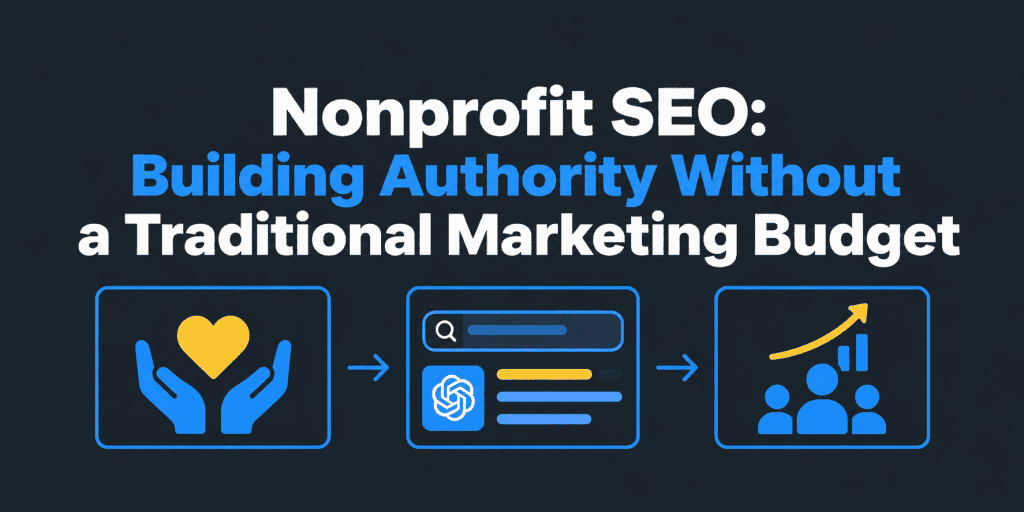
Nonprofit SEO: Building Authority Without a Traditional Marketing Budget
Semantic Summary
Idea: Nonprofit SEO helps donors, volunteers, partners, and the people you serve find you in search and AI answers. A small team can do it with free tools, clear pages, and steady trust-building.
Challenge: Limited staff and no budget, several audiences with different needs, and a mission vocabulary that does not match what people actually search.
Summary: Fix the basics, write for real supporter questions, earn trusted links through partnerships, and check what AI tools say about your cause.
Related reads: Entity SEO in 2026 · How to Turn Customer Feedback Into Actionable Content · Why AI Engines Cite Different Sources
Nonprofit SEO is the practice of helping people find your organization through search engines and AI answers. It works for donors, volunteers, partners, and people who need your services. A small team can start without a budget: fix your key pages, answer real questions clearly, earn trusted links, and keep your information accurate. This guide is marketing advice, not legal or fundraising-compliance advice.
What is nonprofit SEO, and why does it matter?
Nonprofit SEO improves your website and online presence so supporters can find you. It matters because most people search before they give, volunteer, or ask for help.
SEO is a long-term strategy, and no one can guarantee rankings. But it keeps working after you publish, which suits teams with limited time. It also builds the authority that AI tools look for when they describe your cause.
How is nonprofit SEO different from business SEO?
Nonprofits chase different goals and face different limits.
- Several audiences. Donors, volunteers, beneficiaries, partners, and advocates all search differently.
- Trust and transparency. People expect to see who you are, how you use funds, and what you achieve.
- Limited resources. Small teams need simple, high-impact actions.
- Mission language. Internal terms often differ from the words supporters use.
- Different conversions. Success may mean donations, sign-ups, volunteer applications, or service inquiries.
How can a nonprofit get started with SEO with no budget?
Start small and in order. These seven steps need time, not money.
- Set clear goals. Choose one or two outcomes, such as volunteer sign-ups or newsletter subscribers.
- List your key pages. Include mission, programs, donate, volunteer, events, and contact.
- Research supporter keywords. Write down what each audience would type.
- Fix on-page basics. Improve titles, descriptions, headings, and image alt text.
- Claim your local listings. Set up your Google Business Profile if you qualify.
- Earn a few trusted links. Ask partners, funders, and local press to link to you.
- Track results. Use free analytics and search tools, and review monthly.
How NEURONwriter helps: NEURONwriter SERP analysis for a keyword shows the headings, terms, and questions that top pages cover. Use it to plan a program or volunteer page, then check coverage in the content editor and score. The score measures topical coverage, not impact claims, so make sure your facts are accurate.
How do you research keywords for a nonprofit?
Think like your audience. Ask what someone would type when they need what you offer, or want to help.
| Audience | Example search | Page to match |
| Donors | “Donate to [cause] in [city]” | Donate page, impact page |
| Volunteers | “Volunteer [cause] near me” | Volunteer page, events |
| People seeking help | “[Service] for [group] in [city]” | Program or service page |
| Partners and funders | “Organizations working on [issue]” | About, programs, reports |
| Advocates | “How to support [issue]” | Guides, campaign pages |
For free ideas, use search suggestions, related searches, and your own site search data. Ask volunteers and beneficiaries what words they use. Our guide to turning customer feedback into content shows how to use real questions as a source.
Which pages does a nonprofit website need?
Focus on pages that match what supporters want to do.
- Program and service pages. One page per program, in plain language.
- Donate page. Clear, secure, and transparent about how gifts are used.
- Volunteer page. What roles exist, what is needed, and how to apply.
- About and transparency page. Mission, leadership, registration details, and reports.
- Impact stories. Real stories with permission, dates, and context.
- Events page. Dates, places, and sign-up links.
- FAQ page. Direct answers to common supporter questions.
What on-page SEO should every nonprofit do?
On-page SEO is the fastest win. Apply it to your top pages first.
- Title tags. Make each one specific, and put the main topic first.
- Meta descriptions. Write a clear reason to click.
- Headings. Use one H1 and clear subheadings.
- Image alt text. Describe images simply, for accessibility and search.
- Internal linking. Link program pages to donate and volunteer pages.
- Clear calls to action. Tell visitors the next step.
Which technical SEO fixes help nonprofit websites most?
Technical SEO helps search engines reach and understand your pages. Many fixes are free.
- Mobile-friendly design. Many supporters browse on phones.
- Fast pages. Compress images and remove heavy scripts.
- Secure site. Use HTTPS, especially on donation pages.
- Crawlability. Make sure important pages are not blocked, and fix broken links.
- Accessibility. Readable text, contrast, and alt text help everyone.
- Structured data. Where accurate, use types such as NGO or Organization and Event. Markup must match visible content.
Our guides on FAQ schema and structured data for travel explain the “markup must match visible content” rule in detail.
How do you build authority without a marketing budget?
Authority comes from trust and recognition. You can earn both with relationships, not ad spend.
- Partners and coalitions. Ask partners to link to your programs.
- Funders and sponsors. Ask for a link on their grantee or partner pages.
- Local media. Share real stories and expert commentary.
- Universities and schools. Offer speakers, research, or volunteer programs.
- Nonprofit directories. Complete listings and profiles accurately.
- Useful resources. Publish guides that others want to cite.
Never buy links or join link schemes. They can damage trust. Quality and relevance count more than volume.
Which trust signals should a nonprofit show?
Trust signals help both people and AI tools see that you are legitimate.
| Signal | What to show |
| Legal identity | Organization name, registration details, and contact information |
| Leadership | Named staff and board members |
| Financial transparency | Annual reports and clear explanations of how funds are used |
| Impact evidence | Dated results with sources and methods |
| Privacy and security | A clear privacy policy and secure donation pages |
| Independent validation | Partner links, press coverage, and testimonials with permission |
Only show information that is accurate and current. Do not overstate your impact. See also how E-E-A-T applies to trust-sensitive fields.
How can nonprofits use local SEO?
Local SEO helps nearby supporters and people seeking services find you. Complete your Google Business Profile if you qualify, and follow Google’s guidelines for representing your business.
- Consistent details. Keep name, address, phone, and hours the same everywhere.
- Local keywords. Mention your city and service area naturally.
- Event pages. Publish local events with dates and places.
- Reviews and testimonials. Ask for honest feedback, and protect privacy.
How do SEO and Google Ad Grants work together?
SEO and paid search serve different roles. SEO builds long-term organic visibility. Google Ad Grants, for eligible nonprofits, offers ad credit for search ads. Check Google’s current program page for eligibility and rules.
Use ads to test keywords and messages. Use what you learn to improve organic pages. Do not rely on ads alone, because ad credit can change and stop.
How does AI search change nonprofit SEO?
AI tools now answer questions like “best organizations for [cause]” and “how can I volunteer in [city].” They may describe your nonprofit without a click, so accuracy matters.
Take these steps:
- Make your organization unambiguous. Use a consistent name and description.
- Write direct, dated answers. Lead with the answer, add a date, and cite sources.
- Test AI answers. Ask the same supporter questions across engines, and log accuracy.
- Fix errors at the source. Update the pages AI tools rely on.
Generative engine optimization (GEO) builds on SEO. It adds attention to how AI systems describe and cite you. Our GEO, AEO and SEO guide explains the overlap.
How NEURONwriter helps: the AI Visibility module lets you add monitored prompts. It shows whether and how ChatGPT, Perplexity, and Google AI Overviews refer to your organization. Check the current engine list for your plan, and read important answers yourself.
How should nonprofits measure SEO success?
Measure outcomes that connect to your mission, using privacy-safe methods.
- Organic traffic to program, donate, and volunteer pages.
- Conversions. Donations, sign-ups, applications, and inquiries from organic visits.
- Search visibility. Impressions and clicks for key queries.
- Branded search trend. Growth can signal rising awareness.
- AI answer accuracy. What AI tools say about your cause and services.
Use free tools such as Google Analytics and Search Console. Review monthly, and compare against a baseline. Follow data-protection rules for supporter information.
How long does nonprofit SEO take?
There is no fixed timeline. SEO is a long-term strategy, and results often take months. Competition, site health, and content quality all matter. Be wary of anyone who promises exact results.
Should you do SEO yourself or hire help?
A small nonprofit can handle the basics in-house. Hire help when you lack time or skills, or when your site needs a technical audit.
If you hire, check these points:
- Experience with nonprofits and mission-driven sites.
- A clear plan, scope, and honest reporting.
- No guarantees of rankings.
- Respect for your budget and your values.
- Clarity on who owns content, data, and accounts.
What are the basics of SEO for a small nonprofit team?
Search engine optimization is simple to describe. You help search engines understand your pages, and you help people find answers. Google Search and other engines then decide which pages to show for a query.
- Match search intent. Each search term has a purpose, such as giving, volunteering, or getting help. Give each purpose its own page.
- Use free tools. Try free SEO tools such as Google Keyword Planner, Search Console, and analytics to see search queries and performance.
- Run a short SEO audit. A basic technical and content audit finds broken links, thin pages, and missing titles.
- Build a content strategy. Plan SEO content around supporter questions, and publish a few strong pages before many weak ones.
- Use schema markup carefully. It helps search engines understand your organization, events, and programs.
- Stay active on social platforms. A consistent social media presence supports discovery, but social media platforms do not replace your site.
These practical SEO tips and SEO best practices help any nonprofit site rank higher in search results over time. They improve SEO without a large budget, because they rely on clarity and consistency. Traditional SEO still works, and SEO still matters even as the search landscape changes with AI.
The goal is to be authoritative on your cause. Keywords for your nonprofit should reflect real supporter language. Strong nonprofit content helps nonprofits become the clear answer in search engine results and in AI summaries. When a page covers a topic completely, it can help your website rank higher over time. Many practitioners cite six months to a year as a rough range for visible gains, but there is no fixed timeline.
As search shifts toward AI in 2026, keep the same discipline. Optimize pages for people first, and keep your search rankings in perspective. Visibility in AI answers and in Google Search now both depend on clear, accurate pages.
Common nonprofit SEO mistakes
- Using internal jargon. Supporters search in plain words.
- Hiding key facts in PDFs. Put important information on web pages.
- Ignoring the donate and volunteer pages. They are your most important pages.
- Weak transparency. Missing reports and leadership details reduce trust.
- Buying links. They can hurt more than help.
- Never checking AI answers. You cannot fix what you do not see.
How does NEURONwriter help with nonprofit SEO?
NEURONwriter helps you plan complete pages and watch how AI describes your organization. It does not replace your team’s knowledge of your cause. Here is how it maps to the steps above.
- Plan pages. SERP analysis shows competitor headings, suggested terms with usage ranges, and related questions for each keyword.
- Check coverage. The content editor and content score show whether a draft covers what top pages cover.
- Monitor AI answers. The AI Visibility module tracks the prompts you add across the engines it supports.
- Find gaps. Competitors and Opportunities views point to tasks such as earning external mentions or improving existing content.
You can run a keyword analysis in NEURONwriter before you plan your next program or volunteer page. Treat every score as a guide, because no tool can guarantee rankings or citations.
FAQ
What is SEO for nonprofits, and why does it matter?
It helps donors, volunteers, partners, and people who need help find your organization in search. It matters because most people search before they act.
How can a nonprofit get started with SEO?
Set clear goals, list your key pages, research supporter keywords, fix on-page basics, claim local listings, earn a few trusted links, and track results.
How can nonprofits research keywords?
Think like each audience, use search suggestions and your own site search data, and ask volunteers and beneficiaries which words they use.
What keywords should a nonprofit target?
Target phrases that match what supporters want to do, such as donating, volunteering, or finding services, along with your cause and location.
Why are backlinks important for nonprofits?
Links from trusted sites signal credibility and help search engines find your pages. Earn them through partners, funders, local media, and useful resources.
Is SEO better than paid ads for nonprofits?
They do different jobs. SEO builds long-term visibility, while ads can add short-term reach. Many organizations use both, and eligible nonprofits can explore Google Ad Grants.
How long does SEO take to work?
There is no fixed timeline. SEO is a long-term strategy, and results often take months.
How is GEO different from SEO?
GEO focuses on how AI systems describe and cite your organization, while SEO focuses on search results. They share foundations such as clear content and trust signals.
What is keyword search volume?
It is an estimate of how often people search for a term. Use it as a rough guide, and also consider relevance and intent.
What do nonprofit SEO services include?
Typical services include audits, keyword research, content support, technical fixes, local listings, and reporting. Ask for a clear scope and honest expectations.
What makes a good SEO company for nonprofits?
Look for nonprofit experience, a clear process, honest reporting, no ranking guarantees, and respect for your mission and budget.