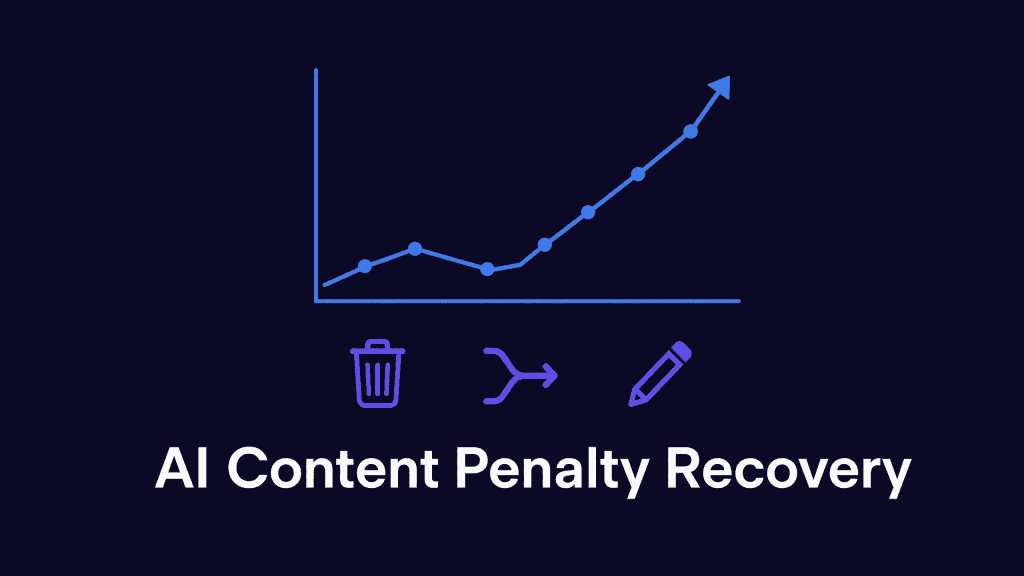
Recovering from an AI Content Penalty: A Step-by-Step Guide.
📍 Semantic Summary
Idea: Google’s helpful content systems target scaled content abuse — pages that synthesize information without adding original value, expertise, or depth.
Challenge: Most publishers respond to an AI content penalty by trying to “humanize” their text cosmetically, changing phrasing without addressing the underlying lack of semantic density and Information Gain that triggered the demotion.
Summary: Recovering from an algorithmic demotion requires a systematic, three-stage approach: diagnosing whether the penalty is manual or algorithmic via Google Search Console, executing a ruthless triage strategy (Prune / Merge / Rewrite), and rebuilding the surviving pages with native NLP entities and original insights. Tools like the NEURONwriter Content Editor provide the semantic benchmarking needed to signal genuine expertise to AI search engines and lift the demotion over time.
Related reads: – The March 2026 Core Update Aftermath: What Actually Survived? – Content Governance in 2026: How to Audit, Update, and Retire Pages at Scale
The traffic drop happens overnight. One day, your AI-generated articles are pulling in thousands of visits. The next morning, your Google Search Console shows a flatline. Pages that used to sit comfortably in the top three are now buried on page four or completely de-indexed.
You have been hit by an algorithmic demotion for scaled content abuse.
In 2026, Google does not penalize AI content simply because a machine wrote it. The search engine penalizes low-quality content, thin pages, and unoriginal synthesis. The problem is not the tool you used; the problem is the lack of Information Gain and semantic depth. If you are staring at a penalized site, this is not a manual action requiring a reconsideration request. It is an algorithmic filter which means you can engineer your way out of it.
Manual Action vs. Algorithmic Demotion: Know What You Are Dealing With.
Before you touch a single word of content, you must understand what kind of penalty you are facing.
Google applies two types of negative actions: manual actions and algorithmic demotions. If a human reviewer at Google determines your site violates their spam policies for example, by generating thousands of unedited AI pages they will issue a manual action. You will see a notification in Google Search Console under the “Security & Manual Actions” tab. Recovery here requires fixing the issue and submitting a formal reconsideration request.
However, in the vast majority of cases involving AI content, you are dealing with an algorithmic demotion. There is no notification. Your traffic simply drops after a confirmed algorithm update. To diagnose this, open Google Search Console, compare the date of your traffic drop to known Google update rollouts, and identify which page types lost the most visibility. If the drop aligns with an update and targets specific content clusters for example, your AI-generated glossary terms tanked while your human-written core pages survived you have an algorithmic quality issue.
“The most important principle in algorithmic recovery is to focus on genuine quality improvement rather than trying to reverse-engineer the specific algorithmic signal that caused the demotion.” — Anthony James Peacock.
The Triage Framework: Prune, Merge, or Rewrite.
When an algorithmic penalty hits, the entire domain’s reputation is dragged down by the lowest-quality pages. You cannot simply wait it out. You must act decisively on the offending content.
Divide your penalized pages into three buckets:
| Action | Criteria | Execution |
| Prune (410 Gone) | Thin content, zero backlinks, no historical traffic, generic AI summaries with no original value. | Delete the page entirely and serve a 410 status code. Do not redirect to the homepage. |
| Merge (301 Redirect) | Multiple AI-generated pages targeting slight keyword variations of the same topic. | Consolidate into one comprehensive master guide. Redirect old URLs to the new master page. |
| Rewrite (Keep) | Pages with high business value, existing backlinks, or historical traffic that simply lack depth. | Strip the generic AI fluff and rebuild using the Semantic Recovery Workflow below. |
The logic behind this framework is straightforward. Google’s systems evaluate the overall helpfulness signal of an entire domain, not just individual pages. A cluster of thin, low-value pages pulls down the perceived quality of every page on your site including the ones that were performing well. Pruning aggressively is not a defeat; it is a strategic investment in the authority of the pages that remain.
The Semantic Recovery Workflow.
For the pages you choose to rewrite, running them through an “AI humanizer” tool will not save you. Changing “In conclusion” to “To wrap up” does not add Information Gain. You must inject semantic depth and original insight.
The recovery workflow has three components. First, eradicate the fluff: delete generic introductions, repetitive conclusions, and robotic transitions. Second, inject original data by adding first-party statistics, original photography, or quotes from Subject Matter Experts (SMEs). This proves the “Experience” in E-E-A-T and is the single most effective differentiator from competing AI-generated pages. Third, optimize for missing NLP entities the highly specific, niche terminology that true experts use naturally, which AI models often miss.
This is where NEURONwriter becomes your recovery engine. Instead of guessing what the page is missing, paste your penalized text into the Content Editor. The tool analyzes the top-ranking competitors and provides a list of missing Basic and Extended Terms. By weaving these missing NLP entities into your rewritten content, you transform a generic AI summary into a semantically dense resource that satisfies the search intent at a level that algorithmic systems can measure.
Monitoring Recovery: Patience and Precision.
Once your pages are pruned, merged, and rewritten, you must force Google to re-evaluate them. Submit your updated URLs to the URL Inspection Tool in Google Search Console and request indexing. Update your internal linking structure to point to the newly rewritten master pages, reinforcing their topical authority.
Recovery from an algorithmic penalty is not instantaneous. It requires Google’s systems to re-crawl your site, process the quality improvements, and recalculate your domain’s overall helpfulness signal. This can take several months, and full recovery often aligns with the next major core update. Monitoring your Content Score in NEURONwriter ensures your semantic relevance remains high as the SERP evolves.
Patience, combined with ruthless quality control, is the only sustainable path out.
FAQ.
How do I know if my site has an algorithmic penalty?
You will not receive a notification. Look for a sudden, sustained drop in organic traffic in Google Search Console that aligns with the confirmed dates of a Google algorithm update. If your human-written pages survived while AI-generated clusters tanked, that is a strong signal of an algorithmic quality demotion.
Will using an AI humanizer tool fix my penalty?
No. AI humanizers only change phrasing and syntax to bypass AI detectors. They do not add Information Gain, original insights, or missing NLP entities the actual factors Google’s algorithms evaluate. Cosmetic changes will not lift an algorithmic demotion.
Should I delete all my AI-generated content?
Not necessarily. You should delete (prune) content that is thin, unoriginal, and provides no value. If an AI-generated page has good structure, existing backlinks, and targets a valuable keyword, you should rewrite it to improve its semantic depth and Content Score rather than deleting it outright.
How long does it take to recover from an algorithmic demotion?
Recovery typically takes several months. Google’s automated systems must re-crawl your updated pages and reassess the overall quality of your domain over time. Full recovery often aligns with subsequent core updates, which is why consistent quality improvement not a one-time fix is the only reliable strategy.
Does Google penalize content just because it was written by AI?
No. Google has explicitly stated that appropriate use of AI is not against their guidelines. They penalize scaled content abuse and low-quality, unhelpful content, regardless of whether it was written by a human or a machine. The question is not “Did AI write this?” it is “Does this page genuinely help the user?”
Why is semantic density important for recovery?
Generic AI content often lacks the specific terminology and contextual depth that true experts use naturally. Increasing semantic density by incorporating relevant NLP entities proves to search engines that your content comprehensively covers the topic at an expert level which is precisely what Google’s helpful content systems are designed to reward.
How can NEURONwriter help me recover?
NEURONwriter helps diagnose why your penalized content failed by benchmarking it against current top-ranking pages. The Content Editor highlights exactly which NLP entities and terms your page is missing, allowing you to systematically rebuild its semantic relevance and Content Score. Tracking your AI Visibility after republishing shows whether the updated content is being cited by AI Overviews and Perplexity a leading indicator of recovery that appears weeks before traditional rankings shift.