The March 2026 Core Update Aftermath: What Actually Survived?
📍 Semantic Summary
- Idea: Google’s March 2026 Core Update was one of the most volatile algorithmic shifts of the decade, creating a stark divide between content winners and losers.
- Challenge: The update aggressively targeted aggregators, thin affiliate content, and sites relying on keyword-swapped templates. Platforms that merely host or syndicate other people’s content saw massive visibility drops, while AI-generated content published without expert review was heavily penalized.
- Summary: The clear winners of the update were brand-owned media properties, government domains, and sites publishing high-friction content with genuine Information Gain. To survive in the post-update landscape, SEOs must pivot away from commodity content. Using NEURONwriter, you can measure the semantic depth of your content to ensure it meets the new threshold for E-E-A-T and originality.
Explore related topics: First-Party Data & Content Strategy · Product-Led SEO
Four months after the volatile December 2025 update, Google rolled out its first major core algorithm update of the year: the March 2026 Core Update. Lasting just under two weeks, it produced a landscape-altering shift in organic visibility.
If you look at the data, a very clear narrative emerges. The era of the middleman is ending.
Google is actively dialing back the visibility of platforms that aggregate, host, or syndicate content, while elevating the sites that originally created it. For content marketers and SEOs, the message is unmistakable: if your content does not add net-new knowledge to the internet, it is no longer going to rank.
Here is a data-driven post-mortem of what actually survived the March 2026 Core Update, and how you need to adjust your strategy moving forward.
The Losers: Aggregators and Commodity Content.
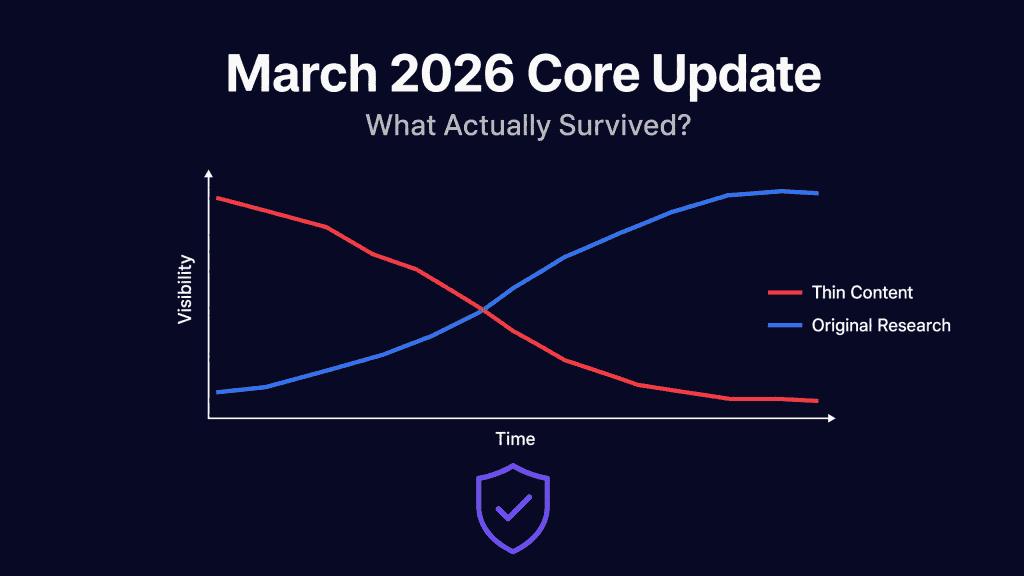
The steepest declines in organic visibility were concentrated in specific types of content models. According to early data analysis, thin, affiliate, and templated content dropped by 30-50% .
The hardest-hit categories included:
- Aggregators and Syndicators: Sites that scrape, summarize, or host third-party content without adding significant value saw massive drops.
- Thin Affiliate Sites: Shallow comparison pages and coupon aggregators, particularly in the finance sector, were heavily penalized.
- Templated Location Pages: Home services, legal, and healthcare sites built on programmatic templates that simply swap in city names experienced major ranking shifts.
- Unreviewed AI Content: AI-generated content published at scale without human editorial oversight or expert review was systematically demoted.
“The top of the loser list is almost entirely ‘the platform people use to talk about the thing.”
The Winners: First-Party Data and Brand-Owned Media.
Conversely, the sites that gained the most visibility were those that possessed undeniable, first-hand authority over their subject matter. Original research and E-E-A-T-rich sites gained 15-25% in organic visibility.
The winning categories included:
- Brand-Owned Media Properties: Destinations like IMDB, Apple, Spotify, and Netflix saw substantial gains. Google is rewarding the actual creators of the entertainment ecosystem, not the publishers discussing them.
- Government and Official Sources: Domains like NPS.gov, NIH.gov, FDA.gov, and IRS.gov showed up consistently as winners, anchoring the top of YMYL (Your Money or Your Life) search results.
- First-Hand Authorities: Brands like GoodRx, IKEA, and Cornell University dominated because they have clear, first-hand authority over the topics they rank for.
“This data presents a clear divide: the top of the winner list is almost entirely ‘the company that owns the thing.”
The Rise of Information Gain.
The most critical takeaway from the March 2026 Core Update is the elevation of Information Gain as a primary ranking signal.
Information Gain measures how much genuinely new knowledge your content adds compared to the existing top-ranking pages. For years, the standard SEO playbook was the “Skyscraper Technique”: analyze the top ten results, synthesize them, and publish a slightly longer version.
In 2026, that strategy is actively harmful. Content that merely restates what already ranks is being demoted . Google’s algorithms, powered by advanced LLMs, can easily detect when a page offers zero novel insights. A single original data point, a proprietary framework, or a unique expert quote is now proving more valuable than dozens of rewritten, synthesized articles.
Tracking Your Recovery with NEURONwriter AI Visibility.
Knowing why you lost traffic is only half the battle. The harder part is knowing when you have recovered and whether your updated content is now being picked up by AI-powered search engines, not just traditional Google.
This is where NEURONwriter AI Visibility feature becomes particularly useful in a post-update environment. Rather than waiting weeks for Google Search Console data to reflect your changes, AI Visibility lets you monitor in near real-time whether your content is being cited or referenced by AI Overviews, Perplexity, and other generative search platforms.
The logic is straightforward: if the March 2026 Core Update rewarded Information Gain and first-hand authority, then the fastest signal that your recovery content is working is its appearance in AI-generated answers. AI search engines are, in effect, running a continuous quality audit of the web. Getting cited by them is a strong leading indicator that your content has cleared the new quality threshold often before traditional rankings catch up.
A practical recovery workflow looks like this. First, identify the pages that lost the most visibility and audit them honestly: are they summaries of other sources, or do they contain something genuinely original? Second, inject high-friction elements a proprietary data point, an expert quote, an original case study to establish real Information Gain. Third, use the NEURONwriter Content Editor to ensure the updated draft is semantically complete, with all expected NLP entities and Basic and Extended Terms covered. Finally, track the page in AI Visibility to watch whether it begins appearing in AI-generated answers across platforms.
This closed feedback loop create, optimize, publish, monitor AI citations is the new rhythm of post-update SEO. It replaces the old cycle of publish, wait 90 days, check rankings, repeat.
What was the main focus of the March 2026 Core Update?
The March 2026 Core Update focused heavily on rewarding original, high-quality content while dialing back the visibility of aggregators, thin affiliate sites, and unreviewed AI-generated content. It strongly emphasized Information Gain and first-hand authority.
Why did my affiliate site lose traffic in the March 2026 update?
If your affiliate site relied on shallow comparisons, keyword-swapped templates, or synthesized content without adding original insights or hands-on product testing, it was likely caught in the update’s filter against thin content. Google is prioritizing sites that offer genuine E-E-A-T .
What is Information Gain in SEO?
Information Gain is a metric used by search engines to evaluate how much new, unique information a piece of content provides compared to documents that already exist on the web. Content with high information gain offers original data, unique perspectives, or novel frameworks .
Did the update penalize all AI-generated content?
No. Google does not penalize content simply because AI was involved in its creation. However, the update did penalize generic, low-effort AI-generated content that was published at scale without human review, expert insight, or added value.
How can I recover from a core update ranking drop?
Recovery requires improving the overall quality and originality of your content. You must audit your site for thin or commodity content, inject high-friction elements (like original research or expert quotes), and optimize for semantic depth using tools like NEURONwriter to rebuild your topical authority.
Why did government and brand sites win so much visibility?
Google’s algorithms are increasingly favoring “the company that owns the thing” over third-party publishers. Government domains and official brand properties possess inherent, undeniable E-E-A-T and first-hand authority, making them the most trusted sources for their respective topics.
How does NEURONwriter help protect against core updates?
NEURONwriter helps on two fronts. Before publishing, the Content Editor ensures your content is semantically complete and covers the NLP entities and Basic and Extended Terms expected by the algorithm. After publishing, the AI Visibility feature monitors whether your content is being cited by AI Overviews, Perplexity, and other generative search platforms giving you a leading indicator of recovery that arrives weeks before traditional ranking data catches up.