
Zero-Party Data: Asking Your Audience What They Want to Search For
Semantic summary
Idea: Traditional keyword research relies on third-party tools that guess search volumes based on historical data. In 2026, the most effective content strategies are built on zero-party data information that your customers intentionally and proactively share with you through surveys, quizzes, and preference centers.
Challenge: As AI search engines like Google’s AI Overviews shift the focus from keyword matching to intent satisfaction, marketers struggle to figure out what their audience actually means when they search. Third-party data cannot reveal the underlying motivations or specific pain points of your buyers.
Summary: By shifting from a keyword-first to an audience-first approach, you can use zero-party data to uncover high-intent topics before they even register in SEO tools. Once you know exactly what your audience wants, you can use NEURONwriter to semantically engineer content that perfectly aligns with their declared needs, driving higher conversions and brand loyalty.
Related reads:
How to Train Your Writers (Human or AI) on Your Brand Voice
The Cost of Bad Content: Calculating the ROI of Semantic Optimization
Imagine you are trying to buy a gift for a friend. You could spend hours analyzing their past credit card purchases (first-party data), or you could look at anonymous demographic trends of people their age (third-party data).
Or, you could just ask them what they want.
This is the fundamental premise of zero-party data in SEO. Instead of relying on external tools to guess what your audience is searching for, you simply ask them. As privacy regulations tighten and third-party cookies disappear, zero-party data has become the cleanest, most accurate source of truth for modern content strategy.
What is Zero-Party Data?
Zero-party data is information that a customer intentionally and proactively shares with your business. It is not inferred from their browsing behavior, nor is it bought from a data broker. It is explicitly given.
Common sources of zero-party data include: * Post-purchase surveys * Interactive quizzes (e.g., “Find your perfect skincare routine”) * Email preference centers * Chatbot conversations * Account registration questionnaires
“Zero-party data is marketing’s cleanest and clearest source of truth. It uncovers the information customers want you to have. It unveils their preferences, motivations, and needs through methods like surveys, quizzes, chatbots, and more.” — Search Engine Journal.
The Problem with Traditional Keyword Research in 2026
For years, SEOs have relied on third-party keyword research tools to dictate their content calendars. You type a seed keyword into a tool, sort by search volume, filter by keyword difficulty, and start writing.
But in the era of AI search, this approach is failing for three reasons:
- It is backward-looking. Keyword tools show you what people searched for months ago, not what they are struggling with today.
- It ignores intent. A tool might tell you that 10,000 people search for “CRM software,” but it cannot tell you why they are searching for it. Are they frustrated with pricing? Do they need better integrations?
- Everyone has the same data. If you are using the same keyword tools as your competitors, you are all writing the exact same articles.
How to Turn Zero-Party Data into an SEO Strategy.
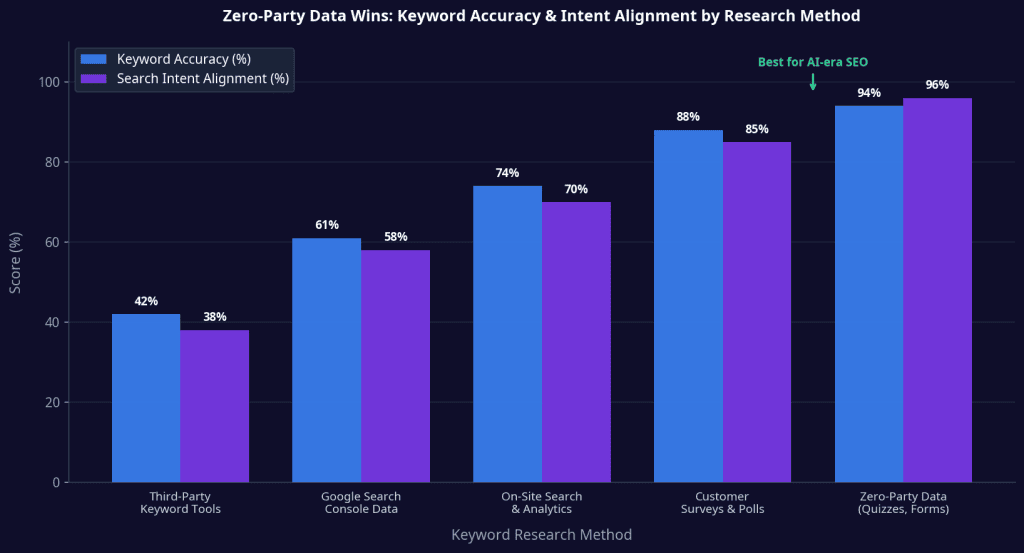
When you ask your audience what they need, you bypass the keyword tools entirely and uncover “zero-volume” keywords that actually drive revenue. Here is how the old way compares to the zero-party data approach:
| Feature | Third-Party Keyword Tools | Zero-Party Data SEO |
|---|---|---|
| Data Source | Aggregated, anonymous historical data | Direct, intentional customer feedback |
| Primary Metric | Search volume & keyword difficulty | Customer pain points & declared intent |
| Content Focus | Matching exact-match keyword phrases | Solving specific, articulated problems |
| Competitive Advantage | Low (everyone has access to the same tools) | Extremely High (proprietary insights) |
| Conversion Potential | Moderate (often attracts top-of-funnel traffic) | High (addresses bottom-of-funnel needs) |
Step 1: Capture the Data
You need to create a value exchange. Customers will not fill out a survey for nothing. Offer a discount code, a personalized recommendation, or exclusive content in exchange for their answers.
Ask open-ended questions like: * What is your biggest frustration with [industry/topic]? * What specific problem were you hoping to solve when you visited our site today? * What topic do you wish we wrote more about?
Step 2: Interpret the Intent
Once you collect the responses, look for recurring themes and specific language. If 40% of your survey respondents say they struggle with “integrating marketing tools without a developer,” you have just found a massive content opportunity.
You do not need to check if that exact phrase has search volume. Your audience has explicitly told you it is a problem.
Step 3: Activate with NEURONwriter
This is where NEURONwriter bridges the gap between human intent and search engine algorithms.
You have the topic straight from your customers. Now, you need to ensure search engines understand that your article is the best answer on the internet.
When you input your zero-party data topic into NEURONwriter, it analyzes the semantic landscape of the SERPs. It tells you exactly which NLP entities, related concepts, and subtopics you need to include to fully satisfy the query.
While your competitors are still writing generic articles based on outdated keyword volumes, you are using NEURONwriter to create semantically rich, highly targeted content that directly answers the exact questions your customers are asking. This is how you build a content moat in 2026.
FAQ
What is the difference between zero-party data and first-party data?
Zero-party data is information a customer intentionally and proactively shares with a brand, such as survey responses or quiz answers. First-party data is information a company collects indirectly through a customer’s interactions with their website or app, such as purchase history or browsing behavior.
Why is zero-party data important for SEO?
Zero-party data is crucial for SEO because it reveals the true search intent and specific pain points of your audience. This allows you to create highly relevant, intent-driven content that converts better than content based solely on generic keyword volume data.
How do I collect zero-party data for my blog?
You can collect zero-party data by implementing interactive elements like quizzes, polls, post-purchase surveys, email preference centers, and conversational chatbots on your website. Always offer a clear value exchange, such as a discount or personalized advice, to encourage participation.
Can I ignore traditional keyword research entirely?
While zero-party data should guide your overarching content strategy and topic selection, traditional keyword research is still useful for understanding the specific terminology and phrasing people use when searching. The best approach combines zero-party insights with semantic optimization.
What are “zero-volume” keywords?
Zero-volume keywords are highly specific search queries that traditional SEO tools report as having zero or very low monthly searches. However, these queries often represent highly targeted, bottom-of-funnel intent that can drive significant conversions.
How does zero-party data help with AI search engines?
AI search engines prioritize intent satisfaction and deep relevance over simple keyword matching. By building content based on zero-party data, you ensure your articles address real human motivations, making them more likely to be cited by AI Overviews as authoritative answers.
How does NEURONwriter fit into a zero-party data strategy?
Once you identify a topic using zero-party data, NEURONwriter helps you optimize the content semantically. It analyzes top-ranking pages to provide the necessary NLP entities and related terms, ensuring your highly relevant topic is also perfectly structured for search engine algorithms.