The Atomic Answer Framework: How to Write Paragraphs AI Overviews Actually Lift
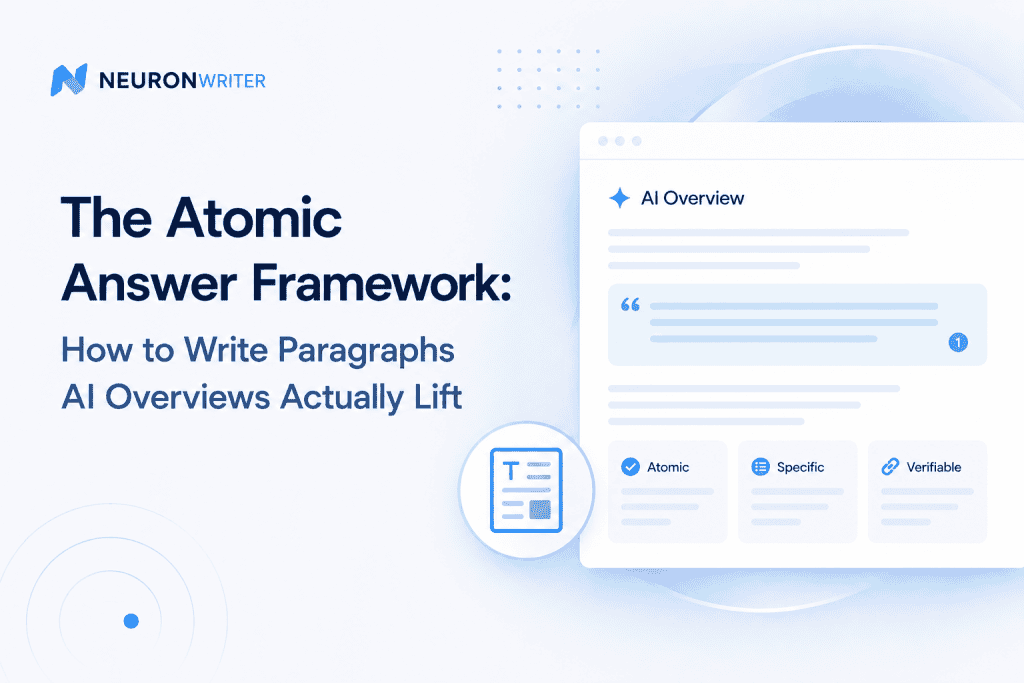
The Atomic Answer Framework is a simple rule for writing paragraphs that AI Overviews can lift on their own: each paragraph should state one direct answer, in the first sentence, with enough context to make sense with no surrounding text. Write this way consistently and you give Google’s AI Overviews, and other AI search engines, self-contained units they can extract without stitching together fragments from across your page.
This matters for reach, not just principle. AI Overviews often sit at the top of the search results, above the traditional blue links, so getting featured in AI Overviews or showing up in AI Overviews at all for a given query puts your answer in front of users before they ever reach a standard listing.
Ranking in AI Overviews doesn’t behave like classic search engine optimization for a single search engine results page: the same underlying content also needs to read cleanly to large language models powering ChatGPT, Perplexity, and Google’s own search generative experience, since users and AI systems are effectively reading the same page through different lenses.
None of this guarantees traffic to your website on every query, but content that’s genuinely easier for AI to parse has a real chance of appearing in AI, being cited in AI Overviews, and showing up again as those systems keep evolving their formats.
What AI Overviews actually extract
AI Overviews don’t cite whole pages they cite passages. When Google’s AI Overviews (or Bing, ChatGPT, and Perplexity’s equivalents) generate an answer, a retrieval step pulls the most relevant chunks from a handful of pages, then a generation step summarizes and cites them.
A chunk is often a single paragraph, sometimes a list item or table row. If your best explanation is spread across three paragraphs that only make sense read in order, none of them work well as a chunk on their own and the AI Overview quietly cites a competitor’s page that said the same thing in one self-contained block.
This is why “write good content” isn’t specific enough advice anymore. The unit that gets rewarded has shrunk from the page to the paragraph.
The Atomic Answer Framework: 4 rules for writing paragraphs
An atomic paragraph is one that could be pasted into an AI Overview by itself and still read as a complete, correct answer. Four rules get you there.
Rule 1: One idea per paragraph
Give every paragraph exactly one job answer one question or make one claim. As soon as a paragraph starts explaining a second, related idea, split it. A retrieval system that grabs the paragraph now gets a clean, single-topic chunk instead of a chunk that’s half-relevant to the query and half noise.
Rule 2: Answer first, context second
Open each paragraph with the direct answer in the first sentence, then use the rest of the paragraph to qualify, explain, or add a caveat.
This is paragraph-level BLUF (bottom line up front), and it matters for two separate reasons: it’s what a retrieval system is actually optimizing to find, and it’s what a human skimmer wants too so this rule pulls double duty rather than trading one audience off against the other.
Rule 3: Make it self-contained
A paragraph that starts with “This is because…” or “As mentioned above…” depends on the paragraph before it, and a retrieval system that grabs it in isolation gets a dangling reference instead of an answer. Repeat the subject by name if you have to — “NEURONwriter AI-Tracking does this by…” rather than “It does this by…” — even though it reads slightly more repetitive to a human reading top to bottom.
Rule 4: Concrete specifics over generic claims
“Structured data helps AI understand your content” is a generic claim that a hundred other pages already make in nearly identical words nothing about it is distinct enough to pull ahead in a retrieval ranking. “Adding FAQPage schema to a support article can shorten the path from a search query to a direct on-page answer” names a specific format and a specific mechanism, which makes the paragraph harder to reconstruct from anywhere else and more likely to be the version that gets picked.
| Before (page-first) | After (atomic) |
| “As we discussed, this approach has several benefits. It’s also worth noting that implementation varies by use case, which we’ll cover next.” | “NEURONwriter AI-Tracking checks citation status across ChatGPT, Perplexity, and Google’s AI surfaces on a set schedule, so a drop shows up as a trend rather than a one-off miss.” |
| Depends on prior paragraph, no concrete answer, can’t stand alone | Names the subject, states the mechanism, complete without any surrounding text |
Query fan-out: writing for the question behind the question
AI Mode and AI Overviews don’t just match your page to one query they break a single user question into a set of related sub-questions (query fan-out) and pull evidence for several of them at once, based on the search intent behind the original question.
A page that only answers the exact headline query, and nothing adjacent, is competing for fewer of those sub-questions than a page that also covers the obvious follow-ups. If your H1 answers “what is X,” add a section that also answers “how does X compare to Y” or “when should you not use X” — the type of content a real searcher asks next, not just the literal keyword. This is also how a single well-built page ends up covering inclusion in AI Overviews for a whole cluster of related searches instead of just one.
Formatting checklist beyond the paragraph
Atomic paragraphs are necessary but not sufficient a few structural basics still determine whether AI systems can parse and trust the page around them, and whether you trigger AI Overviews for a query in the first place:
- Headers that state the question, not a vague label. “How to Optimize for AI Overviews” extracts better as a header than “Optimization Tips,” because the header itself becomes part of the retrievable context around the paragraph.
- Lists and tables for anything comparative or sequential. A retrieval system parses a table row or list item as cleanly as a paragraph, and it’s often a better fit for the kind of content that’s naturally a comparison or a set of steps.
- Structured data that matches the visible content. FAQPage, HowTo, or Article schema, depending on the page type, gives search engines a second, machine-readable confirmation of what each section actually answers but only if it accurately reflects the text on the page.
- A visible freshness signal. A last-updated date, and content that’s actually been revisited, matters more for fast-moving topics where stale answers get quietly passed over.
- Crawlability basics. None of this matters if the page isn’t indexed confirm you’re not blocking relevant crawlers in robots.txt before troubleshooting anything at the paragraph level.
Common mistakes that break atomicity
- Burying the answer in paragraph three. If a human has to scroll past two paragraphs of throat-clearing to get the point, so does the retrieval system, and it’ll often just stop at the first chunk it finds elsewhere that didn’t make it wait.
- Writing one giant paragraph that answers five things. This reads as thorough to a person skimming visually, but it’s a bad retrieval unit — a system can’t cleanly separate the one relevant sentence from the other four topics it’s tangled up with.
- Over-relying on pronouns and “as above” references. Convenient for the writer, costly for extraction — restate the subject.
- Answering only the headline query. Missing the obvious follow-up questions means missing the fan-out sub-queries a system is also trying to satisfy in the same pass.
Where this fits in your content strategy
The Atomic Answer Framework isn’t a replacement for a broader content strategy it’s the paragraph-level layer underneath one. Large language models and Google’s own AI-generated answer systems are both doing the same basic thing when they scan a page: looking for the shortest, cleanest passage that resolves a specific one of the search queries a user might type.
Your seo strategies for keyword targeting, topic clusters, and internal linking still decide which pages get considered in the first place; this framework decides what happens once a page is.
Treat the two as complementary layers of the same plan rather than competing priorities a well-targeted page full of vague paragraphs still underperforms a well-targeted page written atomically, and a beautifully atomic paragraph on the wrong page never gets seen at all, because it never surfaces in Google search results for a query anyone actually types.
How to tell if it’s working
Rewriting paragraphs this way is a bet, not a guarantee the only way to know if it’s paying off is to check whether AI engines are actually citing the page afterward.
Our guide on how to check if ChatGPT or Perplexity is citing your site walks through the manual prompts and the automated tracking setup to verify it, engine by engine, rather than assuming a rewrite worked just because it reads better.
If you’re just learning how to optimize a blog for this, start small: pick your five highest-traffic posts, rewrite the top two or three paragraphs on each using these four rules, and treat that as a test batch before you optimize your blog wholesale.
AI models read for the same signals whether it’s Google’s AI Overviews, an AI answer inside ChatGPT, or a Perplexity summary, so readers and AI systems alike benefit from the same rewrite which is part of why this holds up well even as new AI formats keep showing up in search feature after search feature.
FAQ
How do I write content specifically for AI Overviews?
Structure each paragraph as a standalone unit: state the direct answer first, keep it to one idea, avoid pronouns that depend on earlier text, and use concrete specifics instead of generic claims. Do this consistently across a page rather than in just the opening paragraph.
What are AI Overviews and how do they work?
AI Overviews are Google’s AI-generated summaries that appear above traditional search results for some queries, pulling and synthesizing information from a handful of sources rather than showing only a list of links.
They work through a retrieval step, which finds relevant passages, followed by a generation step that writes the summary and often names or links its sources.
What are the best strategies to optimize content for AI Overviews?
Write atomic, self-contained paragraphs that open with a direct answer; use clear, question-style headers; add structured data that matches the visible content; keep pages fresh; and cover the natural follow-up questions around your main topic, not just the headline keyword.
How can I get my content to appear in AI Overviews?
There’s no guarantee for any single query, but consistently applying the Atomic Answer Framework, adding accurate schema, and confirming your pages are crawlable and indexed all measurably improve your odds across the set of queries you’re targeting.
What is the difference between optimizing for AI Overviews and traditional SEO?
They overlap more than they conflict pages that already rank well in traditional search results have a real advantage in AI Overviews, since Google’s AI Overviews draw heavily on top organic results.
The difference is unit of optimization: traditional SEO optimizes at the page and keyword level, while AI Overviews reward optimization at the paragraph and passage level.
How can I structure my content to be AI-friendly?
Break ideas into short, single-topic paragraphs that open with their conclusion, use headers phrased as questions, add lists and tables for anything comparative, and make sure structured data accurately reflects what’s on the page.
How do I track if my content is appearing in AI Overviews?
Search your target queries directly on Google and check whether an AI Overview appears with your site linked as a source, or use an automated AI-visibility tracker to check this at scale across many queries on a schedule rather than one at a time by hand.
What kind of content performs best in AI Overviews?
Content that gives a direct, extractable answer near the top of a clearly labeled section, backed by specifics rather than generic claims, tends to outperform longer pages where the actual answer is buried in the middle of a paragraph.
Why is it important to rank in Google’s AI Overviews?
AI Overviews often appear above the standard search engine results page for a query, so ranking there or at least being cited as a source puts your brand in front of users before they scroll to any other listing, ahead of the future of search shifting further toward AI-generated search results.
Can I opt out of AI Overviews?
Yes blocking Google-Extended or the relevant crawler in robots.txt keeps your content out of AI Overviews and other Google AI features, though this also removes any chance of appearing in AI overviews or benefiting from that visibility, since it’s an all-or-nothing setting rather than a per-answer choice.
Do AI tools use the same signals as Google’s AI Overviews?
Largely yes generative AI tools and Google’s own AI Overviews prioritize similar things: a direct answer, clean structure, and content for Google AI Overviews (and other engines) that reads as self-contained rather than dependent on surrounding context. Ranking in AI overviews and getting included in AI overviews elsewhere tend to move together for that reason.
How is AI visibility different from ranking in AI Overviews specifically?
AI visibility is the broader goal being cited or mentioned across ChatGPT, Perplexity, Gemini, and Google’s AI surfaces, not just appearing in the AI overview for a Google search.
Rank in AI Overviews is one piece of that larger visibility in AI overviews picture, alongside citations that never show up in Google search results at all.