AI Search Content Accessibility: Presenting Complex B2B Evidence in Plain Language
Semantic Summary
Idea
Make technical B2B evidence easy to understand without removing the conditions, source, or limitation that give it meaning.
Challenge
A short claim can sound persuasive while hiding who it applies to, how it was measured, what it does not prove, or whether it describes a product promise.
Summary
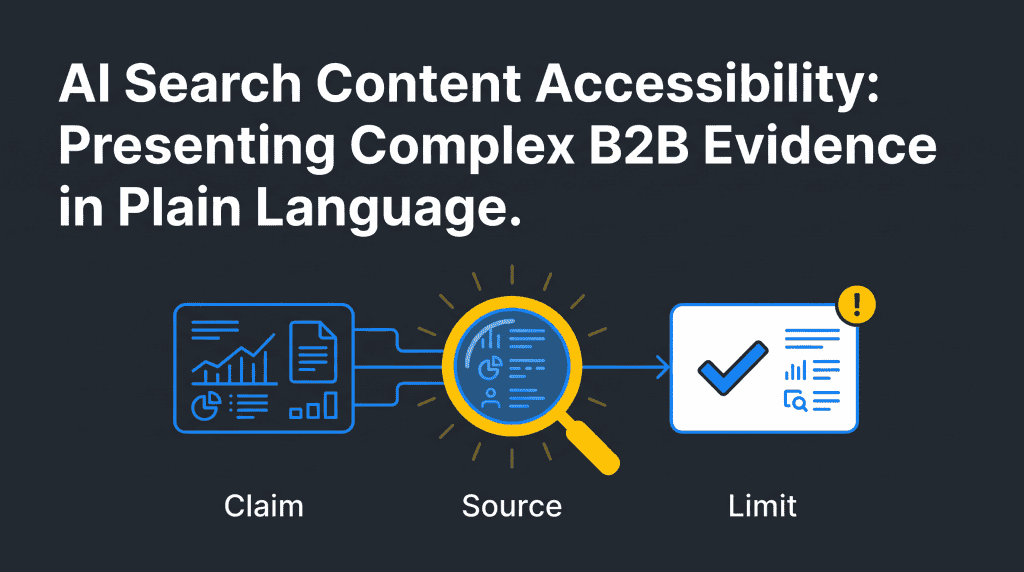
Turn each important piece of evidence into a small explanation unit: clear claim, definition, source, conditions, limit, and the buyer decision it can support.
Related Reads
- How to Write Content That AI Actually Uses
- Content Verification: How to Check Claims, Sources and Product Facts Before Publishing
- Content Governance in 2026: How to Audit, Update, and Retire Pages at Scale
Complex B2B evidence becomes accessible when the explanation keeps its meaning and its limits together. A buyer and an AI assistant should be able to tell what was observed, where it came from, when it applies, and what decision it can reasonably inform.
This is not a guide to shorter sentences, page layout, or generic AI-writing tactics. Those are useful supporting skills, but they do not solve the harder problem: a technically correct statement can still mislead when its conditions disappear. Content accessibility, in this context, means making the evidence understandable without turning a qualified finding into a broad promise.
Accessibility begins with a complete claim, not a simpler claim
A clear claim gives a reader the useful point first, then preserves the detail needed to interpret it. The aim is not to flatten technical evidence. It is to remove unnecessary effort while keeping the parts that change the meaning.
Consider this sentence: “The implementation reduced processing time by 40%.” It sounds clear, but it leaves important questions unanswered. Which implementation? Compared with what? For which work? Over what period? Was the measurement from one controlled test, a group of customers, or an internal estimate?
A more accessible version might say: “In an internal test of one repetitive document-routing workflow, the new process reduced median handling time by 40% compared with the previous manual route.
The result does not predict savings for every workflow.” The second version is longer, but it helps a buyer decide whether the evidence is relevant rather than merely impressive.
Plain-language guidance starts with the audience and the task they need to complete. In B2B content, that task is often a decision: whether to investigate a capability, compare approaches, involve a specialist, or ask for evidence that matches the buyer’s own situation.
Use an evidence-to-explanation unit for every material claim
The most reliable way to explain complex evidence is to package it in a small unit. A reader should not need to search several paragraphs to find the caveat that changes a claim. Keep the claim and the qualification close together.
| Part | Reader question | What to include |
|---|---|---|
| Plain-language claim | What happened or what can this capability do? | One direct statement without promotional exaggeration. |
| Definition | What does the specialist term mean here? | A short explanation in ordinary language, plus the precise term where it matters. |
| Source or provenance | Where did this information come from? | The study, benchmark, customer evidence, product documentation, or internal test and its date. |
| Conditions | When does it apply? | The workflow, population, environment, time period, comparison point, or assumptions that affect relevance. |
| Limit | What does it not establish? | Known uncertainty, excluded cases, sample limits, or the fact that a result is not a universal promise. |
| Buyer implication | What can I decide or ask next? | The practical question the evidence can support, not an instruction to buy. |
This structure makes a claim safer to reuse. A buyer can quote it in an internal conversation without silently dropping the condition. An AI assistant can summarize it with a better chance of retaining the relevant boundary. An editor can see which part still needs verification.
Separate evidence, interpretation, and marketing assertion
Many unclear B2B pages mix three different statements in one paragraph. Separating them makes the page more useful and helps the team avoid overclaiming.
| Statement type | What it does | Example | What must sit nearby |
|---|---|---|---|
| Evidence | Reports an observation or source-backed result. | “A review of 30 support tickets found the same setup question in 11 cases.” | Source, period, and method of review. |
| Interpretation | Explains what the evidence may mean. | “This suggests the setup step needs clearer guidance.” | Language that shows it is an interpretation, not a proven cause. |
| Marketing assertion | States a value proposition or promise. | “Our guided setup helps teams reach the first useful task sooner.” | Current product confirmation and a scope that the product owner can support. |
The difference matters because evidence can be accurate while the interpretation remains uncertain. A product statement can also be valid without proving a wider market outcome. When the page names each type honestly, readers know what they are being asked to trust.
For important claims, use the Content Verification workflow before publication. It is the place to check dates, sources, product facts, and exact wording. The evidence-to-explanation unit then gives verified material a form that is easier to understand and reuse.
Translate technical terms without replacing their meaning
Technical language is sometimes necessary. The problem is not the term itself; it is making the reader carry an unfamiliar word without a working explanation. Define the term where it first affects a decision, then use the precise term consistently.
For example, “data lineage” can be explained as “the record of where data came from and how it changed before it reached this report.” The exact term remains useful for a specialist, while the explanation tells a non-specialist why the record matters. Do not replace every precise term with vague words such as “smart,” “advanced,” or “better.” Those words remove information instead of making it accessible.
A helpful sequence is: state the ordinary-language meaning, name the formal term, explain why it matters in this decision, then return to the reader’s question. That approach gives both audiences a stable reference point. It also reduces the chance that a later summary treats a technical word as a marketing claim.
Use examples that preserve the constraint
An example should show the condition, not just the positive outcome. If a capability works only when source fields are complete, say so in the example. If a benchmark applies to a narrow workflow, name the workflow. A simplified example is useful only when it keeps the element that would change a buyer’s expectation.
State limits early, plainly, and without apology
A limitation does not make evidence weak. It shows the team understands where the evidence applies. Hiding the limit can make a page sound stronger in the moment but less trustworthy when a buyer discovers an exception later.
Use direct language. “This result describes a controlled internal test, not all customer environments.” “The survey captures responses from current users and does not measure the wider market.” “The feature supports this workflow when the required source fields are available.” These statements are easier to understand than legalistic disclaimers and more useful than a broad promise.
The NIST Generative AI Profile recommends documenting assumptions, limitations, context of use, and data origin when teams assess and manage AI-related risks. The same discipline improves B2B content. It tells the reader which conditions matter before they repeat a claim in a decision meeting or rely on it in a summary.
Calibrate certainty so the language matches the evidence
Certainty words should describe the strength of the evidence, not the strength of the campaign. A page earns more trust when “shows,” “suggests,” “may,” and “does not establish” are used deliberately.
| Evidence situation | Useful language | Avoid |
|---|---|---|
| Direct, well-documented observation | “The test found…” or “The record shows…” | Turning one observation into a general market promise. |
| Pattern with plausible but unproven explanation | “This suggests…” or “One possible explanation is…” | “This proves…” |
| Capability with important operating conditions | “Supports…” or “Can help when…” | “Always delivers…” or “Works for every team…” |
| Early or incomplete evidence | “Initial evidence indicates…” and a clear next check | Hiding uncertainty behind a confident headline. |
This is not hedging for its own sake. It is accurate labeling. Buyers can then compare the claim with their own context, and internal reviewers can see which assertions need stronger evidence before they become more specific.
Show what the evidence changes for a buyer
Evidence becomes useful when it connects to a real buyer question. The connection should be practical, not promotional. A reader needs to know which decision the information can support and which question remains open.
For a performance benchmark, the buyer implication may be: “Use this result to decide whether a pilot is worth planning; do not use it to estimate your annual savings without testing your own workflow.” For a security feature, it may be: “Use this description to ask whether the required controls match your environment; it does not replace your organization’s review.”
This distinction is especially important in B2B content, where several people may read the same page for different reasons. A practitioner wants operating detail. A manager wants fit and limits. A procurement or risk reviewer wants evidence and conditions. One clear explanation can serve all three if it does not pretend that one source answers every question.
Build the method into the brief, draft, and refresh process
The method works best when it is part of the content process, not a late edit. Add a field for each material claim in the brief: claim, source, owner, condition, limit, and buyer question. A subject-matter expert can confirm the meaning before a writer turns it into prose.
During the draft, keep the qualification beside the claim. Do not put a key condition several sections later or only in a footnote. During review, confirm that product language still matches current documentation and that the example has not broadened the original result.
The wider Content Governance process can assign ownership and review cadence. This article’s contribution is more specific: it gives each important claim a reusable structure that keeps evidence, interpretation, and buyer implication in the right relationship.
Make the explanation usable by both people and AI assistants
AI assistants work best with passages that answer a question clearly and contain the evidence needed to interpret the answer. That does not require writing for a machine instead of a person. It requires making the human explanation complete enough that a summary does not separate the headline from its boundary.
The guide How to Write Content That AI Actually Uses covers the broader mechanics of clear, extractable content. Use those mechanics after the evidence work is done. A short passage, a clear heading, and a well-labeled table are helpful formats, but they cannot repair an unsupported claim.
Google’s guidance similarly emphasizes helpful, reliable information, clear sourcing, and demonstrated expertise rather than content created only to attract search traffic.
The practical test is simple: if a buyer asks “How do you know?” and “When would this not apply?”, the page should provide a useful answer without forcing them to contact sales.
Start with three high-stakes claims
Do not try to rewrite every page at once. Pick three claims that are important to a buyer decision: a product capability, a benchmark, and a customer or implementation result. Run each through the evidence-to-explanation unit. Ask the source owner to confirm the definition, conditions, and limitation.
Then test the page with someone who did not create the evidence. Can they explain what the claim means? Can they identify its source? Can they say when it does not apply? If not, the page needs more context, not more confidence.
Over time, this practice creates a library of approved evidence units. Writers can reuse them accurately, subject-matter experts spend less time correcting the same misunderstanding, and content refreshes become easier because each claim already has a source and review date.
FAQ
What does AI search content accessibility mean?
In this article, AI search content accessibility means explaining important B2B evidence so that people and AI assistants can understand the claim, source, conditions, and limits together. It is about accurate interpretation, not simply making a page shorter or easier to scan.
How is plain language different from oversimplification?
Plain language removes unnecessary jargon and explains unfamiliar terms. Oversimplification removes conditions or limitations that change the meaning of the evidence. A good explanation keeps the decisive technical detail while making it easier to understand.
What should sit beside a B2B product claim?
A material claim should have a current source or owner, a definition where needed, the conditions in which it applies, and a clear limit. The buyer should also understand what decision the claim can support and what it cannot prove.
Why should content separate evidence from interpretation?
Evidence reports what was observed. Interpretation explains what that observation may mean. Keeping them separate prevents a plausible conclusion from being presented as a proven fact and helps reviewers check each statement properly.
How should a team describe uncertainty without weakening the page?
State the uncertainty directly and explain the next useful question. For example, say that an internal test suggests a result for one workflow and invite the buyer to compare that workflow with their own. Clear limits usually make a page more credible, not less.
Can an internal test be used as evidence in B2B content?
Yes, when the page clearly identifies it as an internal test and explains the workflow, comparison point, date, and relevant limitation. It should not be presented as a universal customer result or an independent market study.
How does this approach help AI assistants?
Complete evidence units make it less likely that a summary separates a result from the condition that qualifies it. An AI assistant can still summarize the content, but the page gives it a more accurate passage to work with.
Who should approve an evidence-to-explanation unit?
The person who owns the source or the product fact should verify the meaning and conditions. An editor can then ensure the explanation is clear for the intended reader. The exact roles should follow the team’s content-governance process.
How often should evidence-led content be refreshed?
Review it when the source, product, policy, market context, or buyer use case changes. High-stakes product and performance claims need a shorter review cycle than general educational explanations.