AI Search Brings Procurement Forward: Build the Evidence Buyers Need Before Sales Calls
Semantic Summary
Idea: Buyers can reach validation questions earlier when AI-assisted research helps them compare options, summarize claims, and prepare internal questions before they speak with sales.
Challenge: The evidence that answers those questions is often scattered across product, security, support, commercial, and documentation teams and can be accurate in one place but stale, incomplete, or inaccessible in another.
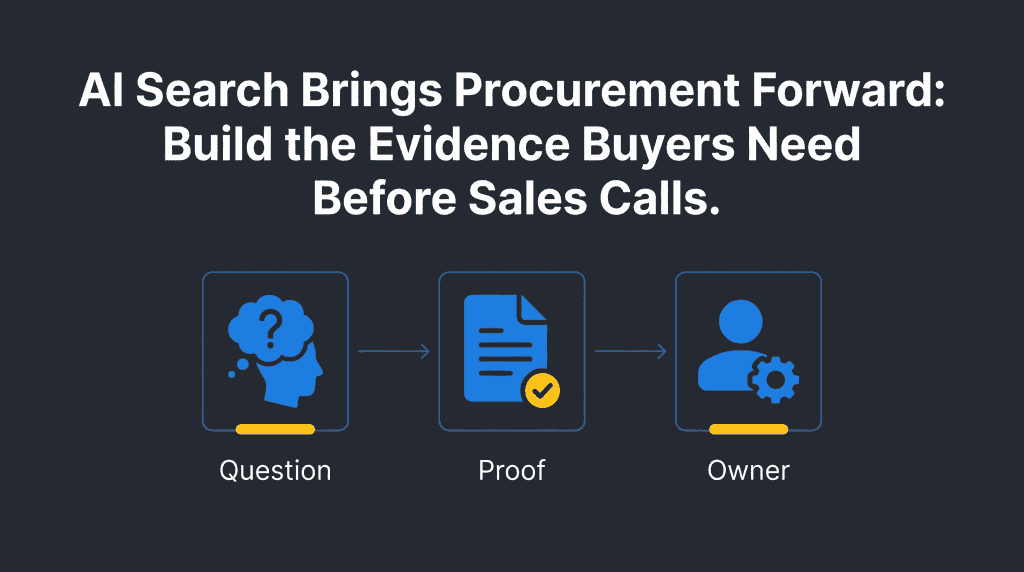
Summary: Build a pre-procurement evidence map that connects each recurring buyer question to an approved source, its scope and limit, the owner, a review trigger, and the right next action.
Related Reads
- SaaS Positioning: Align Category, Use Case and Proof Across Buyer Pages
- AI Prompt Research: Build a Search Query Taxonomy for Better Content Decisions
- Content Verification: How to Check Claims, Sources and Product Facts Before Publishing
AI-assisted research can move a buyer from “What is this?” to “Can we rely on this?” before a sales call happens. That does not remove due diligence.
It makes gaps in security, implementation, support, ownership, data handling, and commercial evidence visible earlier. The practical response is not more promotional copy. It is a maintained evidence map that gives each important question a truthful route to an answer.
This article is not legal, privacy, security, or procurement advice. It does not tell a buyer how to run a full vendor review, and it does not promise that an AI system will cite, rank, or summarize a page.
It helps content and product-facing teams make the information they already control easier to find, assess, and keep current before a buyer asks for it.
Why buyer evidence needs to be ready before a sales call
Modern buyers can collect a category definition, compare claims, and build a shortlist without waiting for a product demonstration. By the time they contact a supplier, they may already need clarity about implementation, access, support, data, commercial scope, or who can confirm a specific fact. If the answer exists only in a private inbox or an outdated document, the buyer experiences delay rather than confidence.
That does not mean every answer belongs on a public website. Some evidence should remain controlled because it contains sensitive, customer-specific, or security-relevant detail.
The goal is to decide which route is appropriate before the question arrives: a public explanation, a controlled evidence path, a scoped conversation, or an honest statement that the organization cannot support the requested claim.
CISA’s software-acquisition guidance is written for government enterprise consumers, not as a universal B2B content template. Its broad lesson is still useful: acquisition teams need relevant information to assess supplier practices and make risk-informed decisions, without every participant becoming a specialist. A good evidence map gives non-specialist buyers a safe first answer and a clear route to the accountable expert.
What a pre-procurement evidence map is
A pre-procurement evidence map is a shared record of the questions that can change whether a buyer advances, pauses, or asks for specialist review. It does not replace a product page, a security review, a legal agreement, or a sales conversation. It connects them so a buyer does not receive contradictory answers from different teams.
The map starts with a buyer question, not with a page type. For every question, record the evidence that can support an answer, the conditions that limit it, the person accountable for accuracy, and the event that should trigger a recheck. This makes the work more useful than an unowned folder of documents or a list of claims copied into several pages.
| Field | What it answers | Why it matters |
| Buyer question | What decision is the buyer trying to make? | Prevents a team from publishing a generic answer to a specific concern. |
| Evidence type | What proof would make the answer credible? | Distinguishes product facts, process descriptions, customer evidence, policies, and approved commercial information. |
| Source and access route | Where is the current answer, and can it be public? | Separates public guidance from controlled evidence and avoids accidental disclosure. |
| Scope and limit | When does the answer apply, and what does it not establish? | Keeps a qualified fact from becoming a broad promise. |
| Accountable owner | Who can confirm that the answer remains true? | Stops the content team from guessing about product, policy, or operational facts. |
| Review trigger | What change makes the record stale? | Connects evidence maintenance to releases, policy updates, changed support processes, or commercial changes. |
| Next action | What should a buyer do after reading the answer? | Routes a reader to a public source, a controlled review, a qualified conversation, or a clear limitation. |
Start with questions that can change the buying decision
Do not try to map every possible question at once. Begin with the questions that can cause a serious buyer to stop, escalate, or ask for proof. These are often not the same as the questions that attract the most search traffic.
The AI Prompt Research taxonomy can help a team distinguish an exploratory question from a validation request. Here, focus on validation requests: questions about whether a capability exists, what it requires, who is responsible, how an issue is handled, and where the claim can be checked.
Five useful question groups
- Product reality: What does the product do today, and under what conditions?
- Implementation reality: What needs to be prepared, who participates, and what remains uncertain until discovery?
- Data and security reality: What can be explained publicly, what requires a controlled review, and who owns the answer?
- Support and operating reality: How are issues handled, what service boundaries apply, and where can a buyer find the current process?
- Commercial reality: What is included, what is conditional, and when does a buyer need a scoped discussion rather than a general statement?
These groups are intentionally broad. The evidence map becomes useful when each team replaces them with the specific questions it hears from qualified buyers. Avoid inventing questions only because they sound impressive in a content brief.
Build each evidence record around source, scope, owner, and next action
An evidence record should make a careful answer easier, not merely store more information. The table below is a model for structure, not a list of statements any company should copy. Use only facts that an accountable owner can verify.
| Buyer question | Evidence route | Scope and limit to state | Accountable owner | Review trigger | Safe next action |
| What information does this workflow use? | Approved public product or policy explanation, plus a controlled route for details that should not be published. | Name the described workflow and any important exclusions. Do not imply that one explanation covers every deployment. | Product and privacy owner | Data-flow, policy, or product change | Read the public explanation or request the appropriate controlled review. |
| What does rollout require? | Implementation overview, documented prerequisites, and a scoped conversation where details depend on the buyer’s environment. | State which requirements are general and which depend on the buyer’s systems, people, or data. | Implementation owner | Release, onboarding-process, or integration change | Compare prerequisites, then identify open questions for a qualified discussion. |
| How is an issue escalated? | Current support process and service-boundary explanation. | Describe the supported route without promising a response or outcome that the service policy does not support. | Support owner | Support-process or service-policy change | Use the published support route or ask for the process that applies to the buyer’s agreement. |
| Who can confirm a sensitive technical or security detail? | Controlled evidence process with approved access conditions. | Say what can be shared publicly and why further detail needs a verified, need-to-know route. | Security or risk owner | Security event, control change, or approved-review process change | Request the appropriate review through the named route. |
| What is included in the commercial scope? | Current public package explanation and an approved route for buyer-specific scope. | Separate general inclusion from contractual, regional, or buyer-specific conditions. | Commercial owner | Packaging, availability, or commercial-policy change | Review public scope, then request a tailored clarification where needed. |
A record that lacks a source, a limit, or an owner is not ready evidence. It is an untested assertion waiting to spread. For individual pages, use the Content Verification process to confirm claims, dates, sources, and links before publication. The evidence map adds the portfolio-level layer: which answer belongs where, and who keeps it true over time.
Keep public answers and controlled evidence on separate routes
Public content should help a buyer understand the product’s boundaries and decide whether a deeper conversation is justified. Controlled evidence should remain controlled when publication would expose sensitive details, customer information, security-relevant material, or information that requires context. The difference is not a reason to be vague. It is a reason to explain the route clearly.
For example, a public page can state which workflow a product supports, name the responsible team, and explain that detailed evidence is reviewed through an approved process.
It should not imply that a buyer can verify every sensitive detail from a marketing page. Equally, a team should not hide an ordinary product limit merely because a controlled review exists.
NIST’s Generative AI Profile recommends transparency policies and processes that document the origin and history of relevant data, and it emphasizes documenting risk-related transparency and accountability.
The practical content lesson is simple: record where an answer came from, what it covers, and what must happen before a more detailed answer is shared.
Make every evidence item understandable before making it discoverable
Evidence does not help a buyer when it is technically accurate but impossible to interpret. Keep the claim, source, conditions, and limit close together. A buyer should be able to tell what was observed, when it applies, and what decision the information can support.
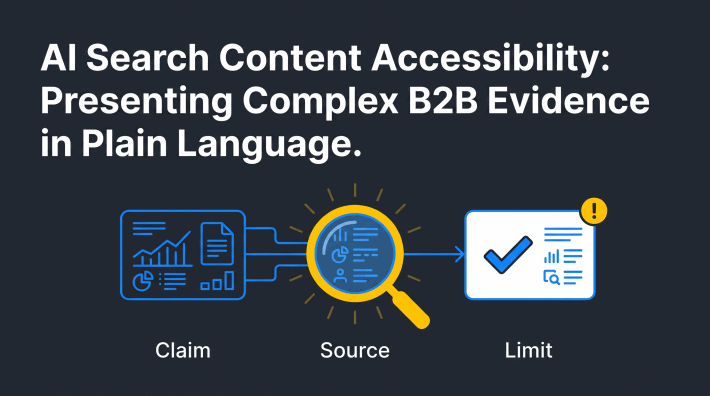
The related guide on AI Search Content Accessibility explains how to turn one complex item into a clear evidence-to-explanation unit. This article solves a different problem: deciding which evidence needs an owner and route before the buyer reaches it. Together, they prevent a common failure: a clear answer that is not maintained, or a maintained source that nobody can understand.
Google’s guidance for helpful, reliable content asks whether material has clear sourcing, evidence of expertise, and easily verified factual accuracy. Treat that as a reader standard, not a promise about visibility. A well-scoped source is more useful than a long page that overstates what it can prove.
Give every answer an owner and a review trigger
Evidence becomes stale when responsibility is assumed rather than named. A content editor may make the page clear, but the editor should not become the owner of a changing product limit, support process, data flow, or commercial condition. The owner is the person or team that can verify the fact when it changes.
| Evidence area | Typical accountable owner | Typical review trigger | Editorial job |
| Capability and product conditions | Product owner | Major release, changed limit, retired capability, or changed availability | Update the explanation, conditions, links, and evidence route. |
| Data, privacy, or security process | Relevant specialist owner | Policy change, control change, security event, or approved-review change | Confirm public wording and controlled-access route; do not infer sensitive facts. |
| Implementation and support process | Implementation or support owner | Changed onboarding process, escalation route, or service boundary | State the practical route and revise any obsolete expectations. |
| Commercial inclusion and conditions | Commercial owner | Package, availability, regional, or contract-policy change | Separate public generalities from buyer-specific scope. |
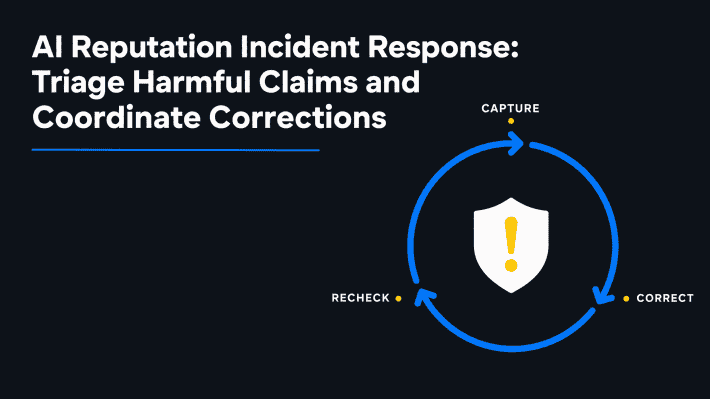
The Content Governance approach can hold those review triggers inside a wider lifecycle. When an answer becomes disputed or several owners disagree, use an explicit escalation route rather than letting the content team choose the least inconvenient version. The In-House Content Escalation Model covers that conflict-resolution layer.
Turn the map into a small operating routine
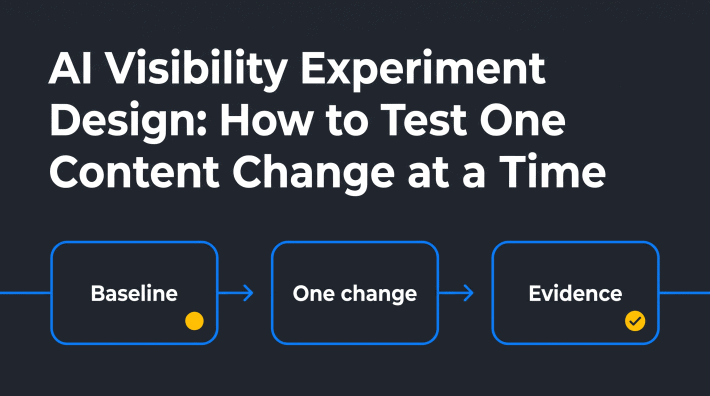
A useful evidence map does not require a large program. Start with ten recurring validation questions from sales, implementation, support, product marketing, and the teams that own high-risk facts. Route each one through a short review, then expand only when the same type of question continues to appear.
- Collect: Capture recurring buyer questions in their original wording and note the decision behind each question.
- Classify: Decide whether the answer should be public, controlled, scoped in a conversation, or declined because the organization cannot support the claim.
- Verify: Identify the strongest available source, the condition that limits it, and the owner who can confirm it.
- Publish or route: Improve the relevant buyer page, documentation page, or controlled process. Do not create a new URL if an accurate canonical source already exists.
- Review: Tie every answer to a real trigger so a release, policy change, or support-process change prompts the right update.
Use NEURONwriter to turn validated gaps into focused content briefs and keep their reader task clear. It should support the evidence process, not replace it. A content tool cannot determine whether a security, product, privacy, commercial, or implementation claim is true.
Avoid five shortcuts that make evidence less trustworthy
The fastest way to weaken a buyer-evidence system is to treat it as a campaign asset instead of a source of truth. Avoid these shortcuts.
- Do not publish confidential detail to look transparent. Explain the controlled route instead.
- Do not turn a limited test or customer example into a universal outcome claim. Keep the condition and evidence type visible.
- Do not use “AI-ready” as a substitute for ownership. An AI system may surface a page, but it cannot maintain the underlying fact.
- Do not create a new page for every buyer question. Strengthen a canonical source when it already owns the reader task.
- Do not promise that an evidence map speeds procurement, guarantees approval, or improves AI visibility. Its value is clearer, better-routed information; outcomes depend on the buyer, context, and review process.
Build evidence before the buyer has to chase it
AI-assisted research gives buyers more ways to reach a validation question before they meet a sales team. The opportunity is not to push every answer into public content. It is to know which questions matter, which evidence is safe to share, who can confirm it, when it becomes stale, and what the buyer should do next.
A pre-procurement evidence map turns scattered expertise into a governed reader path. Begin with the questions that repeatedly slow qualified conversations. Give each one a source, scope, owner, trigger, and next action. Then improve the public pages and controlled routes that deserve to carry the answer.
FAQ
What is a pre-procurement evidence map?
A pre-procurement evidence map is a shared record of decision-changing buyer questions and the approved route to each answer. It links a question to a current source, the answer’s scope and limit, an accountable owner, a review trigger, and a safe next action. It helps teams prepare accurate information before a buyer has to chase several departments.
Does an evidence map replace a security, legal, privacy, or procurement review?
No. It helps a buyer and internal team find the right starting point, but it does not replace specialist review, contractual assessment, or buyer-specific due diligence. The map should make those boundaries clear and route higher-risk questions to the appropriate accountable process.
Should every buyer answer be public?
No. Public content should explain useful product, process, and scope information without exposing sensitive details. Controlled evidence can be appropriate when access requires context, authorization, or a need-to-know review. The public page should still explain what the buyer can learn now and how to request the next appropriate review.
Who owns the evidence map?
A content or product-marketing lead can coordinate the map, but individual facts need owners who can verify them. Product, implementation, support, security, privacy, and commercial teams may each own different records. The coordinating editor keeps the routes clear and flags gaps; the subject owner confirms that the answer remains accurate.
How often should pre-sales evidence be reviewed?
Review each record when its real-world trigger occurs, such as a product release, policy update, change in support process, revised availability, or security event. A general periodic review can catch overlooked items, but a trigger tied to the underlying fact is more reliable than an arbitrary calendar date alone.
Do we need a separate page for every due-diligence question?
No. Create a new page only when the question represents a distinct, durable reader task that no existing canonical page handles. Often the better action is to improve a product, implementation, documentation, support, or policy page and add a clear route to controlled evidence where necessary.
Can AI-assisted research replace conversations with buyers?
No. It can show that a buyer may reach certain questions earlier, but it cannot reveal every context, constraint, or stakeholder concern. Use the evidence map to prepare accurate starting points and preserve space for a scoped conversation where the answer depends on the buyer’s environment or requirements.
Will a pre-procurement evidence map improve AI search visibility?
It should not be built around a visibility promise. A maintained map can make a team’s content more accurate, clear, and internally consistent, which is useful for readers and editors. Whether any AI system cites, summarizes, or surfaces a page depends on factors outside the map’s control.
Where should a small team start?
Start with ten repeated questions that have slowed qualified conversations or triggered internal escalations. For each, identify the source, scope, owner, review trigger, and next action. Do not try to solve every topic at once; expand the map when a question repeats or when a changing fact creates a real reader risk.