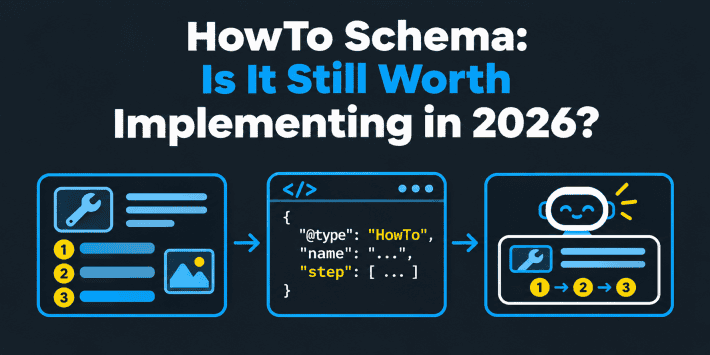
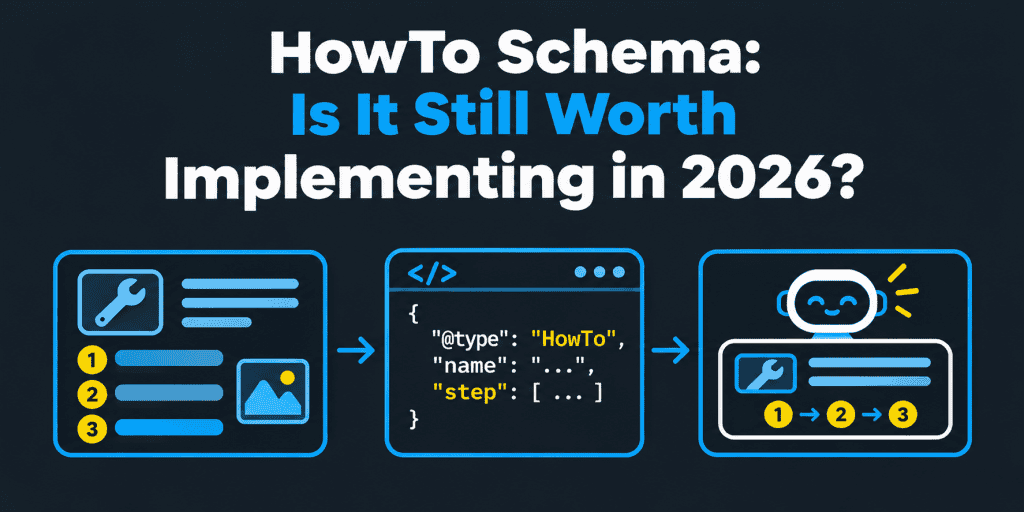
HowTo Schema: Is It Still Worth Implementing in 2026?
Semantic Summary
Idea: HowTo schema labels step-by-step instructions so machines can read them. Google stopped showing HowTo rich results in 2023, so the markup no longer earns a special result in Google Search.
Challenge: Many guides still promise SERP features and AI citations from HowTo markup. There is no published evidence for the second claim, and the first is no longer true in Google.
Summary: Invest first in clear, visible, step-by-step content. Add HowTo markup only if your template can keep it accurate at low cost, and test whether it changes anything for you.
Related reads: Schema Markup for AI Agents: The 5 Tags You Need · The Atomic Answer Framework · AI Visibility Experiment Design
HowTo schema is structured data that labels step-by-step instructions on a page. It is mostly not worth implementing as a Google tactic, because Google stopped showing HowTo rich results in 2023. The markup can still describe your content to machines, and it is harmless when accurate. But clear, visible steps matter far more than the code. This guide is marketing advice, not a guarantee of results.
What is HowTo schema?
HowTo is a type in the schema.org vocabulary. It describes instructions for achieving a result, such as changing a tire or setting up a tool.
A HowTo block can include several parts:
- name. The title of the task.
- step. A list of HowToStep items, each with text, and optionally a name, URL, and image.
- supply and tool. Materials used up, and equipment that is reused.
- totalTime. How long the task takes.
You can read the full definition on schema.org. The vocabulary remains valid. What changed is how Google uses it.
What happened to HowTo rich results?
Google retired them step by step. In its announcement titled Changes to HowTo and FAQ rich results, Google first limited HowTo results to desktop. Then it stopped showing them there too.
| When | What changed |
| August 2023 | HowTo rich results were removed from mobile search |
| 13 September 2023 | HowTo rich results stopped appearing on desktop, so the feature was deprecated |
| After that | Google dropped the HowTo search appearance, the rich result report, and Rich Results Test support, and removed the HowTo documentation |
| 7 May 2026 | Google reported that FAQ rich results no longer appear in Search, which completed the phase-out that began in 2023 |
Google has said that unused structured data does not cause problems for Search. So you do not have to remove existing HowTo markup. You should simply stop expecting a visible result from it. Check Google’s Search Central updates page for the latest status.
So, is HowTo schema still worth implementing?
For most sites, it is optional and low priority. The decision depends on cost and purpose.
| Situation | Reasonable choice |
| You want a Google SERP feature | Skip it. The feature no longer exists. |
| Your CMS template outputs HowTo markup from visible steps at no extra cost | Keeping it is fine. Check that it matches the page. |
| You would need custom development to maintain it | Spend that effort on content quality instead. |
| You want to test whether machine-readable steps affect AI answers | Run a controlled test, and treat the result as your own data. |
| Existing markup is broken or outdated | Fix it or remove it, so it does not contradict the page. |
The honest summary: HowTo schema is no longer a growth lever in Google. It is, at best, a tidy description of content that already works.
Does How To schema help SEO or AI visibility?
There is no published evidence that HowTo markup improves rankings or changes AI answers. Some vendors claim that language models read structured data. That may be true in general, but nobody has published a reliable field-level test for HowTo.
| Claim | Evidence | How to treat it |
| How To markup produced a Google rich result | Documented, but now retired | Do not expect it |
| How To markup improves organic rankings | Not documented | Do not assume it |
| HowTo markup helps AI tools quote your steps | Not documented; plausible but unproven | Test it with a controlled change |
| Clear visible steps help readers and AI tools | Strongly supported by how people and assistants read pages | Prioritize this |
Our guide to AI visibility experiment design shows how to test one change at a time.
What should you do instead of chasing HowTo markup?
Write instructions that are easy to follow and easy to quote. These steps work with or without schema.
- State the goal first. Open with one sentence that says what the reader will achieve.
- List what is needed. Show tools, materials, time, and skill level.
- Use an ordered list. Number the steps in the visible page, one action per step.
- Give each step a clear heading or lead. Start with a verb.
- Add images or video where they help. Describe them with alt text.
- Include warnings and exceptions. Say what can go wrong and how to fix it.
- Date the page. Update it when the process changes.
Our Atomic Answer Framework and our guide to writing content for AI search explain how to make each step self-contained.
How NEURONwriter helps: for a how-to keyword, NEURONwriter’s SERP analysis shows the headings, terms, and People Also Ask questions that top pages cover. Use it to plan steps and missing sections, then check coverage in the content editor and score. Neuro, the inline assistant, can run short commands such as adding an H2, building an FAQ section, or shortening a step. The score measures topical coverage, not whether the instructions are correct, so test the steps yourself.
How do you implement HowTo schema if you decide to keep it?
Keep it simple and accurate.
- Write the visible steps first. The markup must describe what users can see.
- Choose one source of markup. Use your CMS template, a plugin, a generator, or hand-written JSON-LD, but not several at once.
- Map each visible step to a HowToStep. Use the same wording.
- Add optional fields only when true. Include totalTime, supply, and tool only if the page states them.
- Validate the syntax. Use a general schema.org validator, because Google’s Rich Results Test no longer supports HowTo.
- Review after template changes. Updates can break or duplicate markup.
Here is a simplified example with placeholder content. It shows the structure only.
<script type=”application/ld+json”>
{
“@context”: “https://schema.org”,
“@type”: “HowTo”,
“name”: “How to reset the example device”,
“totalTime”: “PT5M”,
“tool”: [{ “@type”: “HowToTool”, “name”: “Paper clip” }],
“step”: [
{ “@type”: “HowToStep”, “name”: “Power off”, “text”: “Hold the power button for five seconds.” },
{ “@type”: “HowToStep”, “name”: “Press reset”, “text”: “Insert the paper clip into the reset hole for ten seconds.” },
{ “@type”: “HowToStep”, “name”: “Restart”, “text”: “Press the power button to turn the device back on.” }
]
}
</script>
Every step must also appear in the visible page text. The Schema Markup Validator can check the syntax.
How NEURONwriter helps: NEURONwriter Generate Schema Markup option can create JSON-LD from your page content, and HowTo is among the types its FAQ lists. In the editor, open the three-dot menu, choose Generate Schema Markup, pick a type, and copy the result. It generates code from your text, so check that every step matches the visible page. It does not validate the code, and Google no longer shows HowTo rich results, so treat the output as a description of your content, not a ranking tool.
How do you find out whether your site already has schema markup?
Many sites already output schema without anyone noticing. Check before you add more.
- View the page source. Search for “application/ld+json” to find JSON-LD blocks.
- Use a schema validator. Paste the page URL into a tool such as the Schema Markup Validator to list detected types.
- Check Search Console. Its enhancement reports show supported types that Google detects.
- Review your CMS and plugins. Many output markup by default.
- Look for duplicates. Two sources can output conflicting blocks.
How NEURONwriter helps: the AI Readiness audit in the AI Visibility module checks whether structured data is present on a page you enter, along with AI crawler access, robots.txt rules, HTTPS, and author information. It reports what it finds. It does not fix the markup or confirm that it is valid.
What are the best practices if you use How To markup?
- Match the visible page. Do not mark up steps that readers cannot see.
- Keep one source of truth. Do not combine several generators.
- Use true values. Do not invent times, tools, or supplies.
- Stay current. Update the markup when the steps change.
- Do not rely on it. Write the page so it works without the markup.
Which tools can generate HowTo schema, and what is the risk of using several?
You can create How To markup in four ways: a CMS template, a plugin, an online generator, or hand-written JSON-LD. Each is fine if the output is accurate and tested.
The main risk is duplication. If a plugin and a theme both output HowTo blocks, or if you paste a generated block on top of an automatic one, the page can carry conflicting versions. Pick one source, remove the others, and re-check the page source after every change.
Any generator gives a draft. Review the draft against the page, and do not publish code you do not understand.
Can HowTo schema be used with other schema types?
Yes, when each type describes the visible page. A tutorial page can combine Article, BreadcrumbList, and HowTo, for example. Avoid stacking types that do not fit.
Our guide to schema markup for AI agents covers which types are most useful today.
How do you monitor what AI says about your instructions?
Test AI answers for the questions your page solves.
- Write prompts. Use how-to questions that your audience asks.
- Run them across engines. Use the same prompts each time.
- Log sources and steps. Note whether your page is cited and whether the steps are correct.
- Fix errors at the source. Update the page that holds the wrong step.
Engines differ, as we explain in why AI engines cite different sources. Our citation-checking checklist explains the method.
How NEURONwriter helps: the AI Visibility module monitors the questions you add, called Monitored Discussions, across Google AI Overviews, Google AI Mode, ChatGPT, and Perplexity. Each discussion gets a visibility score from 0 to 100, a per-engine breakdown, and a sentiment tag. The Opportunities tab lists tasks such as “Earn mention” on pages AI already cites and “Optimize” for your own pages. Use it to see whether a change to your page, with or without markup, shows up in answers. Treat scores as guides.
What are the basics of schema markup for step-by-step pages?
Schema markup is a way to tell search engines what a page means. The same idea helps search engines and AI systems understand a page, even when no rich result follows. Here are the basics, with schema markup examples that apply to tutorials.
- Pick the appropriate schema. Choose a schema type that fits the page. HowTo is a subtype of CreativeWork on schema.org, and its definition is instructions for how to achieve a result, such as how to change a tire.
- Use text values that match the page. Many properties accept text values, so copy the visible wording instead of inventing new text.
- Add schema markup in JSON-LD where you can. JSON-LD markup is easier to maintain than microdata, which sits inside the HTML.
- Keep valid schema markup. Run schema validation after every change, and follow Google’s structured data guidelines, which say markup must reflect visible content.
- Know the types of schema markup you already use. A site may already output Article markup, local business schema on location pages, or product schema on store pages. Do not duplicate them.
- Review what competitors are using. Look at what competitors are using, but do not copy it blindly. Use schema only when it fits your page.
Before 2023, a HowTo rich snippet in Google search could display steps directly in search results, and some sites saw a higher click-through rate. That display is gone, so any plan to add schema markup should now rest on other reasons: describing content clearly, keeping templates consistent, and giving search engines and AI systems machine-readable facts.
A practical workflow looks like this. Write the page, add the markup from a single source, validate it, publish, and review the page in search results and in AI answers. Local pages follow the same idea: a business with a Google Business Profile should keep its markup and its profile consistent. Use specific schema for each page type, and tell search engines the same story that users can see.
In short, schema markup helps search engines understand a page, but it does not replace content. SEO and AI work both depend on clear, accurate, visible information. If markup helps SERPs again in the future, a clean implementation will be ready, and until then it costs little to keep it tidy. Add it to your website only when you can maintain it.
Common HowTo schema mistakes
- Expecting rich results. Google no longer shows them.
- Marking up hidden steps. Markup must match visible text.
- Using several generators. Duplicate blocks conflict.
- Using it for non-instructions. HowTo is for steps that achieve a result.
- Ignoring the content. Weak steps stay weak with perfect code.
- Leaving it stale. Old steps mislead readers and machines.
How does NEURONwriter help with HowTo content and schema?
NEURONwriter helps you plan complete step-by-step pages, generate JSON-LD, check structured data presence, and watch how AI describes your content. It does not validate markup or make Google show HowTo results. Here is how it maps to the steps above.
- Plan the steps. SERP analysis shows competitor headings, suggested terms with usage ranges, and People Also Ask questions. The content editor and content score show whether a draft covers what top pages cover.
- Write and edit. Neuro runs short commands inside the editor, and Content Designer builds an outline with title, meta description, and headings.
- Generate markup. Generate Schema Markup creates JSON-LD from page content, with types that include HowTo, FAQ, Review, Product, and Blog.
- Check presence. AI Readiness checks whether structured data and AI crawler access are in place.
- Monitor AI answers. AI Visibility tracks Monitored Discussions across four AI engines, with visibility scores and sentiment.
You can run a keyword analysis in NEURONwriter before you write your next tutorial. Treat every score as a guide, because no tool can guarantee rankings, rich results, or citations.
FAQ
What is HowTo schema?
HowTo schema is structured data from schema.org that labels step-by-step instructions, including steps, tools, supplies, and time.
Does HowTo schema still matter now that Google has dropped HowTo rich results?
It matters much less. It no longer earns a special result in Google. It can still describe your content to machines, but clear visible steps matter more.
Is HowTo schema still worth implementing in 2026?
Usually as an optional, low-cost extra. Skip it if it needs custom development, and spend that effort on content quality instead.
Should I remove existing HowTo markup?
You do not have to. Google has said unused structured data does not cause problems for Search. Remove or fix it only if it is wrong or conflicts with the page.
Does schema markup help SEO?
It helps machines understand a page, and some types can make pages eligible for rich results. It is not a direct ranking switch, and HowTo no longer has a Google rich result.
Is schema markup important for AI visibility?
There is no published proof that it changes AI answers. It is one possible input. Test it on your own prompts, and focus on clear, accurate content.
How do I implement HowTo schema on my website?
Write the visible steps, choose one markup source, map each step to a HowToStep, add optional fields only when true, validate the syntax, and review after template changes.
How do I find the schema markup on my website?
View the page source and search for “application/ld+json”, use a schema validator, check Search Console reports, and review your CMS and plugins.
How can I tell whether my website has schema markup?
Run a validator on a page URL, inspect the source, or use an audit that checks for structured data. Also look for duplicate blocks from plugins.
How do I test and validate HowTo schema?
Use a general schema.org validator for syntax. Google’s Rich Results Test no longer supports HowTo, so it will not confirm a rich result.
Is it valid for HowTo schema to have a description property?
Schema.org allows a description. Google removed it from its documentation in 2021 because Search did not use it, so it can stay but has no effect in Google.
What is the risk of using multiple schema generators at once?
Duplicate or conflicting blocks. Choose one source and remove the others, then check the page source.
What is the difference between SEO and AEO with regard to schema?
SEO schema often aims at search features. AEO and GEO use clear content structure so that answer engines can extract steps. Schema can describe that structure but does not replace it.