Content Sprint Retrospectives: Capturing What the Team Learned After an AI Search Update
Semantic Summary
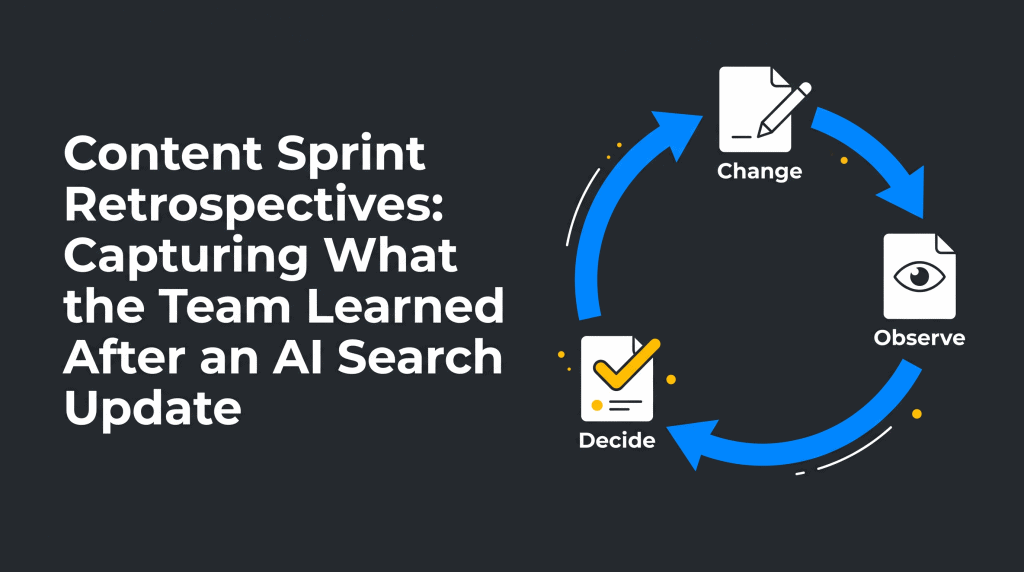
Idea: A content sprint retrospective turns one completed AI-search update into a short, reusable learning record.
Challenge: Teams often remember a result but lose the hypothesis, exact change, limits of the observation and the next decision.
Summary: Review the same agreed evidence, separate observation from interpretation, choose one follow-up action and store the lesson where the next team can use it.
Related Reads
- AI Visibility Experiment Design: How to Test One Content Change at a Time
- AI Visibility Data Governance: How to Store, Audit and Defend AI-Answer Evidence
- AI Visibility Measurement Framework for Content Teams
What Is a Content Sprint Retrospective?
A content sprint retrospective is a short, blame-free review held after one defined content update has had time to be observed. Its job is to preserve what the team expected, what it changed, what it saw, what remains uncertain and what should happen next.
This is not a second experiment-design meeting. The experiment brief comes first: it defines the question, the baseline, the change and the observation window. A retrospective comes later. It asks whether the team followed the plan, what the available evidence suggests and what the next decision should be.
It is also not a replacement for an evidence register. The register preserves the source material and its context. The retrospective uses that material to create a practical lesson for the people who plan, write, review and update pages.
The idea is similar to an after-action review: a structured debrief can compare what was planned with what happened, identify improvements and assign responsibility for agreed actions. For a content team, the format should be lighter. One page and 30 minutes are usually enough for one focused sprint.
| Practice | Main question | When it happens | Output |
| Experiment design | What one change will we test, and how? | Before the update | Hypothesis, baseline and observation plan. |
| Measurement | What do our agreed signals show across a defined sample? | During and after observation | Consistent record of signals and limits. |
| Data governance | Can we trust, protect and reproduce the evidence? | Throughout the process | Evidence register, access rules and change history. |
| Sprint retrospective | What did this completed sprint teach us, and what do we do next? | After the observation window | One learning note, one action, one owner. |
Why Close the Learning Loop After an AI Search Update?
A retrospective prevents a content update from becoming an isolated story that the next team cannot check or reuse. A better-looking answer, a flat result or an unexpected issue can all be useful if the context is preserved.
Without a close-out note, teams often repeat avoidable work. Someone remembers that “adding a table helped,” but not which page, which reader question, what other changes happened or how long the team observed it. Another writer then copies the tactic into a different context and expects the same outcome.
A retrospective turns the update into a more careful lesson. It does not promise a ranking, a citation or a commercial result. It records a decision under the conditions the team actually had.
| A useful retrospective records | It does not claim |
| The original reader question and hypothesis. | That one observation proves cause and effect. |
| The exact published change and date. | That every AI answer will now change. |
| Relevant observations and context. | That a result will repeat in every market or query. |
| Confounding factors, meaning other events that may have affected the result. | That a small test explains all traffic or revenue movement. |
| One follow-up action and its owner. | That no further review is needed. |
The Four Questions a Useful Retrospective Answers
Use the same four questions every time. A stable format makes lessons easier to compare, easier to find and less likely to turn into vague opinion.
What did we expect to learn?
Start with the original hypothesis in plain language. For example: “If we explain the setup limit in a short decision table, readers will have a more complete answer to this specific question.” Do not improve the wording after you know the result. The original expectation is part of the lesson.
If the sprint began without a written hypothesis, say so. The retrospective can still document the change and observation, but it should mark the learning as less certain. This is more useful than inventing a purpose afterwards.
What changed on the page or supporting content?
List the visible change as precisely as possible. “Improved the page” is too vague. “Added a three-row decision table under the implementation section and updated two internal links” gives the next reviewer something they can inspect.
Also note changes that happened outside the plan. An urgent factual correction, a product launch, a navigation change or a new campaign may matter when the team reads the result. These are confounding factors: other events that may influence an observation.
What did we observe, and what remains uncertain?
Write observations separately from interpretations. An observation might be: “The answer to the stored question included the stated limit in two later checks.” An interpretation might be: “The clearer page may have helped the answer become more complete.” The second sentence is careful because it does not claim proof.
Keep uncertainty visible. A short observation window, a changed product page, a different location or an unstable answer can make a result hard to interpret. A clear limitation makes a future decision stronger, not weaker.
What will we do next, who owns it, and when will we review it?
End with one decision. Keep the change, revise it, repeat the observation, investigate another factor, update a different page or stop. Then name the owner and a review date.
Do not close with “monitor results.” That leaves the work unowned. A better ending is: “The editor keeps the new table; the product owner verifies the example; the content lead rechecks the same question in four weeks.”
The 30-Minute Content Sprint Retrospective
A short meeting works when it stays within one completed sprint and uses a shared evidence snapshot. Do not use it to redesign the whole content strategy or reopen every decision made during the work.
The CDC’s debriefing guidance recommends respectful ground rules, avoiding personal blame, looking at the bigger picture and providing paths forward. It also notes that a structured after-action review can describe outcomes and planned actions. Those principles translate well to content work.
Prepare a one-page evidence snapshot.
The facilitator should share a short record before the meeting. It needs the original hypothesis, page URL, baseline, exact change, observation dates, selected signals and known changes around the sprint. Link to the governed evidence record rather than copying every screenshot or transcript into the document.
Set simple, blame-free ground rules.
Focus on the work, the evidence and the next decision. Do not turn a flat result into a review of someone’s writing ability. People will hide useful observations if they expect the meeting to assign blame.
Use neutral language. Say “the result is inconclusive” rather than “the update failed” when the evidence cannot support a stronger conclusion.
Reconstruct the change without rewriting history.
Read the brief and the change log before discussing the outcome. Ask whether the team made the agreed change and whether anything important changed at the same time. This keeps the group from explaining the past with information that was unavailable when the decision was made.
Discuss the observation and its limits.
Give each participant a short turn to name one fact and one uncertainty. The editor may flag that the wording became clearer. A product owner may note a documentation change. The analyst may explain that the sample was too small for a firm conclusion.
Choose one action, one owner and one review date.
The meeting should produce an action that can be completed or checked. If the right action is “no change,” write why. A documented decision to stop prevents the same weak idea from returning as an urgent task next month.
| Time | Activity | Input | Output |
| 0–5 minutes | Restate scope and ground rules. | Sprint name and one-page snapshot. | Shared purpose. |
| 5–10 minutes | Compare the hypothesis with the actual change. | Brief and change log. | Accurate change record. |
| 10–18 minutes | Review observations and limits. | Selected evidence and context notes. | Separate facts from interpretations. |
| 18–25 minutes | Identify the lesson. | Team discussion. | One reusable statement of learning. |
| 25–30 minutes | Agree the next step. | Decision options. | Owner, action and review date. |
The One-Page Retrospective Template
One shared record is enough when it lets another team understand the decision without attending the meeting. Keep the language plain and limit the template to what will affect future work.
| Field | What to write | Example |
| Sprint and page | Name of the sprint and canonical URL. | “Implementation clarity update — /implementation-guide/”. |
| Reader question | The task the page should help a reader complete. | “Which setup route suits a small team?” |
| Original hypothesis | The expected learning before the update. | “A decision table may make the trade-off easier to understand.” |
| Exact change | The visible page or link change. | “Added a three-row choice table and one related FAQ.” |
| Observation window | Start, end and repeat-check dates. | “1–29 September; checked weekly.” |
| Evidence used | Short links to approved records, not a long evidence dump. | “Stored prompt checks; page feedback; support theme note.” |
| What we observed | Neutral facts. | “Later answers included the choice condition in two of four checks.” |
| What remains uncertain | Limits or confounds. | “A documentation release occurred in the same period.” |
| Learning | A careful, reusable statement. | “A clear choice condition is worth retaining; it is not proof of cause.” |
| Next action | One specific step. | “Keep table; verify example after next release.” |
| Owner and review date | One accountable person or team. | “Content lead; 27 October.” |
A worked example
Imagine a team updates a guide because readers repeatedly ask what changes when they choose a faster setup route. The hypothesis is that a small table will make the trade-off easier to understand. The team publishes the table, records the exact date and checks a stored question over the next month.
The later answers are clearer in some checks, but a product-documentation update was also published during the same period. The team records a directional observation, not a success claim.
It keeps the helpful table, asks the product owner to check one example and repeats the observation after the next release. The next brief can now use a more precise lesson: explain a trade-off in a scannable table and record nearby documentation changes.
How to Handle Positive, Flat and Negative Results
Do not let the label decide the story. First write the evidence, then choose the least dramatic interpretation that it supports.
| Observed signal | Safe interpretation | Unsuitable claim | Next action |
| A later answer is clearer in repeated checks. | The change is worth retaining and reviewing again. | “The update caused the answer to improve.” | Keep the useful update; repeat the check. |
| No clear change appears. | The observation is flat or the available signal is insufficient. | “The update had no value.” | Check reader value, timing and other factors before changing it again. |
| The page becomes harder to understand or a fact is questioned. | The update may need review. | “AI rejected our content.” | Verify facts, revise or revert the specific passage. |
| Evidence varies by question, date or context. | The signal is unstable. | “Results are random.” | Narrow the question and define a later review. |
A positive result can be useful without being final proof. A flat result can protect the team from over-investing in a weak idea. A negative result can reveal an unclear statement before it spreads across more pages. The goal is better decisions, not a retrospective that tells a perfect success story.
Common Content Sprint Retrospective Mistakes
Most retrospective mistakes happen when a team tries to explain more than the evidence can support. Keep the session narrow and make the next decision visible.
| Mistake | Why it harms learning | Safer alternative |
| Starting with the result instead of the original question. | The team rewrites the purpose after it knows what happened. | Read the original hypothesis first. |
| Treating one answer as proof. | AI-search answers can vary with conditions and time. | Record it as one observation and recheck consistently. |
| Turning the meeting into a blame session. | People stop reporting uncertainty and useful problems. | Discuss process, evidence and actions—not personal fault. |
| Listing every idea but choosing no action. | The lesson cannot influence the next content cycle. | Select one action, one owner and one review date. |
| Copying raw evidence into the retrospective. | The document becomes hard to read and may expose sensitive detail. | Link to the approved evidence record and write a short neutral summary. |
| Expanding into a general content-strategy meeting. | One sprint’s learning is lost in a larger debate. | Park wider issues and schedule them separately. |
How to Reuse the Lesson in the Next Content Cycle
A retrospective is valuable only when a later brief, editing rule, priority decision or runbook can use the lesson. Store it alongside the sprint record and add a short link from the next relevant task.
The NASA lessons-learned lifecycle offers a useful sequence: collect, record, disseminate and apply. Lessons can be gathered in pause-and-learn sessions or team discussions, but their value comes from being documented, shared with the people who need them and integrated into future checklists or processes.
For a content team, applying a lesson might mean adding one acceptance criterion to a brief, using a clearer table pattern on a similar page, or asking for a product-source check earlier in the process. It does not mean copying one tactic across every article.
Use the retrospective as context when preparing the next approved brief in NEURONwriter. It can help a team remember a tested structure, a known limit or a useful reader question. It does not replace fresh search-intent validation, duplicate checking, source review or human approval.
If the retrospective identifies several possible next tasks, send them to the Content Prioritization Matrix rather than deciding by enthusiasm alone. If it identifies an evidence problem, return to the AI Visibility Data Governance guide. Each specialist page has a different job; the retrospective links them into a practical learning loop.
FAQ
What is a content sprint retrospective?
A content sprint retrospective is a short review held after one defined content update has been observed. It records the original question, actual change, available evidence, limits, lesson and next action so another team can use the result later.
When should a team hold a retrospective after an AI search update?
Hold it after the observation window agreed in the original sprint brief. The meeting should happen while the evidence, change log and context are still easy to find, but not so early that the team has only a technical publication check.
Who should attend a content retrospective?
Include the people who can clarify the change, evidence and next action. That often means the content lead, editor, analyst and a product or subject-matter owner when the update involved product facts. Keep the group small enough to make one decision.
What evidence should the team bring to the meeting?
Bring the original hypothesis, URL, baseline, exact published change, observation dates, selected evidence records and notes about other important changes. Link to the approved evidence register rather than pasting every raw screenshot or transcript into the retrospective.
Can one AI answer prove that a content update worked?
No. One answer is one observation in a changing context. It can be useful, but it should be rechecked consistently and described with appropriate limits before the team treats it as a basis for a wider decision.
What should we do with an inconclusive result?
Write the result as inconclusive, retain a useful reader-facing improvement where appropriate and choose one next action. The next step may be a later recheck, a source review, a smaller follow-up experiment or a decision to stop.
How is a retrospective different from an AI visibility experiment?
An AI visibility experiment is designed before a change and states what the team will test. A retrospective happens after the planned observation window. It captures what was learned from the completed sprint and assigns the next action.
How is a retrospective different from AI visibility data governance?
Data governance protects the quality, context, access and traceability of observations. A retrospective uses already governed evidence to make a small learning decision. It should link to the evidence record rather than duplicate it.
Where should the team store the retrospective?
Store it beside the brief, change log and approved evidence record for the relevant page or sprint. The location matters less than making it easy for the next content owner to find, understand and apply the lesson.