Voice of Customer Analysis: Turn Sales Calls and Support Tickets into Evidence-Led Content Updates
Semantic Summary
Idea: Voice of customer analysis turns real customer wording into patterns that can improve existing pages, FAQs and future briefs.
Challenge: Sales calls and support tickets are rich sources, but a memorable one-off comment, private detail or unusual request can send a content team in the wrong direction.
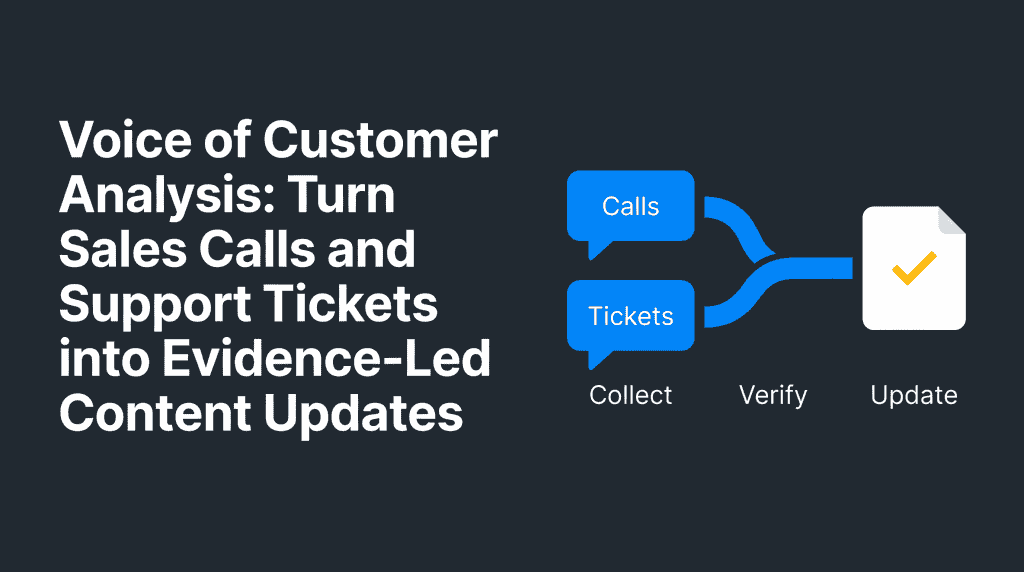
Summary: Collect a focused sample, remove personal details, check repetition and context, then route each verified pattern to the right content action and owner.
Related Reads
- First-Party Data & Content Strategy: How to Build SEO That AI Cannot Copy
- Zero-Party Data: Asking Your Audience What They Want to Search For
- Content Optimization Workflow for SEO: Research, Brief, Write, Refresh, Measure
What Is Voice of Customer Analysis?
Voice of customer analysis is the disciplined process of turning customer feedback into themes that a team can check and act on. For content teams, its purpose is not to collect more quotes. Its purpose is to decide whether a real, repeated question should improve a page, become an FAQ, inform a brief, or be left alone.
“Voice of the customer,” often shortened to VoC, means what people say about their needs, expectations, doubts and experiences. In this article, the useful inputs are existing sales calls and support tickets. They often show the words people use when they compare options, get stuck, or need a clearer explanation.
This is qualitative information: words, questions and stories rather than a score. The National Institute of Standards and Technology describes qualitative research as gathering information about opinions and experiences, then coding it adding labels and extracting themes. For content work, label the evidence, keep the context and look for a pattern rather than trusting one sentence.
A VoC analysis is not a shortcut to a keyword list. A customer may use a phrase that is important for support, but not search for it. Equally, a repeated question may reveal that an existing page needs a clearer answer even when it does not justify a new article.
How Voice of Customer Analytics Improves Content Decisions
Voice of customer analytics improves content decisions because calls and tickets capture language used at real decision and problem-solving moments. It does not replace search research, product knowledge or editorial judgment. It adds context that a search-volume number cannot show on its own.
A full voice of the customer program may use customer surveys, customer reviews and other customer interactions across the customer journey. This narrower workflow uses approved sales calls and customer support interactions to understand customer needs, customer pain points and expectations. When the same uncertainty recurs, inspect the page that should answer it.
Which sources are appropriate for voice of customer analysis?
Voice of the customer data can come from sales calls, support tickets, interviews, customer surveys and customer reviews. A larger VoC program may use several sources to build a fuller view of customer perspectives.
A survey response can complement call records, and gathering customer feedback across sources can test whether a theme is wider than one conversation. For content work, start with sources that have a stated purpose, a known owner and a clear link to a reader task.
Understanding customer needs starts with customer listening across the right customer touchpoints. A successful VoC program uses voice of the customer as a disciplined way to capture customer perspectives, not as a promise to satisfy every request.
The aim is a fuller view of customer preferences, pain points and customer engagement. Use the resulting insight to improve customer experience when a page has a clear answer gap; do not assume it will automatically improve customer satisfaction, customer loyalty or customer relationships.
What makes a phrase useful for content
Useful phrases have three qualities. They repeat, they appear in a clear context, and they connect to a page that can help the reader. A repeated phrase from different people at the same stage of a journey is more useful than a highly emotional comment from one person.
| Evidence level | What you see | Safe content response |
| One-off remark | One person uses an unexpected word or asks for a special exception. | Save it as a note; do not change a page yet. |
| Repeated wording | Several people describe the same confusion in similar language. | Check the relevant page, FAQ or help content for a missing explanation. |
| Repeated wording with context | The same question occurs across calls or tickets and is linked to a clear page, feature or decision. | Draft a proposed update and ask a subject-matter owner to verify it. |
| Verified pattern | The wording, context and underlying fact are confirmed by the people responsible for the product or service. | Publish the update, then re-check whether the question becomes easier to answer. |
What a single comment cannot prove
One comment cannot prove a keyword opportunity, a market trend, a product defect or the cause of a conversion change. It may be valuable, but it is still one person’s view in one situation.
Treat a single call or ticket as a lead, not a conclusion. Check whether it occurs elsewhere and whether an existing page should answer it.
Set a Voice of Customer Strategy and Analysis Question
Start with one content decision, not with a large pile of transcripts. A narrow question tells you what to collect, what to ignore and what “enough evidence” looks like.
Good customer analytics starts with a stated purpose. You may collect customer feedback to improve customer experience, but the page update should answer one clear reader question. If a customer satisfaction score, customer effort score or survey response is available, use it only as supporting context; it cannot explain the reason for a question on its own.
For example, a content lead might ask: “Do prospective customers repeatedly misunderstand the difference between two plan features?” Another useful question is: “Which unanswered support question should we add to the setup guide?” These questions are small enough to test and specific enough to route to a page.
Define the audience, page type and review period
Name the reader first. A buyer, user and administrator may use different words for the same subject. Then name the page type to improve: product page, guide, FAQ, onboarding article or comparison explanation.
Set a review period that preserves context. A four-week sample may be enough for a focused support theme; a complex buying decision may need longer.
Examples of useful analysis questions
| Analysis question | Evidence to collect | Possible content action |
| What prevents readers from understanding an important trade-off? | Sales-call notes where the trade-off is discussed. | Add a plain-language decision section to an existing commercial page. |
| Which setup question comes back after readers use the guide? | Tickets linked to the same task or step. | Add an FAQ or clarify the relevant numbered step. |
| Which term confuses new readers? | Call and ticket excerpts using the same unclear term. | Define the term the first time it appears on a high-traffic page. |
| Is a proposed new article genuinely distinct? | Repeated, contextual questions that are not answered by a canonical URL. | Create a brief only after a duplicate check and editorial review. |
A Voice of Customer Analysis Workflow for Content Updates
A repeatable workflow prevents an attractive anecdote from becoming a weak content decision. These six steps move a team from raw wording to an owned action.
1. Collect a consented, anonymised sample.
Collect only the material needed to answer your analysis question. Use approved call notes, transcripts or support tickets, and follow your organisation’s retention, access and consent rules. Remove names, email addresses, account details, payment information and other details that the content team does not need.
Data minimisation is a useful principle here: personal data should be adequate, relevant and limited to what is necessary for the stated purpose. The UK Information Commissioner’s Office also recommends reviewing what is held and deleting what is no longer needed. This is not legal advice; ask the person responsible for privacy in your organisation how local rules apply.
2. Normalise wording without erasing meaning.
Copy the meaningful question or concern into a simple record. Correct obvious spelling only when it does not change the meaning. Keep a short context note such as “new buyer comparing options” or “existing user during setup.”
Do not turn a customer’s sentence into marketing copy. The point is to understand it, not to quote it publicly. A neutral label such as “confusion about export limits” is easier to compare than a long transcript excerpt.
3. Tag theme, context, stage and sentiment.
Add four short labels: theme, context, journey stage and sentiment. A theme is the topic; context explains the trigger; stage might be evaluation, onboarding or everyday use. Sentiment describes customer sentiment as positive, neutral or frustrated.
Text analytics, text analysis and sentiment analysis can help sort feedback, but should not decide for you. This simple data analysis still needs enough original context to avoid a misleading label.
4. Verify frequency and check source context.
Now compare items with the same theme. Ask three questions: Does the concern recur? Does it recur for a similar reader or stage? Can a colleague confirm that the underlying explanation or product fact is accurate?
Count helps, but context matters more. Three independent questions from people using the same setup guide can be more actionable than ten vague comments from unrelated situations. Keep the source date and page or task link for later checking.
5. Prioritise by reader impact and existing content gap.
Prioritise patterns that create a real problem for readers and that an existing page can solve. Look for a missing definition, an unspoken trade-off, an outdated step or a comparison that assumes too much prior knowledge.
Do not prioritise a phrase solely because it sounds commercially attractive. If a page already answers it well, record the insight and move on.
6. Route the finding to refresh, FAQ, brief or no action.
Choose one visible next step and assign an owner. In many cases, an update to an existing canonical page is better than another closely related URL. A new brief is justified only when the question is distinct, important and not already served by the site.
| Finding | Evidence threshold | Content action | Owner |
| A familiar term is unclear on one key page. | Repeated question plus verified definition. | Add a short definition near first use. | Page owner or editor. |
| A guide misses one practical step. | Repeated support issue tied to that task. | Refresh the guide and add an FAQ if useful. | Subject-matter owner and editor. |
| Readers need help choosing between genuinely different paths. | Repeated evaluation question plus no adequate canonical answer. | Prepare a new brief after duplicate review. | Content lead. |
| The evidence is vague, private or isolated. | One-off, unclear or unverified comment. | Log it; take no publishing action. | Research owner. |
Turn Customer Insight into an Evidence-Led Content Update
The safest use of VoC analysis is usually to improve the page that should already answer the reader’s question. This avoids keyword cannibalisation, protects link equity and gives the reader a more complete answer in one place.
Add a concise answer to an existing page.
Use the customer’s underlying question to identify the missing answer. Then write the answer in the site’s own clear language, checked by someone who understands the topic. Add a short example only when it reflects a real, approved scenario.
A good update may be two paragraphs, a table row or an FAQ. The test is whether a reader can understand the point without contacting support.
Refresh a section that no longer explains a trade-off.
Trade-offs deserve plain language. If people repeatedly ask which option suits a particular use case, state the choice, the condition and the limit. Avoid broad promises. Explain who each path is for, what changes and what the reader should check next.
This is useful when an older section is accurate but no longer answers the reader’s current question.
Create a new brief only when the question is distinct.
Create a brief only after you check the site’s existing URLs. The brief should state the user task, the evidence pattern, the canonical gap, the source owner and the page that will link to it. This makes the new page easier to position and reduces the chance of publishing near-duplicate content.
When preparing the brief in NEURONwriter, use the verified question to clarify reader intent and cover related subquestions. Do not treat private call language as text to copy into the article, and do not use it as proof of an external claim.
Record why you chose not to act.
A “no action” decision is useful information. Record the reason and review date when evidence is too small, too private or already answered.
A Worked Example: From Repeated Question to Better Page
Imagine a content team notices a similar question in several sales conversations: new buyers are unsure which implementation route fits a small team. The evidence does not prove market-wide demand. It does justify checking whether the relevant page explains the trade-off clearly.
| Stage | Evidence or action | Decision rule |
| Raw material | Three anonymised call notes mention concern about setup time for a small team. | Keep only the question and the buyer context. |
| Normalised theme | “Which implementation route is realistic for a small team?” | Group similar wording, not every exact phrase. |
| Verification | A subject-matter owner confirms the routes and limits are accurately described. | Do not publish until the facts are checked. |
| Page review | The existing implementation guide describes routes but does not say who each route suits. | Improve the canonical guide rather than create a new post. |
| Update | Add a short decision table and one FAQ. | Keep the answer direct and avoid unsupported outcome claims. |
| Re-check | Review later tickets and call notes for the same uncertainty. | Look for clearer questions, not a promised conversion result. |
The insight is restraint: use real feedback to find a clarity gap, then solve it on the appropriate page. Do not claim that three conversations forecast every reader’s behaviour.
Privacy, Customer Data and Quality Guardrails
Customer wording is sensitive source material, not ready-made public copy. The right process protects people and page quality.
Remove personal and account information.
Before any content review, delete or mask information that identifies a person, company, order, payment, contract or support case. Do not move full transcripts into a broad content workspace when a short, anonymous note is enough.
Preserve meaning while anonymising.
“An administrator could not find the export setting” preserves the content insight. Naming the person, account or date rarely helps write a better page. Keep only the stage, theme and question needed for the decision.
Do not confuse sentiment with demand.
Sentiment is useful context, not a popularity score. A frustrated comment can show urgency; a cheerful comment can reveal a useful phrase. Neither proves how many people search for the issue. Pair VoC analysis with page review, search data and expert verification.
Let a subject-matter owner verify claims.
A content editor should not decide that a customer interpretation is technically correct. Ask the responsible product, service or support owner to confirm facts, limits and safe wording before publication. Add a review date when the topic can change.
Measure Customer Experience After a Content Update.
Measure clarity at the page level before connecting a content update to a business result. Start by checking whether the same question becomes easier to answer and whether the updated page remains easy to find and use.
Re-check the same feedback theme.
After an agreed period, look again for the theme in new calls and tickets. Has the wording changed or a new concern replaced it? This is a feedback loop, not a claim of causation.
Observe on-page questions and search behaviour.
Where available, review internal search terms, page feedback, help requests and search performance data. Look for signs that the page reaches the intended query and explains the answer. Use Google Search Console for search performance, but avoid assuming that a ranking change came from one edit alone.
Refresh the analysis cadence.
A small monthly or quarterly review is often easier to sustain than a large, irregular project. Keep the same labels and decision rules long enough to compare patterns. Update them when the product, audience or support process changes.
A good article must still be crawlable, indexable and internally linked. Keep the XML sitemap accurate; no special file for AI systems is required.
Voice of Customer Metrics for Content Decisions
VoC metrics give a content team context, not proof of impact. An established VoC program may include customer satisfaction surveys, a customer satisfaction score and a customer effort score. For content, also track recurring questions by page and task, then re-check the same theme after an update.
This creates a fuller picture of customer behavior across customer touchpoints and service interactions. It does not prove that an update will reduce customer churn, improve customer retention or increase customer lifetime value; those outcomes need separate data analysis.
Common Customer Feedback and Voice of Customer Analysis Mistakes
Most VoC mistakes happen when a team moves from an interesting comment to a publishing decision too quickly. A simple evidence check keeps the process useful.
| Mistake | Why it misleads | Safer alternative |
| Treating a vivid quote as proof | The quote may be unusual or missing context. | Look for independent repetition and verify the underlying fact. |
| Publishing a new post for every question | It creates overlapping URLs and divides editorial attention. | Update the canonical page first. |
| Copying customer wording directly | It can expose private detail or create unclear copy. | Keep the meaning, anonymise it and write a reader-facing answer. |
| Using sentiment as a demand score | Emotion does not show search demand or page priority on its own. | Combine context, recurrence, page gap and expert review. |
| Leaving the finding without an owner | Useful evidence becomes an untracked idea. | Assign one owner, one action and one re-check date. |
| Measuring only a business outcome | Many factors influence revenue and conversion. | First measure whether the page answers the repeated question more clearly. |
FAQ
What is voice of customer analysis?
Voice of customer analysis is the process of organising customer feedback into themes, checking the context, and deciding what action is justified. For a content team, the action might be an FAQ, an update to a guide, a new brief or no publishing change at all.
How is voice of customer analysis different from customer feedback?
Customer feedback is the raw material: a ticket, call note, survey answer or comment. Voice of customer analysis is the method used to label, compare and verify that material before deciding what it means.
Can sales calls be used for content research?
Yes, when the calls were collected and accessed appropriately and personal details are removed. They are most useful for identifying repeated questions, decision concerns and unclear wording; they do not replace search research or factual review.
How many comments are needed before changing a page?
There is no universal number. Look for independent repetition, a shared context and a clear page that should answer the question. A small set of closely related support issues can justify a focused clarification when the underlying fact is verified.
Should a repeated customer phrase become a keyword?
Not automatically. A repeated phrase can improve the words used on a page, but it does not prove search demand or reader intent. Check search data, the existing page and the full customer context before treating it as a keyword target.
When should feedback update an existing page instead of create a new one?
Update an existing page when it already owns the reader’s task but fails to explain part of it clearly. Create a new page only when the question is distinct, important and not properly served by a current canonical URL.
How can a team protect privacy when analysing call notes and tickets?
Collect only material needed for the defined question, limit access, and remove names, account details and other unnecessary personal information. Keep a short anonymous summary rather than a full transcript, and follow your organisation’s privacy process.
What is a good VoC score?
There is no single good VoC score for content work. A customer satisfaction score or customer effort score can add context, but neither explains why the reader is confused. Review the quality of the evidence: recurring theme, clear context, verified fact, named owner and a defined re-check date.
Can voice of customer analysis support content for AI search?
Yes. It can reveal the plain-language questions readers need answered. The final page should still be factual, structured with clear headings, internally linked, crawlable and written to help people rather than to imitate a private transcript.