Stop Writing for Traffic: The Case for Product-Led SEO
📍 Semantic Summary
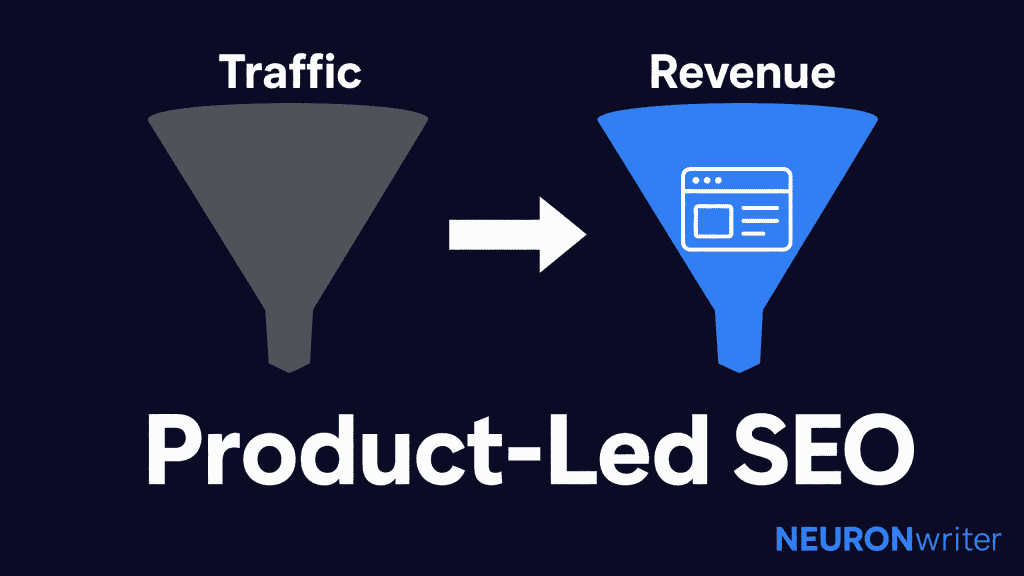
- Idea: Traditional content marketing focuses on generating top-of-funnel traffic, often resulting in high pageviews but zero conversions. In 2026, the most successful strategy is product-led SEO, which positions your product as the direct solution to a user’s problem within the content itself.
- Challenge: As AI Overviews and Generative Engine Optimization (GEO) answer basic informational queries directly in the search results, generic “how-to” content is losing its value. Users who do click through are usually looking for a specific tool or solution. If your content hides the product until a generic CTA at the bottom of the page, you lose the bottom-of-funnel (BOFU) conversion.
- Summary: To drive actual revenue, marketers must shift to product-led SEO. By targeting high-intent BOFU keywords and naturally weaving product screenshots, use cases, and workflows into the narrative, you turn your blog into an acquisition engine. When combined with NEURONwriter semantic optimization, you ensure this highly converting content also ranks for the exact NLP entities your buyers are searching for.
Read the full guide below, or explore related topics: The Attribution Crisis · Why Third-Party Keyword Tools Are Failing
For the past decade, the SEO playbook was simple: find a high-volume keyword, write a 2,000-word guide, and watch the traffic roll in. The assumption was that if you cast a wide enough net at the top of the funnel, some percentage of that traffic would eventually trickle down and convert.
In 2026, that strategy is broken. As one frustrated marketer recently noted, “User searches for a query and most of the times the question is answered in SGE… So goodbye conversions”
If your content strategy relies on answering basic informational questions, you are competing directly with AI search engines. To survive, you must stop writing for traffic and start writing for revenue. You need product-led SEO.
What is Product-Led SEO?
Product-led SEO is a strategy that positions your product as the primary method for solving the user’s problem or helping them achieve their goal. Instead of writing a generic article about “how to manage remote teams” and slapping a “Start your free trial” button at the end, product-led content uses screenshots, workflows, and specific features of your software to demonstrate how to manage a remote team. The product is not an afterthought; it is the hero of the story.
The ROI of the Bottom of the Funnel.
Why make this shift? Because the data heavily favors the bottom of the funnel. A recent case study found that articles targeting BOFU keywords (bottom-of-funnel) generated 2400% higher user signups compared to top-of-funnel content. When you target users who are already aware of their problem and are actively evaluating solutions, the conversion friction drops dramatically.
The Three Types of Product-Led Keywords.
To implement product-led SEO, you must stop looking at search volume and start looking at search intent. High-intent BOFU keywords generally fall into three categories
| Keyword Category | Definition | Example Query |
| Category Keywords | Terms that define your exact software category. | “best semantic SEO software” |
| Comparison & Alternative | Queries from users evaluating specific competitors. | “Writesonic alternatives” |
| Jobs to Be Done (JTBD) | Queries describing specific, complex problems users need to solve with a tool. | “how to optimize content for AI overviews” |
How to Weave Your Product into Content Naturally.
The biggest mistake marketers make with product-led content is treating it like a sales pitch. If the content reads like a brochure, the user will bounce. The integration must be natural and visually driven.
Show, Don’t Tell
Instead of listing features, use a visual asset library of high-quality product screenshots and GIFs. If you are explaining a complex workflow, show exactly what that workflow looks like inside your dashboard.
Use the “Briefing Stage” Rule.
As content creators note, successful product integration must happen at the briefing stage. If you ask a writer to “add some product mentions” to a finished draft, it will feel forced. The brief must explicitly state: “In Step 3, use a screenshot of our reporting dashboard to show how to measure this metric.”
Provide a 1-Click Solution.
If your reader has to figure out how to navigate to the mentioned tool or feature, you lose the conversion. When you mention a specific feature in your product-led content, provide a direct link or a contextual CTA that takes them exactly to that feature.
Scaling Product-Led SEO with Programmatic Frameworks.
Creating deep, product-led content takes time. To capture existing search demand at scale, successful B2B SaaS companies are turning to Programmatic SEO (pSEO). Programmatic SEO allows you to systematically target thousands of high-intent, long-tail keywords by creating pages from data templates. For example, you can build a standardized template for “Competitor Alternative” pages. The template includes core elements that satisfy user intent (features, pricing, integration steps), and is populated programmatically with data. This approach is ideal for capturing BOFU queries across hundreds of different use cases without manually writing a new blog post for every single one.
The NEURONwriter Advantage in Product-Led SEO.
Creating product-led content solves the conversion problem, but you still need that content to rank. This is where NEURONwriter bridges the gap between CRO (Conversion Rate Optimization) and SEO.
When you write a highly specific, product-focused article (like a JTBD guide), traditional keyword tools will often tell you the search volume is zero. But as we know, third-party volume metrics are often inaccurate.
By running your BOFU keywords through NEURONwriter Content Editor, you extract the exact NLP entities and semantic terms that Google associates with that specific use case.
This ensures that your product-led content is not just a great sales asset, but a highly optimized semantic document that search engines and AI agents can easily parse, rank, and recommend.
Stop chasing vanity traffic. Build content that proves your product’s value, optimize it semantically, and watch your revenue grow.
FAQ
What is product-led SEO?
Product-led SEO is a content strategy where your product’s features and workflows are naturally integrated into the content as the primary solution to the user’s search query, rather than just being mentioned in a call-to-action at the end.
How is product-led SEO different from traditional content marketing?
Traditional content marketing often focuses on top-of-funnel, high-volume informational keywords to drive traffic. Product-led SEO focuses on bottom-of-funnel (BOFU) keywords and prioritizes conversions and product signups over raw traffic numbers.
Why are bottom-of-funnel (BOFU) keywords so important?
BOFU keywords indicate high commercial intent. Users searching these terms are already aware of their problem and are actively evaluating solutions. Targeting these keywords can result in significantly higher conversion rates compared to informational queries.
What is the best way to integrate product mentions without sounding salesy?
The best approach is to “show, don’t tell.” Use high-quality screenshots, GIFs, and step-by-step tutorials to demonstrate how your product solves the specific problem discussed in the article. The product should feel like a helpful tool, not a sales pitch.
What is Programmatic SEO (pSEO)?
Programmatic SEO is a method of scaling content creation by using data templates to generate hundreds or thousands of pages targeting long-tail, high-intent keywords (such as “Alternative to [Competitor]” or “[Software] for [Industry]”).
How does NEURONwriter help with product-led SEO?
While product-led SEO focuses on the narrative and conversion, NEURONwriter ensures the content is semantically optimized. It provides the exact NLP entities needed to ensure your highly specific, product-focused content ranks well in search engines and AI overviews.
Should I stop writing top-of-funnel content entirely?
Not necessarily, but the balance should shift. In an era where AI answers basic questions instantly, the ROI on generic top-of-funnel content is dropping. Reallocating resources to product-led content ensures your SEO budget drives measurable pipeline and revenue.