How to Correct Published Content Without Hiding the Change
Semantic Summary
Idea: A correction is not just an edit. It is a reader-trust decision about what changed, who could be affected, and how clearly the page should explain it.
Challenge: Teams often fix a live error quietly, change the date, or remove the page before deciding whether readers who saw the original information need a clear record.
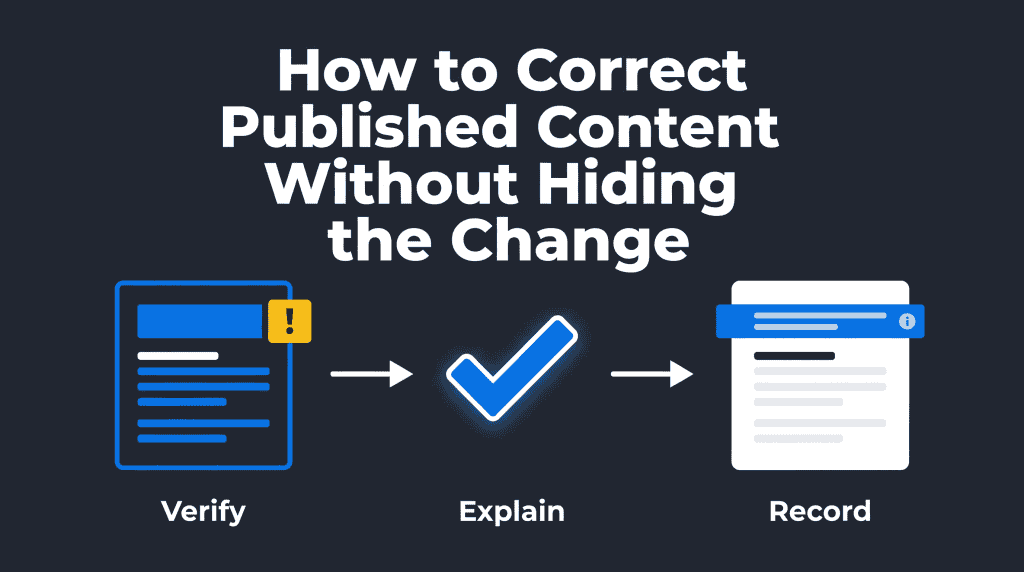
Summary: Confirm the fact, judge the reader risk, choose the smallest response that is still honest, place the explanation where readers need it, and record the decision for the next review.
Related Reads
- Content Verification: How to Check Claims, Sources and Product Facts Before Publishing
- Content Governance in 2026
- AI Reputation Incident Response: Triage Harmful Claims and Coordinate Corrections
When a live page contains a meaningful mistake, correct the information first but do not stop there. Decide whether a reader who acted on, shared, or relied on the original wording needs to see what changed.
The right response may be a silent edit, a correction note, an editor’s note, a replacement, or removal. The choice depends on reader risk, not embarrassment or search traffic.
This is an editorial operating model, not legal advice. It applies to pages your team owns: guides, product pages, help content, blog posts, comparisons, reports, and other published explanations.
If the issue involves a contract, privacy, regulated claim, safety risk, or active dispute, involve the appropriate qualified reviewer before changing public wording.
Start with the reader risk, not the type of typo
The best correction is proportional. A spelling error that does not alter meaning usually needs a simple edit. A wrong product limit, outdated eligibility rule, misleading quotation, or unsupported performance claim can change a reader’s decision. That kind of error deserves a visible response and a durable record.
Public-sector publishing guidance makes a useful distinction: change notes are not needed for ordinary typos or style changes, but they are appropriate when new information changes what a user must do or when misleading guidance is removed.
It also recommends saying exactly what changed instead of merely announcing that a page was updated.
Correction response matrix: choose the smallest response that still protects the reader
| What is wrong? | Likely reader risk | Default response | Reader-facing record |
| Typo, punctuation, formatting, or a broken nonessential link | Meaning has not changed | Fix it directly after a quick check. | Internal edit log only. |
| Outdated detail that changes a step, deadline, availability condition, or practical choice | A reader may take the wrong next action | Correct the passage and add a concise change note near the relevant section or at the top of the page. | What changed, when, source of the corrected fact, and owner. |
| Misleading claim, wrong quotation, incorrect product statement, or advice that could materially influence a purchase or implementation decision | A reader may rely on false information | Pause or amend the affected claim promptly. Use a clear correction or editor’s note. Link to the accurate source when appropriate. | Impact assessment, approval, original wording, corrected wording, and any follow-up. |
| Page is unsafe, substantially unreliable, or cannot be corrected without changing its core promise | Continuing to publish it causes ongoing harm or confusion | Remove, replace, or redirect the page after an accountable review. | Why it was retired, destination or explanation, decision owner, and review date. |
A simple test helps: Would a reasonable reader make a different decision if they knew the corrected information? If the answer is yes, a quiet fix is rarely enough.
Confirm the fact before you correct the sentence
Do not let speed turn one mistake into two. First identify the exact statement that is wrong, the source that should replace it, and the person who can confirm that source. Then decide how far the error travelled: one paragraph, several pages, a downloadable file, an email, a social post, or a sales enablement asset.
This is where a pre-publish practice pays off. The Content Verification audit can help teams keep claims, sources, dates, and owners close together before release.
After publication, use the same discipline in reverse: find the claim, confirm the source of truth, then identify every public location where the reader could still encounter the old version.
Ask four questions before changing the page
- What exactly was inaccurate? Quote the original sentence or capture the affected visual, table cell, or instruction.
- What is the verified replacement? Use a primary source, an accountable product or policy owner, or another source that can be checked.
- Who could have relied on it? Think about new visitors, existing customers, prospects, partners, and internal teams.
- Where else does the same claim appear? Check linked pages, summaries, product copy, PDFs, newsletters, and reusable sales or support material.
Google’s people-first content guidance asks whether a page has easily verifiable factual errors and emphasizes clear information about who created or reviewed content.
It also warns against changing dates merely to make content look fresh when nothing substantial changed. Treat the published date as information for readers, not as a cosmetic signal.
Choose a visible response when the original claim could change a decision
A visible correction does not need to be dramatic. It needs to make the important change understandable. Readers should not have to compare page versions or guess whether a revised sentence fixes a harmless detail or reverses the page’s meaning.
Use a silent edit only for a non-material fix
A silent edit is appropriate when the fix does not change meaning, instructions, eligibility, price, scope, safety, evidence, or the reader’s likely action.
Correcting a spelling error in a heading is a normal maintenance task. Logging the edit internally still helps a team spot recurring quality problems.
Use a correction note when the factual content changed
A correction note works well when a specific passage needs a clear repair. Put it near the affected passage, or at the beginning of the page if the error shaped the page’s central conclusion. State the old issue in plain language, state the accurate information, and say when the correction was made.
For example: “Correction, 1 October 2026: An earlier version said that the feature was available on every plan. It is available only on plans that include the reporting module.
The product section below has been updated.” This tells a reader what changed without asking them to decode a generic “updated” label.
Use an editor’s note when context matters
An editor’s note is useful when the correction needs more context: the page has been substantially rewritten, a key source changed, a quotation was removed, or readers may have seen a widely shared earlier version.
The note should identify the editorial reason without turning the page into an internal debate.
Replace, unpublish, or redirect only when the page no longer earns its place
Some pages cannot be repaired with a note. A withdrawn report, a guide built on a false premise, or a product explanation that no longer reflects the offering may need replacement or retirement.
Give readers a useful next destination where possible. If no honest replacement exists, do not redirect people to a loosely related page simply to preserve traffic.
Write a correction note that answers the reader’s real question
A good note answers three things quickly: what was wrong, what is correct now, and what the reader should do with that information. It is specific enough to be useful and short enough not to bury the page.
What a useful correction note includes
| Include | Why it helps | Avoid |
| The affected claim or section | Readers can tell whether the correction matters to them. | “Minor updates made” with no explanation. |
| The accurate replacement or clear link to it | Readers leave with the right information. | Vague wording that hides the correction behind process language. |
| The relevant date | Readers can judge whether an earlier copy may have affected them. | Changing a date with no material explanation. |
| A next step if action is needed | Readers know where to confirm, replace, or seek help. | Sending every reader to a generic contact form. |
Clear correction practice is a trust habit, not a legal formula. The Society of Professional Journalists frames correction as part of being accountable and transparent, and recommends acknowledging mistakes promptly and explaining corrections carefully and clearly. Its code is guidance for journalism rather than a rule for every organization, but the reader-first principle travels well.
Give the correction a real owner and a short record
A page does not correct itself just because an editor changes the words. Someone must confirm the source, someone must approve the public explanation, and someone must check related pages. Small teams may assign all three tasks to one person. Larger teams should still name the role for each task.
A lightweight correction record
| Record field | What to capture |
| Page and affected location | Canonical URL, section, original wording, and an image or archived copy if the claim was visual. |
| Issue and materiality | What was inaccurate, who could be affected, and why the chosen response is proportionate. |
| Source of truth | Primary evidence, accountable owner, and date verified. |
| Public response | Silent edit, correction note, editor’s note, replacement, removal, or redirect—and the exact reader-facing wording. |
| Related locations | Other pages, PDFs, campaign copy, support content, or internal assets checked and updated. |
| Follow-up | Owner, review date, unresolved questions, and the prevention improvement for the publishing workflow. |
This record is not bureaucracy for its own sake. It prevents future confusion about why a page changed, helps a new editor understand prior decisions, and reveals patterns. If the same type of issue appears often, strengthen the upstream workflow rather than relying on more correction notes.
Keep the correction separate from SEO theatre
Do not treat a correction as a tactic to recover rankings, gain citations, or manufacture freshness. A correction exists to give readers accurate information and a fair account of a meaningful change. Search performance may move for many reasons, so it should not determine whether the public explanation is honest or visible.
Use a normal content-governance rhythm to prevent repeat errors. The Content Governance guide helps define ownership and review triggers across the wider content library. The Content Optimization Workflow can then turn recurring correction patterns into better source checks, clearer briefs, and safer reviews before publication.
Keep a different boundary for external AI answers. If a harmful or false statement appears in an AI answer, use the separate AI Reputation Incident Response process. It involves source tracing and correction requests outside your own page. This article covers the simpler but essential responsibility: correcting the content you control.
Build a correction practice that readers can trust
A reliable correction practice is simple: verify the issue, judge the reader impact, make the information accurate, explain meaningful changes, and keep a short record.
The aim is not to spotlight every small edit. It is to avoid leaving readers with information that is wrong, misleading, or impossible to interpret after the page changes.
Start with one shared rule: if an earlier version could reasonably change a reader’s decision, the correction should be easy for that reader to find and understand. Then use the record to improve the checks that should have caught the issue in the first place.
FAQ
When can a team silently fix published content?
A silent fix is usually appropriate for a typo, formatting issue, or other small edit that does not change the meaning, instruction, scope, price, eligibility, evidence, or likely reader action. Keep an internal edit record when the page is important. If a reader could make a different decision after seeing the correction, use a visible explanation instead.
When should a correction note appear on the page?
Use a correction note when a live error could change what a reader believes or does. Examples include outdated guidance, an incorrect product statement, a misleading quote, or a condition that affects eligibility or a purchase decision. Put the note near the affected claim or at the top of the page when the issue shaped the main conclusion.
What is the difference between a correction note and an editor’s note?
A correction note usually identifies a specific factual repair and states the accurate information. An editor’s note adds context when the change is broader, such as a substantial rewrite, removed quotation, changed source, or previously shared version that could still circulate. Both should be concise and written for readers rather than internal teams.
Should the published date change after every edit?
No. A published or updated date should communicate a meaningful reader-facing change, not make a page appear newer than it is. Google specifically advises against changing dates when content has not substantially changed. Use an updated date and a clear note when the new information materially affects the page.
What should happen when an old product claim is wrong?
First confirm the current product fact with an accountable owner. Then correct the claim on the page and check related product, help, sales, and downloadable material that repeats it. Add a visible note when the original statement could reasonably influence a buyer, customer, or implementation decision.
When should a team remove a page instead of correcting it?
Remove, replace, or redirect a page when its core premise is no longer reliable and a narrow correction would still leave readers confused. Use a relevant replacement destination when one exists. Do not redirect to an unrelated page merely to keep visits or links flowing.
Who should approve a public correction?
The person who owns the underlying fact should confirm the correction, and an editorial owner should approve the reader-facing wording. In higher-risk areas, add the appropriate product, privacy, legal, safety, or compliance reviewer. The point is clear responsibility, not an unnecessarily large approval chain.
Will transparent corrections hurt SEO?
A transparent correction should be judged by reader trust and accuracy, not by a promise about rankings. Clear, helpful, reliable content is a sound objective; however, no correction note can guarantee a search outcome. Avoid changing public dates or adding vague updates as an SEO tactic.
How long should a correction record be kept?
Keep it long enough for the page’s ownership, review cycle, and likely reader reliance. For an important evergreen page or product claim, retain the record while the page is live and through its next substantial review. Your organization may need a longer retention period for regulated, contractual, or policy-sensitive content.