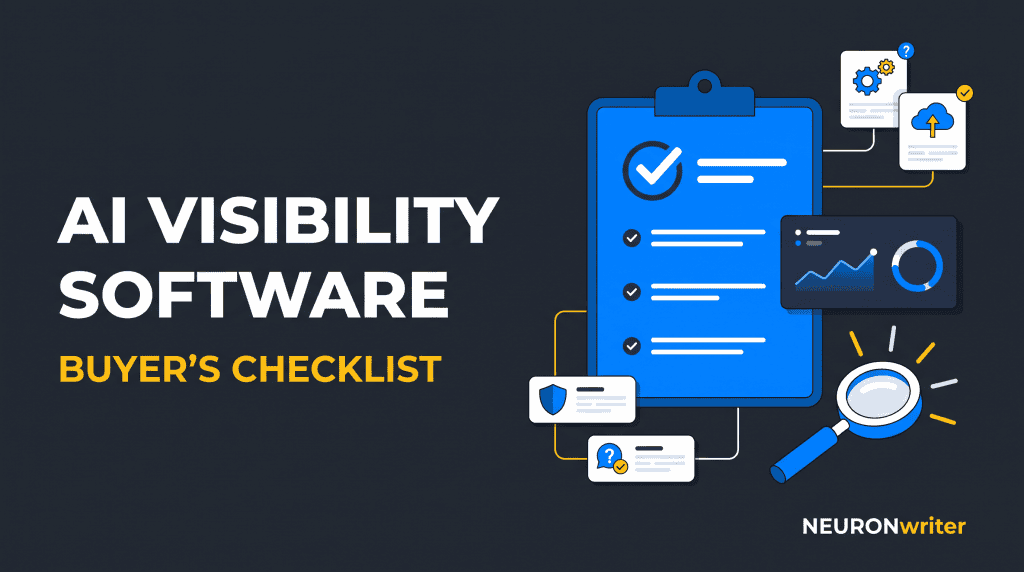
AI Visibility Software: A Buyer’s Checklist for Coverage, Evidence and Action.
Semantic Summary
Idea: AI visibility software helps you see what AI answers say about your brand. A useful system does more than count mentions: it shows the buyer question, the answer, the supporting source when available, and the next action for your team.
Challenge: It is easy to choose software by dashboard size or one visibility score. But a mention can be wrong, incomplete, or impossible to act on. That does not help a buyer or your business.
Summary: Choose AI visibility software by checking seven things: relevant coverage, evidence, clear definitions, action workflow, analytics context, governance, and realistic workload. First, run a short pilot with real buyer questions.
Related reads:
AI Visibility: Track Your Brand in AI Answers
AI Visibility Measurement Framework for Content Teams
AI Visibility Report Template for Agencies and In-House Teams
Bottom line: the right AI visibility software gives your team evidence that leads to a clear decision. It should not only display a score or a large list of brand mentions.
People increasingly use AI answers to understand a product, compare options, or check whether a company can solve a problem. If those answers describe your brand poorly, a potential customer may form an opinion before visiting your site. This is why AI visibility tracking matters. However, buying the wrong system can create a lot of reporting and very little useful work.
Use this checklist to compare options in plain language. It does not rank software providers. Instead, it helps you ask better questions during a trial or demonstration.
What AI Visibility Software Should Help You Decide.
Good AI visibility software helps you find an issue, understand it, and decide what to do next. It should not only tell you that your brand appeared in an AI answer.
An AI answer is the response produced after someone asks an AI system a question. AI visibility is how often your brand, product, or page appears in the answers that matter to your buyers. An AI citation is a source link or source label shown beside an answer. A visibility score is a summary number based on the software’s own rules and chosen question set.
Each signal is useful, but they are not interchangeable. A brand mention does not mean the information is correct. A citation does not prove one page caused an answer. A score can show change over time, but it should never replace the original answer and a human review.
| What the software shows | The question to ask | Why it matters |
| Brand mention | Does the answer name us for a relevant buyer question? | Shows whether the brand is present. |
| Citation | Can we open the source and check it? | Helps verify supporting information. |
| Answer wording | Does the AI describe us correctly? | Protects against wrong product or category claims. |
| Visibility score | How is the score calculated? | Makes trends easier to report when definitions are clear. |
| Action note | Can the team assign a next step? | Turns a finding into useful work. |
Before you compare systems, write one sentence about the decision you need to make. For example: “We need to check whether buyers see correct descriptions of our product in the AI answers they use.” This prevents feature lists from distracting you.
The Seven Questions to Ask Before You Buy
Ask every provider the same seven questions. Clear answers are more important than impressive-sounding features.
1. Which AI Search Platforms and Answer Types Does It Cover?
Start with the AI services your customers actually use. Depending on your audience, this may include Google AI Overviews, AI Mode, ChatGPT, Gemini, Perplexity, or other public AI services. You do not need to monitor every service from the first day.
Ask whether the software captures normal written answers, source links, recommendations, or only a simple mention. More coverage is not always better. Each extra platform produces more data for your team to review.
2. Can We Inspect the Exact Prompt, Answer, Date, Market, and Source?
Evidence matters more than a summary score. A reviewer should be able to see the exact buyer question, the answer returned, the date, the language or market, and any visible source.
Without this information, it is difficult to check a claim or explain a result to a product manager. Ask to see one record from start to finish during the trial.
| Evidence field | What “good” looks like |
| Prompt | The exact buyer question, not a vague topic label. |
| Answer | The wording where your brand appears. |
| Date and market | Clear context for a result and its history. |
| Source or citation | A visible link or source label when the AI provides one. |
| History | A way to compare the same question over time. |
3. Does It Separate Mentions, Citations, Accuracy, and Visibility Score?
A useful AI visibility platform defines its terms clearly. A mention means your name appears. A citation means a source is shown. Accuracy means the statement is factually correct. A visibility score is a summary number.
If all four are mixed together, your team will not know what changed. Ask the provider to explain each measure in everyday language and show a real example.
4. Can the Team Turn a Finding into an Owned Action?
A dashboard is only useful when it leads to a next step. A finding may require a content update, a product-page check, a correction to a public source, or simply another review later.
Ask whether you can add notes, assign an owner, record a due date, and export an evidence record. During a demonstration, ask: “Show us how a wrong feature claim becomes a task for the person who can fix it.”
5. Can It Work with Our Existing Analytics and Reports?
AI visibility data is more useful when you can compare it with other signals. Google Search Console can show how people find pages through Google Search. Google Analytics can help you understand identifiable referral visits. These tools do not explain every AI answer, but they add context.
Do not expect software to prove that one AI mention caused a sale. Instead, look for clear exports and reports that help you compare AI visibility with content changes, traffic patterns, and business priorities.
6. Are Governance and Data Ownership Clear?
Governance simply means who can see, change, approve, and export the data. It is important because several people may use the same AI visibility records.
Ask who can edit tracked questions, who approves a high-risk correction, whether you can export your data, and whether the system keeps a change history. If the provider cannot explain these basics clearly, it will be difficult to build a reliable process later.
7. What Will the Ongoing Work Require?
AI visibility software cannot replace human judgment. People still need to read important answers, check facts, and decide what to improve. Ask how many questions you can track, how often to review them, and who will handle serious issues.
The best option is not always the one with the most features. It is the one your team can use every week without creating a reporting burden.
Use a Simple Buyer Scorecard
A scorecard keeps the buying decision focused on what your team needs. Give each area a score from 1 to 5, then add a short note explaining why.
| Area | Question | What good enough looks like |
| Coverage | Does it check the AI search environments our buyers use? | Your core buyer journey is covered. |
| Evidence | Can we inspect prompt, answer, date, market, and source? | Important claims are easy to verify. |
| Accuracy | Can the team flag a wrong description? | Wrong claims do not count as a positive result. |
| Action workflow | Can a finding reach the right owner? | Each serious issue has a clear next step. |
| Reporting | Is the report easy to understand? | A busy person can see what changed quickly. |
| Governance | Are roles, exports, and history clear? | The process remains reliable as the team grows. |
| Workload and cost | Can we maintain the system after the pilot? | Value is realistic for the budget and team time. |
The notes matter more than the final number. A system can have broad AI platform coverage but weak evidence. Another may cover fewer services but fit your workflow far better.
Run a 30-Day Pilot Before You Commit
A short pilot is the safest way to test AI visibility software. Use 10 to 20 real buyer questions, rather than a huge list of random prompts.
| Week | What to do | What you learn |
| Week 1 | Choose buyer questions and record key product facts. | Whether the system fits your real questions. |
| Week 2 | Review answers, mentions, citations, and accuracy. | Whether the evidence is clear enough to trust. |
| Week 3 | Give a few findings to content or product owners. | Whether the action workflow works. |
| Week 4 | Compare workload, data quality, and value. | Whether to continue, change scope, or stop. |
During the pilot, check at least three important product facts manually. A system may report more mentions after a change, but that is not useful if the answer gives the wrong price, feature, audience, or category.
You can also start with a manual check. Ask a few real questions in public AI services, save the answers, and compare them with approved facts. This will show whether your team needs a repeatable system with shared history, alerts, and reporting.
Avoid These Common Buying Mistakes
Most mistakes happen when teams skip the pilot or trust a single score. Keep the following points in mind.
| Mistake | Better approach |
| Buying the largest dashboard | Ask to inspect one real answer from start to finish. |
| Trusting one visibility score | Separate mentions, citations, accuracy, and trends. |
| Choosing only by platform count | Start with the services your customers use. |
| Skipping a pilot | Test real buyer questions for a short period. |
| Ignoring ownership | Decide who reviews findings and who takes action. |
| Expecting a guarantee | Use the data for better decisions, not promised AI citations or rankings. |
AI answers can change by question, time, market, and language. Use the software to observe, verify, act, and recheck. That is more reliable than chasing a vague “best AI visibility” score.
How NEURONwriter Supports an Evidence-to-Action Workflow
NEURONwriter helps teams move from an AI answer to a focused content action. Its AI Visibility feature helps teams track selected questions, review mentions and citations, compare relevant competitors, and find opportunities across supported AI answers.
For a repeatable reporting method, use the AI Visibility Measurement Framework and the AI Visibility Report Template. To turn a citation gap into a specific writing task, see How to Get Cited by AI: From Citation Gap to Content Brief.
Frequently Asked Questions
What is AI visibility software?
AI visibility software helps a team monitor how its brand, products, or pages appear in AI-generated answers. It can show answers, brand mentions, source links, and changes over time. The best systems help a team choose a useful next action.
What should I look for before buying AI visibility software?
Check relevant coverage, evidence quality, clear definitions, accuracy review, action workflow, reporting, governance, and workload. A short pilot using real buyer questions is the most reliable test.
Is a brand mention the same as an AI citation?
No. A mention means your brand name appears in the answer. A citation is a source link or source label shown beside it. Neither proves that the answer is accurate or that one page caused the AI to use the information.
Can AI visibility software guarantee that my brand will appear in AI answers?
No. AI answers can change by question, date, market, and language. Use software to find possible issues and guide better content decisions, not as a guarantee of citations, rankings, or sales.
How many AI services should a team monitor?
Start with the AI search services your customers actually use. A small set that your team reviews well is better than broad coverage that creates more data than anyone can check.
How should I test AI visibility software?
Run a 30-day pilot with 10 to 20 real buyer questions. Save the prompt, answer, date, market, and source. Check important facts, assign one action, and review whether the process provides useful evidence.
Do I still need Google Search Console and Google Analytics?
Yes. Google Search Console and Google Analytics add useful context about website discovery and activity. They do not explain every AI answer, but they can help you compare AI visibility observations with wider marketing results.
Who should own AI visibility work?
Content, product, marketing, and analytics teams may all take part. Give each serious finding one clear owner. A content owner can improve a page, while a product owner can verify a feature or pricing fact.