Localization Termbase Governance: Preventing Entity Drift Across Markets
Semantic Summary
Idea
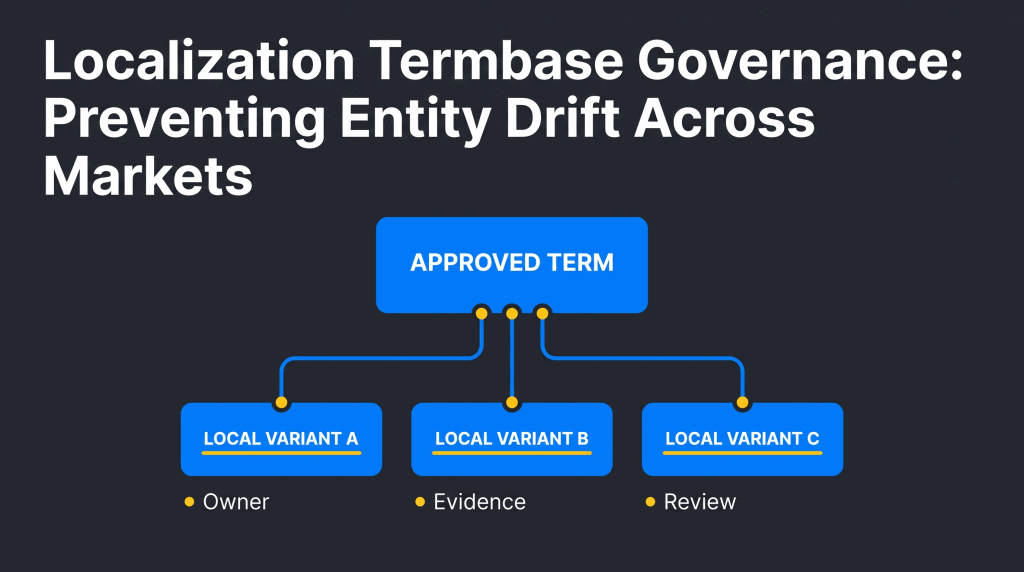
Keep one approved record for every high-impact entity, capability, and use-case term that appears across markets.
Challenge
Local pages can describe the same thing in different ways, leaving readers, editors, product teams, and AI systems with conflicting signals.
Summary
A small, owned termbase with evidence, change control, local exceptions, and regular reviews prevents drift without forcing every market to use unnatural language.
Related Reads
- Localizing Semantic Content: Why Direct Translation Ruins NLP Scores
- How to Launch a Multilingual Website Without Creating an SEO Mess
- International SEO in the AI Era: Does Hreflang Still Matter?
A multilingual site does not stay clear just because every page has been translated. It stays clear when the people creating product pages, articles, help content, and campaigns can tell what each important name means, which local wording is approved, and who can change it. That is the job of termbase governance.
A termbase is a shared record of agreed terms. In this article, it is not a large dictionary and it is not a technical setup for a website. It is a working decision system for the few words that could change a reader’s understanding of your offer. Used well, it helps teams retain a consistent meaning while still writing naturally for each market.
A termbase prevents drift by recording decisions, not just words
The most useful termbase records the decision behind a term. A word list alone cannot explain why one local phrase is preferred, whether another phrase is wrong, or who should settle a disagreement.
Entity drift happens when the same thing gradually receives different names or meanings. A product capability might be called “content brief” in one market, “article plan” in another, and a phrase that implies automatic publishing somewhere else. Each choice may sound reasonable in isolation. Together, they make the brand harder to understand and make updates harder to manage.
Localization is broader than swapping words from one language to another. It adapts content to the language, culture, and other needs of a target market.
A governance termbase gives that adaptation a clear boundary: local teams can improve relevance, but they do not silently redefine the entity, capability, or use case itself.
Start with terms that carry a promise or define a relationship. Examples include the names of products and features, core capabilities, customer roles, use cases, service levels, and regulated concepts.
Do not begin by documenting every common adjective. Begin where a wording change could alter meaning, create a support problem, or contradict an existing page.
The minimum viable termbase record makes each decision usable
One row should give an editor enough information to use the term correctly without opening a long policy document. The record below is enough for most teams to start.
| Field | What to record | Why it matters |
| Canonical entity or term | The central name and a plain definition. | Shows what must keep the same meaning everywhere. |
| Approved local variant | The preferred wording for a named language or market. | Lets local writers use language that sounds natural to readers. |
| Context or use case | Where the wording applies, such as a product page, support article, or campaign. | Prevents a correct phrase from being used in the wrong situation. |
| Disallowed alternative | A term that is misleading, outdated, too broad, or attached to another meaning. | Stops known confusion from reappearing in new copy. |
| Evidence or source note | The product decision, customer language, legal guidance, or approved source that supports the choice. | Makes the decision traceable instead of personal preference. |
| Owner | One named role responsible for the current decision. | Gives the team a clear route when a question or conflict appears. |
| Status and last reviewed | Approved, under review, retired, or temporary; plus a date. | Shows whether writers can rely on the entry now. |
Keep the definition short. “An editor’s working plan for an article, including intent, scope, and required evidence” is more useful than a paragraph full of marketing language. If a reader needs more detail, link from the record to the source note rather than making the termbase difficult to scan.
Use an example that exposes the risk.
Imagine a capability called “Content Brief.” Its canonical definition is a structured plan that guides an article before drafting. A local team proposes a phrase that literally means “content order.”
That phrase may sound transactional and imply a different service. The termbase can approve a more natural local equivalent, mark the literal phrase as disallowed, and note why. The point is not to protect English wording. The point is to protect the reader’s understanding.
Choose terms by impact, not by volume
High-impact terms deserve governance because they influence how people understand the offer. You can build a useful first version with 20 to 40 entries rather than waiting for a perfect global catalogue.
Review existing pages and mark terms that appear in several content types. A term is a good candidate when it is used on a product page and in an article, appears in both sales and support copy, or changes the scope of a claim. Also add terms that local teams have already questioned or translated in more than one way.
A useful test is simple: if two readers in different markets saw different wording, would they still understand the same promise? If the answer is uncertain, record the term. The process becomes even more valuable after a semantic debt audit finds conflicting claims. The audit identifies the symptom; the termbase prevents the same mismatch from returning.
Do not use the termbase to erase local knowledge. Local writers know the words their audience actually uses. Their research should shape the approved local variant. The related guide to localizing semantic content explains why direct translation can lose local relevance. This governance layer begins after that research, when the team needs to record and maintain a decision.
Give every term one accountable owner
Every important term needs one person or role that can make the final call. Without an owner, teams often settle wording in private messages, reuse an old page, or choose the fastest available phrase. Those choices rarely reach every affected page.
The owner does not have to write all local copy. Their job is to protect the decision process. They check the evidence, ask the right local reviewer when needed, update the record, and make sure the outcome is visible. For a product capability, this may be a product-content owner. For a brand concept, it may be a content lead. For a compliance-sensitive phrase, the owner should include the appropriate internal reviewer.
Use a backup role too. Ownership should survive holidays, team changes, and changing markets. What matters is that writers know where to send a question and can see the latest decision without hunting through old conversations.
Separate contributor, reviewer, and owner.
These roles can be different people. A local writer contributes the proposed wording and context. A subject specialist checks that the meaning is accurate. The owner accepts, rejects, or records a temporary exception. This separation reduces the chance that a single preference becomes a permanent global rule.
Use a short change-request path before terminology spreads
A change request should be easy enough that people use it before publishing. A short form, shared document, or ticket is sufficient if it captures the decision and leaves a record.
| Step | What happens | Output |
| 1. Request | A writer records the current term, proposed wording, market, context, and reason. | A request that can be understood without a meeting. |
| 2. Evidence check | The owner checks source material, current content, and relevant local input. | A supported recommendation rather than a preference. |
| 3. Decision | The owner approves, rejects, requests more evidence, or grants a temporary exception. | A clear status and named decision-maker. |
| 4. Record and notify | The termbase is updated and affected page owners are told what changed. | One visible source of truth and a practical update list. |
Set an expected response time that fits the importance of the term. A simple editorial synonym may be reviewed in a weekly batch. A claim about what a product does may need a faster decision before a campaign or release. Do not call a term “approved” while the evidence is still unclear. “Under review” is a useful status because it stops a draft from turning into an accidental standard.
Record the reason, not only the result.
The reason saves time later. A note such as “approved after local customer interviews showed this is the familiar category name” helps a new editor understand the choice. A note such as “retired because the capability no longer includes manual review” prevents outdated copy from being reused. Evidence also makes it easier to explain why a requested wording was not adopted.
Resolve global and local conflicts with a clear rule
A global canonical term should protect the meaning; it should not force an awkward phrase into every market. The practical rule is: keep the same underlying entity, promise, and boundary, but allow a local variant when it communicates those elements more clearly to the intended audience.
When a local team disagrees with the global wording, first ask whether the disagreement is about language or meaning. If it is language, a local variant may solve it.
If it changes the promise, scope, or relationship between concepts, it is a product or content decision and needs stronger evidence.
Use a small threshold for exceptions. Approve a local exception when there is a clear reason, such as a well-established local category term, a legal requirement, a cultural risk, or evidence that the direct equivalent misleads readers.
Do not approve an exception only because one writer prefers a phrase or because it appeared on an old page.
Make exceptions visible and time-bound.
A local exception should include the market, the affected context, the reason, the owner, and a review date. A visible exception is not a failure of consistency. It is proof that the system can preserve meaning while respecting real local usage. A time-bound exception also prevents a temporary campaign phrase from becoming permanent by accident.
Build term reviews into normal content operations
Termbase governance works when it becomes part of the existing editing rhythm. It should not rely on an annual clean-up that everyone postpones.
Review high-impact entries after product changes, major content updates, new market launches, and recurring support questions. For stable terms, a quarterly or twice-yearly review is often enough. The right cadence depends on change, not on a fixed calendar rule. An entry that supports many pages should be reviewed more often than a phrase used in one older article.
Add a simple check to the editorial workflow: before a page is approved, confirm that its high-impact terms match the current termbase. This is a small extension of a content optimization workflow, not a separate bureaucratic project. It gives writers a quick way to catch a term before it reaches several channels.
Track only measures that improve the process. Useful signals include the number of repeated corrections, the time taken to resolve a change request, entries overdue for review, and pages affected by a significant term update. Avoid treating a raw count of entries as a success measure. A short, used termbase is better than a large file nobody opens.
Use the termbase to make content updates safer and faster
A current termbase turns a broad update into a clearer set of actions. When a capability changes name or scope, editors can search for the canonical term, its former variants, and any disallowed alternatives. They can then update the relevant pages with the right local context instead of guessing from page to page.
This does not replace careful editorial judgment. A phrase may be accurate in a support article but too narrow for an introductory guide. The context field is what keeps a shared term from becoming rigid. It tells editors where to use it, where to explain it, and where a related phrase is acceptable.
For NEURONwriter teams, use the termbase as an input before outlining or refreshing a page. Confirm the approved entity names, feature boundaries, and local variants first. Then use the content workflow to improve the page for the reader. This order helps writers avoid polishing a draft around language that will later need to change.
Consistent terminology also supports people-first content. Google advises creators to make helpful, reliable information for people rather than pages designed mainly to manipulate rankings.
A shared, evidence-backed term decision is useful for that goal because it makes claims easier to explain, review, and keep current. It is not a ranking shortcut, and it should never replace real local research or clear writing.
Start small with one shared record and one review habit
You do not need a complex platform or a large governance committee to begin. Create a shared table, choose the 20 terms most likely to cause confusion, and name an owner for each group of terms. Then add the change-request path to the way your team already plans and reviews content.
After the first review cycle, inspect the requests that appeared. If teams repeatedly ask about the same kind of term, improve the record template or guidance. If a local exception has become the normal way readers describe an entity, consider making it the approved local variant. Governance should make better decisions easier, not make ordinary writing slower.
Keep this process separate from the technical tasks of a multilingual site. URL structure, language routing, and indexing have their own requirements, covered in this multilingual website launch guide and the discussion of international SEO in the AI era. The termbase answers a different question: when a reader sees a key name on any of your pages, can they trust that it means the same thing?
FAQ
What is a localization termbase?
A localization termbase is a shared record of important approved terms and their market-specific variants. It explains what a term means, where to use it, which alternatives to avoid, and who owns the decision.
What is entity drift in multilingual content?
Entity drift occurs when the same product, capability, use case, or customer role is described with different meanings across markets or teams. It often starts with small wording choices that spread through new pages, campaigns, and support material.
Which terms should go into a termbase first?
Start with product names, important capabilities, customer roles, use cases, and claims that appear in more than one content type. Prioritize terms that could mislead readers or create repeated editorial corrections if their meaning changes.
Who should own a termbase entry?
Each entry needs one accountable owner who can make or record the final decision. Local writers and subject specialists can contribute evidence, but the owner should keep the current version visible and resolve requests.
Can local teams use a different term from the global canonical term?
Yes, when a local variant communicates the same entity, promise, and boundary more clearly. Record the market, context, evidence, owner, and review date so the exception stays intentional rather than becoming hidden drift.
How often should a termbase be reviewed?
Review high-impact terms when a product, claim, or major page changes, and inspect stable entries on a regular quarterly or twice-yearly cycle. Review frequency should reflect how often the term changes and how many pages depend on it.
Does a termbase replace local keyword or audience research?
No. Local research helps a team understand how people in a market search and speak. The termbase records the final decision for high-impact concepts after that research, so related pages use the agreed meaning consistently.
Is a termbase the same as a technical multilingual SEO setup?
No. A termbase governs language decisions in content. Technical multilingual SEO concerns how language and regional pages are organized and signaled; both matters are useful, but they solve different problems.
How can a small team start termbase governance?
Begin with a shared table of the 20 terms most likely to create confusion. Add the canonical name, approved local variant, context, disallowed wording, evidence, owner, status, and last-review date, then use it in the next content review.