SEO Product Descriptions: A Practical Writing Template for Ecommerce Pages
Semantic Summary
Idea An SEO product description helps a buyer understand one specific product while giving search engines clear, useful page content.
Challenge Many ecommerce pages reuse supplier text, list features without context, or force keywords into copy that does not answer a real buying question.
Summary Build each description from verified facts, one buyer need, a clear structure and a final accuracy check. The template below makes that process repeatable without turning the page into generic sales copy.
Related Reads
- Ecommerce Category Page Content: Explain Filters, Attributes and Trade-Offs Before Product Selection
- E-commerce SEO 2026: Optimizing Product Pages for AI Answer Engines
- How to Write a Buying Guide: A Research-First Process for E-commerce Stores
- Shopping Optimization
What Are SEO Product Descriptions?
SEO product descriptions are clear explanations of one product that help a potential customer decide whether it fits their need and help search engines understand what the page is about. They are not a pile of keywords, a copied manufacturer paragraph, or a promise that every visitor will buy.
A good product description gives useful information about the product: what it is, who it is for, what it does, what matters before purchase, and where its limits begin. It turns a product title and a raw list of specifications into a decision-ready explanation.
This is why product copy supports both ecommerce SEO and user experience. Search engines need understandable page content, while shoppers need enough context to decide whether to add the product to their cart, compare it, save it, or move on.
Google’s guidance is straightforward: create helpful, reliable content for people rather than content designed mainly to manipulate rankings. Its people-first content guidance is a useful test for every product page.
| Page element | Its job | Useful question to answer |
| Product title | Names the specific item clearly. | What is this product? |
| Product description | Explains use, facts, benefits, compatibility and limits. | Is this product right for my situation? |
| Specifications | Provides exact measurable details. | Will it meet my practical requirements? |
| Meta description | Offers a concise page summary that may help Google form a search snippet. | Why should someone open this result? |
Keep those jobs separate. A product description can inform the meta description, but it should not be squeezed into a short search-result pitch. Google primarily creates snippets from page content and may use a meta description when it is more accurate, so both need to be unique and descriptive. Google’s snippet documentation also warns against keyword-string descriptions that do not explain the page.
Start With Approved Facts and One Buyer Question
Write the brief before writing the paragraph. The strongest SEO product descriptions begin with approved information and one real buyer question, not with a blank page and a keyword list.
Collect facts from the product team, documentation, packaging, tested specifications, support material, and approved policies. Then choose the one question a buyer needs this product page to answer. For example: “Will this fit my small workspace?” or “Is this the right option for someone who needs easy cleaning?”
| Brief field | What to record | Why it improves the description |
| Product identity | Product type, model or clear name | Keeps the opening direct and prevents vague copy. |
| Verified facts | Materials, dimensions, capacity, included items or tested compatibility | Gives the description useful detail without invention. |
| Primary use | The job the product helps a person do | Connects a feature to a real situation. |
| Buyer question | The uncertainty before purchase | Sets a helpful order for the information. |
| Limit or condition | What the product is not for, a fit requirement or a care condition | Builds trust and reduces avoidable disappointment. |
| Evidence owner | The person or source that can confirm each important fact | Makes later updates safer and faster. |
Do not turn an assumption into a benefit. “Made from a lighter material” is a fact only if the material and weight are verified. “Easier to carry” may be a reasonable buyer benefit, but it should still follow from a fact the team can support.
Advertising claims should be truthful, not deceptive or unfair, and evidence-based, as the FTC’s advertising guidance explains.
The Six-Part Product Description Template
A repeatable structure makes writing product descriptions quicker without making every page sound the same. Use the six parts below as prompts, not as six mandatory blocks of identical copy. A simple product may need a compact version; a technical or high-consideration product may need more detail.
| Part | What to write | Plain-language prompt |
| 1. Direct opening | Name the product, primary use and most important verified fact. | “What is it, and who is it for?” |
| 2. Use context | Describe the task, setting or person it suits. | “When would someone choose this?” |
| 3. Proof and specifications | Give the details that let a buyer check fit. | “What can the buyer verify?” |
| 4. Buyer benefit | Explain the practical result of a feature. | “Why does this detail matter?” |
| 5. Compatibility or limit | State a condition, exception, care need or unsuitable use. | “What should the buyer check first?” |
| 6. Next step | Offer a relevant action or link, without pressure. | “What can the buyer do now?” |
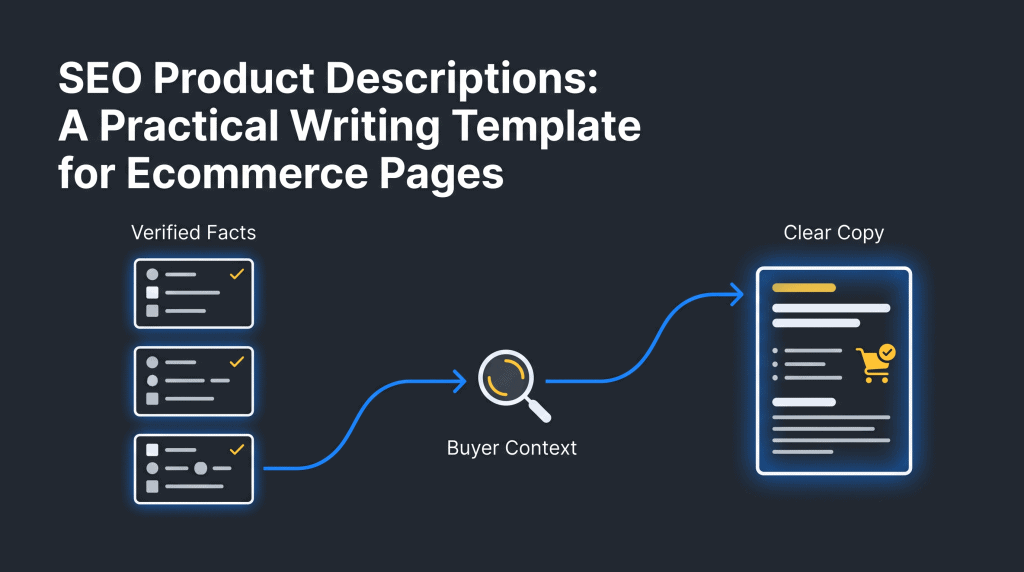
Use the template as a fact-to-context workflow
A hypothetical example shows the difference. Imagine a fictional 500 ml insulated travel mug. A weak product description says, “A stylish, high-quality mug for every day.” It gives no evidence, no use context and no reason to trust the claim.
A clearer opening could say: “This 500 ml insulated travel mug is for commuters who want to carry a hot or cold drink on a short journey. Its stainless-steel body and secure lid give you two practical facts to check before choosing it.” The next sentences would explain only verified details: cleaning instructions, whether the lid is leak resistant under specified conditions, and whether the size fits a standard cup holder.
The point is not to make every product description long. The point is to help a buyer find the information that changes the decision. Use bullet points when details are easier to scan as a list, but do not use bullet points as a substitute for context.
Turn Features Into Useful Buyer Context
Features become persuasive when you explain their practical effect without exaggeration. A specification tells a buyer what the product has. Buyer context explains when that detail matters and who should pay attention to it.
| Raw feature | Helpful context | Unsafe or vague version |
| “Includes an adjustable strap” | “The adjustable strap lets the user change the fit within the stated range.” | “The perfect fit for everyone.” |
| “Made from a washable material” | “The material can be washed according to the supplied care instructions.” | “Never worry about cleaning again.” |
| “Works with the listed connector type” | “Check that your device uses the listed connector type before ordering.” | “Works with every device.” |
| “Available in three sizes” | “Use the size guide to compare your measurement with the listed range.” | “Guaranteed to fit.” |
This approach helps effective product descriptions stay persuasive because they reduce uncertainty. It also protects the reader from a common copywriting mistake: presenting emotional language as if it were proof. The product feature comes first; the likely buyer benefit follows; any limit stays visible.
Answer the objection that belongs on this product page
One page does not need to answer every question about a category. It should answer the questions that decide whether this specific product is suitable. For a size-sensitive item, fit information may be essential. For an accessory, compatibility may matter most. For a care product, instructions and limitations may matter more than a long brand story.
Use customer-service questions, on-site search terms, return reasons and sales feedback to find those points. They are better sources of useful wording than a list of adjectives.
Use Keywords Without Keyword Stuffing
Use a keyword where it names the product or buyer need clearly; do not repeat it where ordinary language is more useful. SEO product descriptions should sound like a person explaining a product, not a page trying to repeat the same phrase.
Start with the product title and the way customers describe the item. Then add closely related words only when they make the page more precise: material, size, use case, compatibility, audience or a problem the product addresses. This is a practical approach to SEO because it helps both people and search engines understand the product page.
| Use keywords here | What to avoid |
| A clear product title and first sentence | Repeating the exact keyword in every paragraph |
| Verified product features and natural variant labels | Adding terms that do not describe the product |
| Headings that help shoppers scan a longer product page | Making every heading a near-duplicate of the product title |
| Image alt text that describes the image honestly | Using alt text as a hidden list of SEO keywords |
Keyword stuffing is not a shortcut to better ranking. It makes a paragraph harder to read and can hide the useful information a customer needs. A good product description may use the product name several times because clarity requires it. That is different from repeating it without a reason.
Make Product Copy Easy to Scan
Most shoppers scan a product page before they read it closely, so important facts need a clear visual order. Use a direct first paragraph, short sections, useful headings and bullet points for facts that a buyer needs to compare quickly.
A readable layout can include a short overview, a small set of key details, a fit or compatibility note, and a clear call-to-action. It does not need a dramatic headline for every feature. The product title and description should work together: the title identifies the item; the copy explains the choice.
Write a practical call-to-action
A call-to-action should match what the reader can do next. “Check the size guide,” “Compare the compatible options,” or “Read the care instructions” can be more useful than a generic push to buy. If there is a relevant internal link, send the buyer to the exact information that helps them decide.
Use images as support, not a replacement for copy
Product images can show scale, color, components or use. They cannot reliably explain a material, a compatibility condition or a care limitation on their own. Describe the key information in visible page copy and use honest, concise alt text for the image itself.
Keep Similar Products Distinct Across a Catalog
Similar items can share a structure, but they should not share the same description word for word. Each product page needs enough unique information to explain its own use, facts, variant, compatibility and limitation.
Duplicate content often appears when a catalog has near-identical sizes, colors, bundles or model versions. The solution is not to invent differences. Instead, record the fields that truly change and use them to create a distinct description.
| If this changes | Explain it in the description | Do not do this |
| Size or capacity | State the measurement and the buyer situation it affects. | Copy the same paragraph and change only the size number. |
| Material or finish | Explain the verified care, feel or use implication. | Claim one material is universally better. |
| Compatibility | Name the supported type or the check a buyer must make. | Use broad “works with all” language. |
| Included items | List what comes with this specific product. | Assume the bundle is obvious from images. |
For large catalogs, use a controlled product-information brief rather than asking every writer to guess. A shared source of approved facts makes it easier to create unique product copy while preserving accuracy and a consistent voice.
Use a Short SEO Copywriting Quality Check
Good SEO descriptions and useful buyer copy pass the same test: they name the product accurately, answer a real question and make the next step clear. A short quality check gives SEO copywriters a repeatable way to write product descriptions without treating every ecommerce page as the same template.
Start with lightweight keyword research. Look for the language potential customers use for a relevant product, its material, its use or the problem it solves. Then decide whether the phrase actually fits the target audience.
Product description SEO does not mean adding every related term; descriptions could attract the wrong people when the wording suggests a different e-commerce product or a different need.
| Quality check | Question to ask | Safe action |
| Product titles and descriptions | Do they identify the same specific item and variant? | Correct a mismatch before publishing. |
| Readability | Can a buyer find the material, fit, limit and next step quickly? | Use short written content, headings and bullet points where they help. |
| Meta tags and links | Do the meta description and internal links describe the actual page? | Keep them page-specific and link only to useful supporting information. |
| Product SEO measurement | Are impressions, queries and buyer feedback moving in the same direction? | Use evidence before changing the copy again. |
These best practices support an SEO strategy without promising a result. A well-crafted product page can improve the visibility of the product in search engine results and contribute to organic traffic, but no single change can guarantee that a page will rank higher. The best results come when accurate product SEO, useful product images, clear internal links and technical SEO work together on an ecommerce website.
When you write SEO-friendly product descriptions, keep the copy SEO friendly for a reader first. A detailed description is useful only when it answers a buying question. The benefits of the product should be clear, but they should not become unsupported claims about traffic and sales. Valuable content can build trust, improve your product page, and encourage customers to explore a relevant product or continue toward adding the product to their cart.
Add Supporting Page Details Without Mixing Jobs
Product copy is one part of a useful product page, not the whole of technical SEO. Keep the description focused on the buyer’s decision, then support it with a clear meta description, relevant internal links, usable images and a technically accessible page.
A meta description is a short page summary, not a copy-and-paste version of the body. Write one that accurately describes this product page and its distinguishing information. Google may use it when it helps form a useful search snippet, but it can also choose different visible page content for different searches.
Internal links should also serve a real buyer need. Link to a size guide, care page, compatible accessory or relevant category only when it helps someone continue the decision.
A category page has a different job: it helps a shopper compare a group of products before choosing one. If that is the reader’s current question, send them to a category-page decision-support guide rather than overloading one product description.
Review, Measure and Update Product Descriptions
Review product descriptions whenever a material fact, buyer question or product condition changes—not simply because a calendar says it is time. Updates should protect accuracy first and then improve clarity, visibility or conversion rates where evidence shows a problem.
Use Google Search Console to see the queries and pages that receive impressions and clicks. Combine that with on-site search, customer questions, return reasons and product changes.
A page that appears often for an irrelevant query may need clearer wording; a page with recurring support questions may need a missing fact or limitation.
| Signal | Check first | Possible update |
| New product specification | Whether the title, copy, bullet points and images agree | Update every affected fact and record the source. |
| Repeated buyer question | Whether the answer is already clear on the product page | Add a short answer near the relevant feature or limitation. |
| Low-quality search traffic | Whether the product wording attracts the wrong intent | Clarify the product type, audience or use case. |
| Variant expansion | Whether new products reuse too much copy | Create a distinct brief for the facts that changed. |
Do not promise that changing product descriptions will produce a particular ranking or sales result. Measure the outcome, keep the change that improves the buyer experience, and retain a record of what changed and why.
Use AI as a Drafting Assistant, Not a Fact Source
AI can help organize a product brief or suggest a first draft, but it cannot verify your product facts, legal claims, availability or compatibility. Treat any AI-generated product description as an editable starting point, not publish-ready copy.
Give the AI system approved inputs: product name, verified features, buyer question, intended tone, prohibited claims and a required limit. AI can organize a brief, suggest a first paragraph, put verified details into a more readable order, or prepare a draft for human review. AI cannot decide whether a claim is true just because the sentence sounds persuasive.
Use an AI output as a working draft, then have a human reviewer compare every sentence with the source record. Remove invented benefits, unsupported superlatives, false comparisons and generic filler before publication. This simple AI review step protects the product description, the buyer and the wider SEO effort.
How NEURONwriter Fits Into the Workflow
NEURONwriter can support the SEO stage after the product facts and buyer need are clear. Use a content analysis to understand the terms and questions that appear in relevant search results, then decide which ones genuinely describe the product page.
The practical order matters: collect approved information first, write the product description for a person, check the page for natural search language, and finish with human fact review. This avoids a common problem with AI-assisted product copy: a polished paragraph that says too little about the real product.
FAQ
What is an SEO product description?
An SEO product description is product-page copy that explains a specific item clearly for buyers and gives search engines useful context about the page. It should cover verified facts, practical use, relevant benefits and any important conditions or limits.
How long should an SEO product description be?
There is no single best word count. Use enough copy to answer the buyer’s real questions and explain the information that affects the decision. A simple item may need a short paragraph and bullet points, while a technical product may need more structured detail.
Should every product have a unique description?
Yes, every product page should have enough unique copy to describe what is distinct about that item. Similar products can share a template and approved language, but their facts, variant details, compatibility and use context should not be copied word for word.
How should I use keywords in product descriptions?
Use keywords naturally where they identify the product, feature, material, audience or use case. Put clarity before repetition. If a keyword makes the sentence less accurate or less useful, leave it out rather than forcing it into the product description.
Is a product description the same as a meta description?
No. A product description helps a visitor assess the item on the page, while a meta description is a short summary that can help search engines present the page in search results. The two should agree, but each has a different job.
Can AI write SEO product descriptions?
AI can help turn an approved product brief into a first draft, create a consistent structure or suggest plain-language alternatives. A human must still verify every fact, limit, compatibility statement and claim before publication, because AI is not a reliable source of product truth.
Do product descriptions help SEO?
Helpful, unique product descriptions give search engines and shoppers more context about a product page. They can support organic visibility when the page is accessible, accurate and relevant to the searcher’s need, but they do not guarantee a particular ranking.
When should I update a product description?
Update product copy when product facts change, a new variant is added, buyers repeatedly ask an unanswered question, or performance evidence shows that the page attracts the wrong audience. Record the source for each factual change so future reviews stay accurate.